







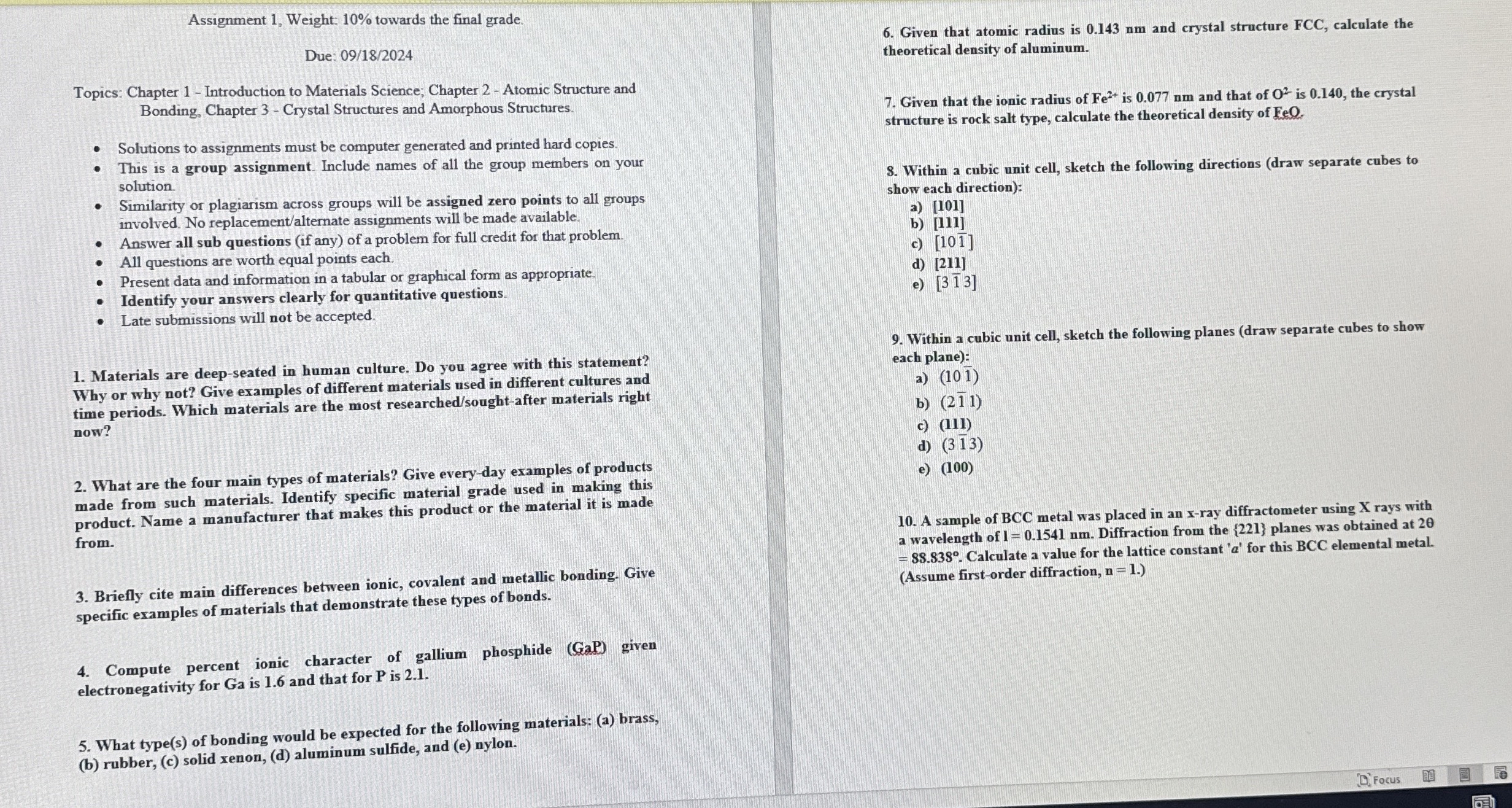
Question: Assignment 1 , Weight: 1 0 % towards the final grade. Due: 0 9 1 8 ? 2 0 2 4 Topics: Chapter 1 -
Assignment Weight: towards the final grade.
Due:
Topics: Chapter Introduction to Materials Science; Chapter Atomic Structure and
Bonding, Chapter Crystal Structures and Amorphous Structures.
Solutions to assignments must be computer generated and printed hard copies.
This is a group assignment. Include names of all the group members on your
solution.
Similarity or plagiarism across groups will be assigned zero points to all groups
involved. No replacementalternate assignments will be made available.
Answer all sub questions if any of a problem for full credit for that problem.
All questions are worth equal points each.
Present data and information in a tabular or graphical form as appropriate.
Identify your answers clearly for quantitative questions.
Late submissions will not be accepted.
Materials are deepseated in human culture. Do you agree with this statement?
Why or why not? Give examples of different materials used in different cultures and
time periods. Which materials are the most researchedsoughtafter materials right
now?
What are the four main types of materials? Give everyday examples of products
made from such materials. Identify specific material grade used in making this
product. Name a manufacturer that makes this product or the material it is made
from.
Briefly cite main differences between ionic, covalent and metallic bonding. Give
specific examples of materials that demonstrate these types of bonds.
Compute percent ionic character of gallium phosphide GaP given
electronegativity for Ga is and that for P is
What types of bonding would be expected for the following materials: a brass,
b rubber, c solid xenon, d aluminum sulfide, and e nylon.
Given that atomic radius is nm and crystal structure calculate the
theoretical density of aluminum.
Given that the ionic radius of is nm and that of is the crystal
structure is rock salt type, calculate the theoretical density of FeO
Within a cubic unit cell, sketch the following directions draw separate cubes to
show each direction:
a
b
c
d
e
Within a cubic unit cell, sketch the following planes draw separate cubes to show
each plane:
a
b
c
d
e
A sample of BCC metal was placed in an ray diffractometer using rays with
a wavelength of Diffraction from the planes was obtained at
Calculate a value for the lattice constant for this BCC elemental metal.
Assume firstorder diffraction,
Questions only
Step by Step Solution
There are 3 Steps involved in it
1 Expert Approved Answer
Step: 1 Unlock

Question Has Been Solved by an Expert!
Get step-by-step solutions from verified subject matter experts
Step: 2 Unlock
Step: 3 Unlock
 Study Help