Question: Assignment 3 Systems Analysis and Design 1 (ITEC3010 Fall 2021) Objectives: In this assignment you will be asked to experience systems analysis and design by
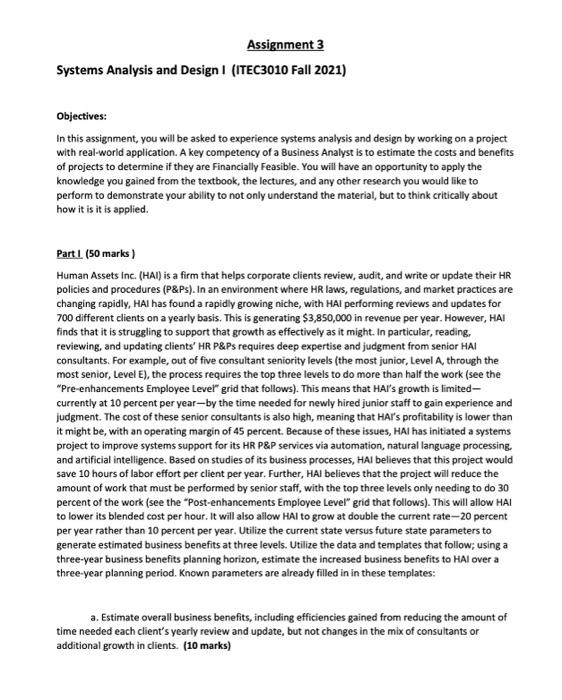
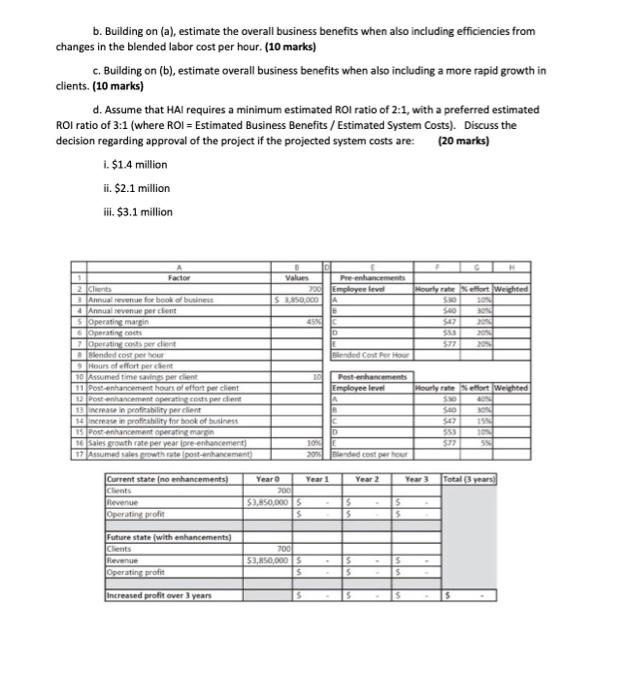
Assignment 3 Systems Analysis and Design 1 (ITEC3010 Fall 2021) Objectives: In this assignment you will be asked to experience systems analysis and design by working on a project with real-world application. A key competency of a Business Analyst is to estimate the costs and benefits of projects to determine if they are Financially Feasible. You will have an opportunity to apply the knowledge you gained from the textbook, the lectures, and any other research you would like to perform to demonstrate your ability to not only understand the material, but to think critically about how it is it is applied. Part 1 (50 marks) Human Assets Inc. (HAI) is a firm that helps corporate clients review, audit, and write or update their HR policies and procedures (P&Ps). In an environment where HR laws, regulations, and market practices are changing rapidly, HAI has found a rapidly growing niche, with HAI performing reviews and updates for 700 different clients on a yearly basis. This is generating $3,850,000 in revenue per year. However, HAI finds that it is struggling to support that growth as effectively as it might. In particular, reading, reviewing and updating clients' HR P&Ps requires deep expertise and judgment from senior HAI consultants. For example, out of five consultant seniority levels (the most junior, Level A, through the most senior, Level E), the process requires the top three levels to do more than half the work (see the Pre-enhancements Employee Level" grid that follows). This means that HAI's growth is limited- currently at 10 percent per year-by the time needed for newly hired junior staff to gain experience and judgment. The cost of these senior consultants is also high, meaning that Har's profitability is lower than it might be, with an operating margin of 45 percent. Because of these issues, HAI has initiated a systems project to improve systems support for its HR P&P services via automation, natural language processing, and artificial intelligence. Based on studies of its business processes, HAI believes that this project would save 10 hours of labor effort per client per year. Further, HAI believes that the project will reduce the amount of work that must be performed by senior staff, with the top three levels only needing to do 30 percent of the work (see the "Post-enhancements Employee Level" grid that follows). This will allow HAI to lower its blended cost per hour. It will also allow Hal to grow at double the current rate-20 percent per year rather than 10 percent per year. Utilize the current state versus future state parameters to generate estimated business benefits at three levels. Utilize the data and templates that follow; using a three-year business benefits planning horizon, estimate the increased business benefits to HAl over a three-year planning period. Known parameters are already filled in in these templates: a. Estimate overall business benefits, including efficiencies gained from reducing the amount of time needed each client's yearly review and update, but not changes in the mix of consultants or additional growth in clients. (10 marks) b. Building on (a), estimate the overall business benefits when also including efficiencies from changes in the blended labor cost per hour. (10 marks) C. Building on (b), estimate overall business benefits when also including a more rapid growth in clients. (10 marks) d. Assume that HAl requires a minimum estimated Rol ratio of 2:1, with a preferred estimated ROI ratio of 3:1 (where ROI = Estimated Business Benefits / Estimated System Costs). Discuss the decision regarding approval of the project if the projected system costs are: (20 marks) 1. $1.4 million ii. $2.1 million ili. $3.1 million Values 200 550.000 Pre-enhancements Employee level Hourly rate tort Weighted SO 100 30 5C D 377 inded Contro Factor 2 Clients 3 Annual revenue for book of business Annual revenue percent 5 Operating margin Operating Operating cost Blended cost per hour Hours of effort percent 10 Assumed time savines per client 11 Pose-enhancement hours of elfort per client Port enhancement operating per dient 13 increase in profitability per client 34 increase in proibility for Book of business Spostament operating Sales growth rate per year e enhancement) 17 Assumed sales prowth rate postanhancement 10 Post-enhancements Employee level Mourly rate effort Weighted SMO SHO SE2 1994 553 572 55 dados per hout 10 200 Year 2 Year Total years Current state (no enhancements) Clients Revenue Operating profil Year Year 1 200 $3,850,000 S 5 S S 5 Future state with enhancements) Clients Revenue Operating profit 700 53,850.0005 $ 15 5 Increased profit over 3 years 5 5 s Assignment 3 Systems Analysis and Design 1 (ITEC3010 Fall 2021) Objectives: In this assignment you will be asked to experience systems analysis and design by working on a project with real-world application. A key competency of a Business Analyst is to estimate the costs and benefits of projects to determine if they are Financially Feasible. You will have an opportunity to apply the knowledge you gained from the textbook, the lectures, and any other research you would like to perform to demonstrate your ability to not only understand the material, but to think critically about how it is it is applied. Part 1 (50 marks) Human Assets Inc. (HAI) is a firm that helps corporate clients review, audit, and write or update their HR policies and procedures (P&Ps). In an environment where HR laws, regulations, and market practices are changing rapidly, HAI has found a rapidly growing niche, with HAI performing reviews and updates for 700 different clients on a yearly basis. This is generating $3,850,000 in revenue per year. However, HAI finds that it is struggling to support that growth as effectively as it might. In particular, reading, reviewing and updating clients' HR P&Ps requires deep expertise and judgment from senior HAI consultants. For example, out of five consultant seniority levels (the most junior, Level A, through the most senior, Level E), the process requires the top three levels to do more than half the work (see the Pre-enhancements Employee Level" grid that follows). This means that HAI's growth is limited- currently at 10 percent per year-by the time needed for newly hired junior staff to gain experience and judgment. The cost of these senior consultants is also high, meaning that Har's profitability is lower than it might be, with an operating margin of 45 percent. Because of these issues, HAI has initiated a systems project to improve systems support for its HR P&P services via automation, natural language processing, and artificial intelligence. Based on studies of its business processes, HAI believes that this project would save 10 hours of labor effort per client per year. Further, HAI believes that the project will reduce the amount of work that must be performed by senior staff, with the top three levels only needing to do 30 percent of the work (see the "Post-enhancements Employee Level" grid that follows). This will allow HAI to lower its blended cost per hour. It will also allow Hal to grow at double the current rate-20 percent per year rather than 10 percent per year. Utilize the current state versus future state parameters to generate estimated business benefits at three levels. Utilize the data and templates that follow; using a three-year business benefits planning horizon, estimate the increased business benefits to HAl over a three-year planning period. Known parameters are already filled in in these templates: a. Estimate overall business benefits, including efficiencies gained from reducing the amount of time needed each client's yearly review and update, but not changes in the mix of consultants or additional growth in clients. (10 marks) b. Building on (a), estimate the overall business benefits when also including efficiencies from changes in the blended labor cost per hour. (10 marks) C. Building on (b), estimate overall business benefits when also including a more rapid growth in clients. (10 marks) d. Assume that HAl requires a minimum estimated Rol ratio of 2:1, with a preferred estimated ROI ratio of 3:1 (where ROI = Estimated Business Benefits / Estimated System Costs). Discuss the decision regarding approval of the project if the projected system costs are: (20 marks) 1. $1.4 million ii. $2.1 million ili. $3.1 million Values 200 550.000 Pre-enhancements Employee level Hourly rate tort Weighted SO 100 30 5C D 377 inded Contro Factor 2 Clients 3 Annual revenue for book of business Annual revenue percent 5 Operating margin Operating Operating cost Blended cost per hour Hours of effort percent 10 Assumed time savines per client 11 Pose-enhancement hours of elfort per client Port enhancement operating per dient 13 increase in profitability per client 34 increase in proibility for Book of business Spostament operating Sales growth rate per year e enhancement) 17 Assumed sales prowth rate postanhancement 10 Post-enhancements Employee level Mourly rate effort Weighted SMO SHO SE2 1994 553 572 55 dados per hout 10 200 Year 2 Year Total years Current state (no enhancements) Clients Revenue Operating profil Year Year 1 200 $3,850,000 S 5 S S 5 Future state with enhancements) Clients Revenue Operating profit 700 53,850.0005 $ 15 5 Increased profit over 3 years 5 5 s









 Study Help