Question: ASSIGNMENT 6 AN AVERAGE DAY AT PETROBILD The purpose of this exercise is to introduce you to a normal day for an operator at a
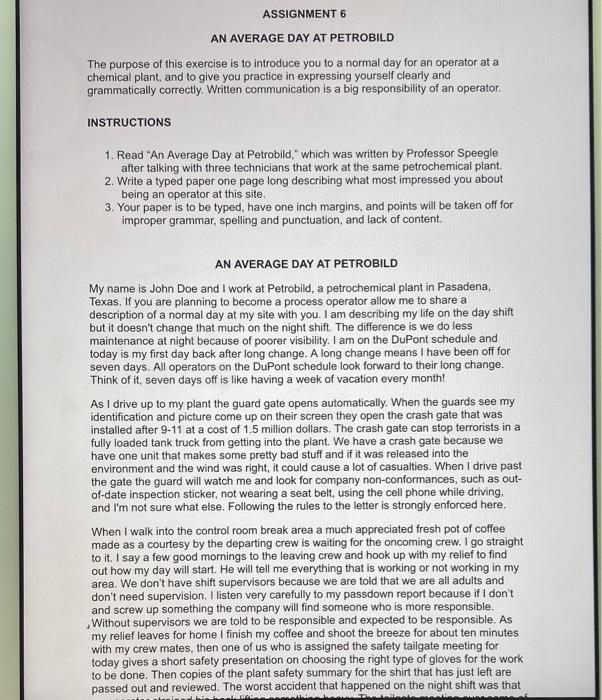
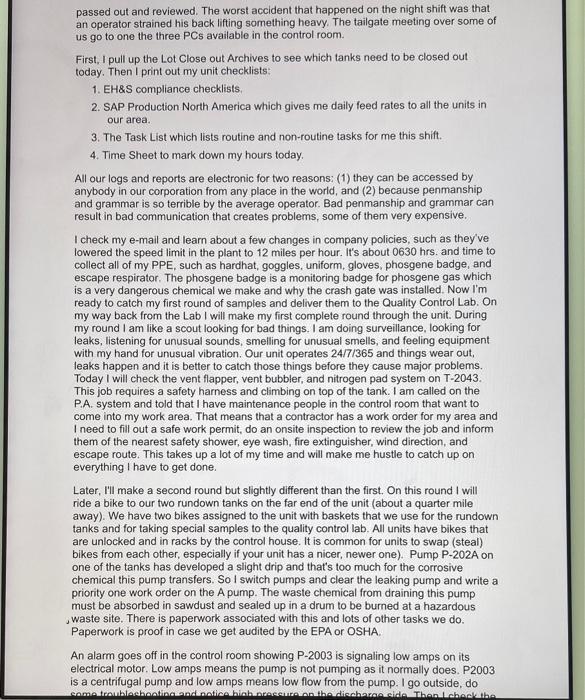
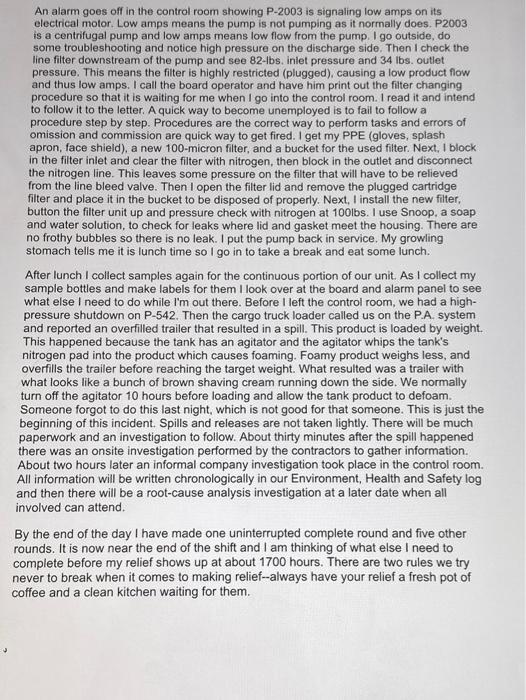
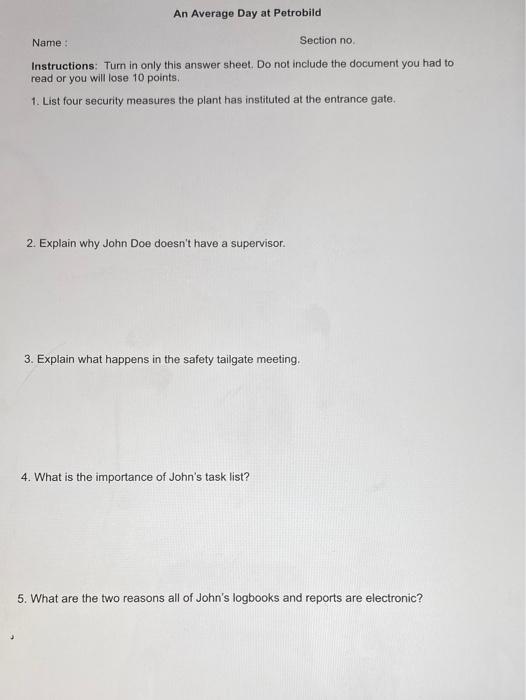
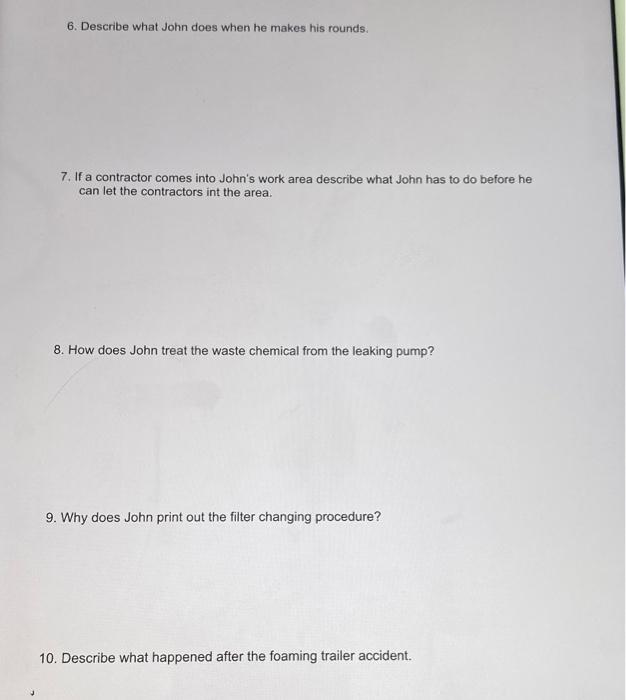
ASSIGNMENT 6 AN AVERAGE DAY AT PETROBILD The purpose of this exercise is to introduce you to a normal day for an operator at a chemical plant, and to give you practice in expressing yourself clearly and grammatically correctly. Written communication is a big responsibility of an operator. INSTRUCTIONS 1. Read "An Average Day at Petrobild," which was written by Professor Speegle after talking with three technicians that work at the same petrochemical plant. 2. Write a typed paper one page long describing what most impressed you about being an operator at this site. 3. Your paper is to be typed, have one inch margins, and points will be taken off for improper grammar, spelling and punctuation, and lack of content. AN AVERAGE DAY AT PETROBILD My name is John Doe and I work at Petrobild, a petrochemical plant in Pasadena, Texas. If you are planning to become a process operator allow me to share a description of a normal day at my site with you. I am describing my life on the day shift but it doesn't change that much on the night shift. The difference is we do less maintenance at night because of poorer visibility. I am on the DuPont schedule and today is my first day back after long change. A long change means I have been off for seven days. All operators on the DuPont schedule look forward to their long change. Think of it, seven days off is like having a week of vacation every month! As I drive up to my plant the guard gate opens automatically. When the guards see my identification and picture come up on their screen they open the crash gate that was installed after 9-11 at a cost of 1.5 million dollars. The crash gate can stop terrorists in a fully loaded tank truck from getting into the plant. We have a crash gate because we have one unit that makes some pretty bad stuff and if it was released into the environment and the wind was right, it could cause a lot of casualties. When I drive past the gate the guard will watch me and look for company non-conformances, such as out- of-date inspection sticker, not wearing a seat belt, using the cell phone while driving and I'm not sure what else. Following the rules to the letter is strongly enforced here. When I walk into the control room break area a much appreciated fresh pot of coffee made as a courtesy by the departing crew is waiting for the oncoming crew. I go straight to it. I say a few good mornings to the leaving crew and hook up with my relief to find out how my day will start. He will tell me everything that is working or not working in my area. We don't have shift supervisors because we are told that we are all adults and don't need supervision. I listen very carefully to my passdown report because if I don't and screw up something the company will find someone who is more responsible. Without supervisors we are told to be responsible and expected to be responsible. As my relief leaves for home I finish my coffee and shoot the breeze for about ten minutes with my crew mates, then one of us who is assigned the safety tailgate meeting for today gives a short safety presentation on choosing the right type of gloves for the work to be done. Then copies of the plant safety summary for the shirt that has just left are passed out and reviewed. The worst accident that happened on the night shift was that passed out and reviewed. The worst accident that happened on the night shift was that an operator strained his back lifting something heavy. The tailgate meeting over some of us go to one the three PCs available in the control room. First, I pull up the Lot Close out Archives to see which tanks need to be closed out today. Then I print out my unit checklists: 1. EH&S compliance checklists, 2. SAP Production North America which gives me daily feed rates to all the units in our area. 3. The Task List which lists routine and non-routine tasks for me this shift. 4. Time Sheet to mark down my hours today. All our logs and reports are electronic for two reasons: (1) they can be accessed by anybody in our corporation from any place in the world, and (2) because penmanship and grammar is so terrible by the average operator. Bad penmanship and grammar can result in bad communication that creates problems, some of them very expensive. I check my e-mail and learn about a few changes in company policies, such as they've lowered the speed limit in the plant to 12 miles per hour. It's about 0630 hrs. and time to collect all of my PPE, such as hardhat, goggles, uniform, gloves, phosgene badge, and escape respirator. The phosgene badge is a monitoring badge for phosgene gas which is a very dangerous chemical we make and why the crash gate was installed. Now I'm ready to catch my first round of samples and deliver them to the Quality Control Lab. On my way back from the Lab I will make my first complete round through the unit. During my round I am like a scout looking for bad things. I am doing surveillance, looking for leaks, listening for unusual sounds, smelling for unusual smells, and feeling equipment with my hand for unusual vibration. Our unit operates 24/7/365 and things wear out, leaks happen and it is better to catch those things before they cause major problems. Today I will check the vent flapper, vent bubbler, and nitrogen pad system on T-2043. This job requires a safety harness and climbing on top of the tank. I am called on the P.A. system and told that I have maintenance people in the control room that want to come into my work area. That means that a contractor has a work order for my area and I need to fill out a safe work permit, do an onsite inspection to review the job and inform them of the nearest safety shower, eye wash, fire extinguisher, wind direction, and escape route. This takes up a lot of my time and will make me hustle to catch up on everything I have to get done. Later, I'll make a second round but slightly different than the first. On this round I will ride a bike to our two rundown tanks on the far end of the unit (about a quarter mile away). We have two bikes assigned to the unit with baskets that we use for the rundown tanks and for taking special samples to the quality control lab. All units have bikes that are unlocked and in racks by the control house. It is common for units to swap (steal) bikes from each other, especially if your unit has a nicer, newer one). Pump P-202A on one of the tanks has developed a slight drip and that's too much for the corrosive chemical this pump transfers. So I switch pumps and clear the leaking pump and write a priority one work order on the A pump. The waste chemical from draining this pump must be absorbed in sawdust and sealed up in a drum to be burned at a hazardous waste site. There is paperwork associated with this and lots of other tasks we do. Paperwork is proof in case we get audited by the EPA or OSHA An alarm goes off in the control room showing P-2003 is signaling low amps on its electrical motor. Low amps means the pump is not pumping as it normally does. P2003 is a centrifugal pump and low amps means low flow from the pump. I go outside, do Some troublebastiandi pati liabean the dischar side Then Lichaath An alarm goes off in the control room showing P-2003 is signaling low amps on its electrical motor. Low amps means the pump is not pumping as it normally does. P2003 is a centrifugal pump and low amps means low flow from the pump. I go outside, do some troubleshooting and notice high pressure on the discharge side. Then I check the line filter downstream of the pump and see 82-Ibs. inlet pressure and 34 lbs. outlet pressure. This means the filter is highly restricted (plugged), causing a low product flow and thus low amps. I call the board operator and have him print out the filter changing procedure so that it is waiting for me when I go into the control room. I read it and intend to follow it to the letter. A quick way to become unemployed is to fail to follow a procedure step by step. Procedures are the correct way to perform tasks and errors of omission and commission are quick way to get fired. I get my PPE (gloves, splash apron, face shield), a new 100-micron filter, and a bucket for the used filter. Next, I block in the filter inlet and clear the filter with nitrogen, then block in the outlet and disconnect the nitrogen line. This leaves some pressure on the filter that will have to be relieved from the line bleed valve. Then I open the filter lid and remove the plugged cartridge filter and place it in the bucket to be disposed of properly. Next, I install the new filter, button the filter unit up and pressure check with nitrogen at 100lbs. I use Snoop, a soap and water solution, to check for leaks where lid and gasket meet the housing. There are no frothy bubbles so there is no leak. I put the pump back in service. My growling stomach tells me it is lunch time so I go in to take a break and eat some lunch. After lunch I collect samples again for the continuous portion of our unit. As I collect my sample bottles and make labels for them I look over at the board and alarm panel to see what else I need to do while I'm out there. Before I left the control room, we had a high- pressure shutdown on P-542. Then the cargo truck loader called us on the P.A. system and reported an overfilled trailer that resulted in a spill. This product is loaded by weight. This happened because the tank has an agitator and the agitator whips the tank's nitrogen pad into the product which causes foaming. Foamy product weighs less, and overfills the trailer before reaching the target weight. What resulted was a trailer with what looks like a bunch of brown shaving cream running down the side. We normally turn off the agitator 10 hours before loading and allow the tank product to defoam. Someone forgot to do this last night, which is not good for that someone. This is just the beginning of this incident. Spills and releases are not taken lightly. There will be much paperwork and an investigation to follow. About thirty minutes after the spill happened there was an onsite investigation performed by the contractors to gather information. About two hours later an informal company investigation took place in the control room. All information will be written chronologically in our Environment, Health and Safety log and then there will be a root-cause analysis investigation at a later date when all involved can attend. By the end of the day I have made one uninterrupted complete round and five other rounds. It is now near the end of the shift and I am thinking of what else I need to complete before my relief shows up at about 1700 hours. There are two rules we try never to break when it comes to making relief--always have your relief a fresh pot of coffee and a clean kitchen waiting for them. An Average Day at Petrobild Name : Section no. Instructions: Turn in only this answer sheet. Do not include the document you had to read or you will lose 10 points. 1. List four security measures the plant has instituted at the entrance gate. 2. Explain why John Doe doesn't have a supervisor. 3. Explain what happens in the safety tailgate meeting. 4. What is the importance of John's task list? 5. What are the two reasons all of John's logbooks and reports are electronic? 6. Describe what John does when he makes his rounds. 7. If a contractor comes into John's work area describe what John has to do before he can let the contractors int the area. 8. How does John treat the waste chemical from the leaking pump? 9. Why does John print out the filter changing procedure? 10. Describe what happened after the foaming trailer accident









 Study Help