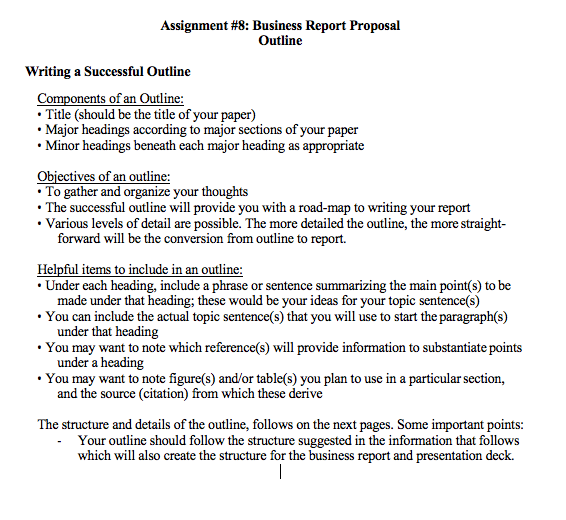
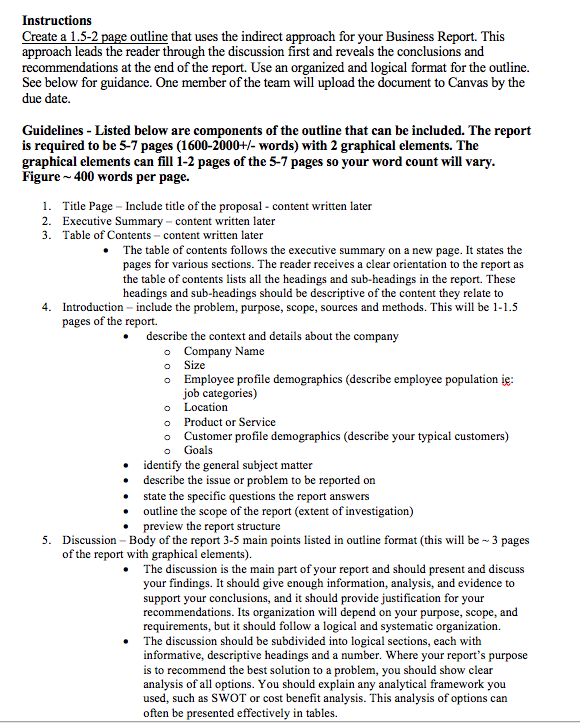
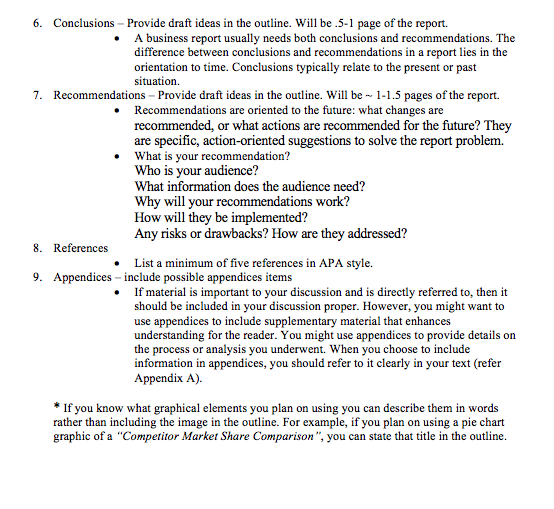
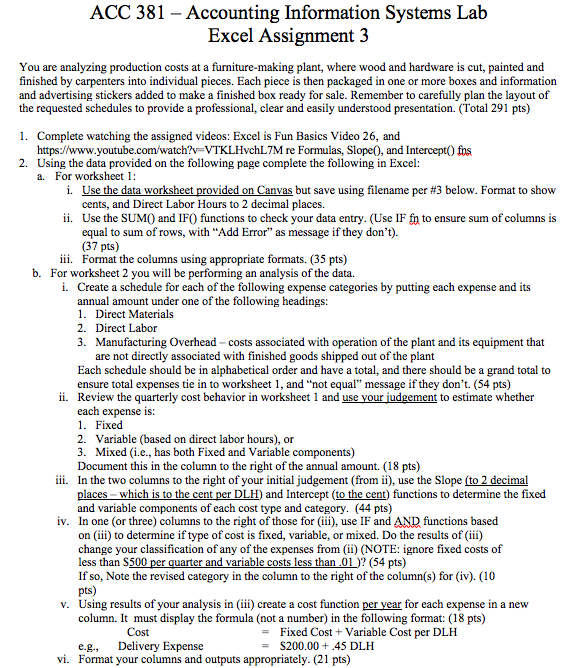
Assignment #8: Business Report Proposal Outline Writing a Successful Outline Components of an Outline: Title (should be the title of your paper) Major headings according to major sections of your paper Minor headings beneath each major heading as appropriate Objectives of an outline: To gather and organize your thoughts The successful outline will provide you with a road-map to writing your report . Various levels of detail are possible. The more detailed the outline, the more straight- forward will be the conversion from outline to report. Helpful items to include in an outline: Under each heading, include a phrase or sentence summarizing the main point(s) to be made under that heading; these would be your ideas for your topic sentence(s) . You can include the actual topic sentence(s) that you will use to start the paragraph(s) under that heading . You may want to note which reference(s) will provide information to substantiate points under a heading You may want to note figure(s) and/or table(s) you plan to use in a particular section, and the source (citation) from which these derive The structure and details of the outline, follows on the next pages. Some important points: - Your outline should follow the structure suggested in the information that follows which will also create the structure for the business report and presentation deck. Instructions Create a 1.5-2 page outline that uses the indirect approach for your Business Report. This approach leads the reader through the discussion first and reveals the conclusions and recommendations at the end of the report. Use an organized and logical format for the outline. See below for guidance. One member of the team will upload the document to Canvas by the due date. Guidelines - Listed below are components of the outline that can be included. The report is required to be 5-7 pages (1600-2000+/- words) with 2 graphical elements. The graphical elements can fill 1-2 pages of the 5-7 pages so your word count will vary. Figure -400 words per page. 1. Title Page - Include title of the proposal - content written later 2. Executive Summary - content written later 3. Table of Contents content written later The table of contents follows the executive summary on a new page. It states the pages for various sections. The reader receives a clear orientation to the report as the table of contents lists all the headings and sub-headings in the report. These headings and sub-headings should be descriptive of the content they relate to 4. Introduction include the problem, purpose, scope, sources and methods. This will be 1-1.5 pages of the report. describe the context and details about the company o Company Name o Size o Employee profile demographics (describe employee population ie: job categories) o Location o Product or Service o Customer profile demographics (describe your typical customers) o Goals identify the general subject matter describe the issue or problem to be reported on state the specific questions the report answers outline the scope of the report (extent of investigation) preview the report structure 5. Discussion - Body of the report 3-5 main points listed in outline format (this will be -- 3 pages of the report with graphical elements). The discussion is the main part of your report and should present and discuss your findings. It should give enough information, analysis, and evidence to support your conclusions, and it should provide justification for your recommendations. Its organization will depend on your purpose, scope, and requirements, but it should follow a logical and systematic organization. The discussion should be subdivided into logical sections, each with informative, descriptive headings and a number. Where your report's purpose is to recommend the best solution to a problem, you should show clear analysis of all options. You should explain any analytical framework you used, such as SWOT or cost benefit analysis. This analysis of options can often be presented effectively in tables. 6. Conclusions - Provide draft ideas in the outline. Will be 5-1 page of the report. A business report usually needs both conclusions and recommendations. The difference between conclusions and recommendations in a report lies in the orientation to time. Conclusions typically relate to the present or past situation. 7. Recommendations - Provide draft ideas in the outline. Will be - 1-1.5 pages of the report. Recommendations are oriented to the future: what changes are recommended, or what actions are recommended for the future? They are specific, action-oriented suggestions to solve the report problem. What is your recommendation? Who is your audience? What information does the audience need? Why will your recommendations work? How will they be implemented? Any risks or drawbacks? How are they addressed? 8. References List a minimum of five references in APA style. 9. Appendices - include possible appendices items If material is important to your discussion and is directly referred to, then it should be included in your discussion proper. However, you might want to use appendices to include supplementary material that enhances understanding for the reader. You might use appendices to provide details on the process or analysis you underwent. When you choose to include information in appendices, you should refer to it clearly in your text (refer Appendix A). * If you know what graphical elements you plan on using you can describe them in words rather than including the image in the outline. For example, if you plan on using a pie chart graphic of a "Competitor Marker Share Comparison", you can state that title in the outline. ACC 381 - Accounting Information Systems Lab Excel Assignment 3 You are analyzing production costs at a furniture-making plant, where wood and hardware is cut, painted and finished by carpenters into individual pieces. Each piece is then packaged in one or more boxes and information and advertising stickers added to make a finished box ready for sale. Remember to carefully plan the layout of the requested schedules to provide a professional, clear and easily understood presentation. (Total 291 pts) 1. Complete watching the assigned videos: Excel is Fun Basics Video 26, and https://www.youtube.com/watch?v=VTKLHvchL7M re Formulas, Slope(), and Intercept() fos 2. Using the data provided on the following page complete the following in Excel: a. For worksheet 1: i. Use the data worksheet provided on Canvas but save using filename per #3 below. Format to show cents, and Direct Labor Hours to 2 decimal places. ii. Use the SUMO and IFO functions to check your data entry. (Use IF fn to ensure sum of columns is equal to sum of rows, with "Add Error" as message if they don't). (37 pts) iii. Format the columns using appropriate formats. (35 pts) b. For worksheet 2 you will be performing an analysis of the data. i. Create a schedule for each of the following expense categories by putting each expense and its annual amount under one of the following headings: 1. Direct Materials 2. Direct Labor 3. Manufacturing Overhead - costs associated with operation of the plant and its equipment that are not directly associated with finished goods shipped out of the plant Each schedule should be in alphabetical order and have a total, and there should be a grand total to ensure total expenses tie in to worksheet 1, and "not equal" message if they don't. (54 pts) ii. Review the quarterly cost behavior in worksheet 1 and use your judgement to estimate whether each expense is: 1. Fixed 2. Variable (based on direct labor hours), or Mixed (i.e., has both Fixed and Variable components) Document this in the column to the right of the annual amount. (18 pts) iii. In the two columns to the right of your initial judgement (from ii), use the Slope (to 2 decimal places - which is to the cent per DLH) and Intercept (to the cent) functions to determine the fixed and variable components of each cost type and category. (44 pts) iv. In one (or three) columns to the right of those for (iii), use IF and AND functions based on (iii) to determine if type of cost is fixed, variable, or mixed. Do the results of (iii) change your classification of any of the expenses from (ii) (NOTE: ignore fixed costs of less than $500 per quarter and variable costs less than .01 )? (54 pts) If so, Note the revised category in the column to the right of the column(s) for (iv). (10 pts) v. Using results of your analysis in (iii) create a cost function per year for each expense in a new column. It must display the formula (not a number) in the following format: (18 pts) Cost = Fixed Cost + Variable Cost per DLH e.g., Delivery Expense = $200.00+ 45 DLH vi. Format your columns and outputs appropriately. (21 pts) Assignment #8: Business Report Proposal Outline Writing a Successful Outline Components of an Outline: Title (should be the title of your paper) Major headings according to major sections of your paper Minor headings beneath each major heading as appropriate Objectives of an outline: To gather and organize your thoughts The successful outline will provide you with a road-map to writing your report . Various levels of detail are possible. The more detailed the outline, the more straight- forward will be the conversion from outline to report. Helpful items to include in an outline: Under each heading, include a phrase or sentence summarizing the main point(s) to be made under that heading; these would be your ideas for your topic sentence(s) . You can include the actual topic sentence(s) that you will use to start the paragraph(s) under that heading . You may want to note which reference(s) will provide information to substantiate points under a heading You may want to note figure(s) and/or table(s) you plan to use in a particular section, and the source (citation) from which these derive The structure and details of the outline, follows on the next pages. Some important points: - Your outline should follow the structure suggested in the information that follows which will also create the structure for the business report and presentation deck. Instructions Create a 1.5-2 page outline that uses the indirect approach for your Business Report. This approach leads the reader through the discussion first and reveals the conclusions and recommendations at the end of the report. Use an organized and logical format for the outline. See below for guidance. One member of the team will upload the document to Canvas by the due date. Guidelines - Listed below are components of the outline that can be included. The report is required to be 5-7 pages (1600-2000+/- words) with 2 graphical elements. The graphical elements can fill 1-2 pages of the 5-7 pages so your word count will vary. Figure -400 words per page. 1. Title Page - Include title of the proposal - content written later 2. Executive Summary - content written later 3. Table of Contents content written later The table of contents follows the executive summary on a new page. It states the pages for various sections. The reader receives a clear orientation to the report as the table of contents lists all the headings and sub-headings in the report. These headings and sub-headings should be descriptive of the content they relate to 4. Introduction include the problem, purpose, scope, sources and methods. This will be 1-1.5 pages of the report. describe the context and details about the company o Company Name o Size o Employee profile demographics (describe employee population ie: job categories) o Location o Product or Service o Customer profile demographics (describe your typical customers) o Goals identify the general subject matter describe the issue or problem to be reported on state the specific questions the report answers outline the scope of the report (extent of investigation) preview the report structure 5. Discussion - Body of the report 3-5 main points listed in outline format (this will be -- 3 pages of the report with graphical elements). The discussion is the main part of your report and should present and discuss your findings. It should give enough information, analysis, and evidence to support your conclusions, and it should provide justification for your recommendations. Its organization will depend on your purpose, scope, and requirements, but it should follow a logical and systematic organization. The discussion should be subdivided into logical sections, each with informative, descriptive headings and a number. Where your report's purpose is to recommend the best solution to a problem, you should show clear analysis of all options. You should explain any analytical framework you used, such as SWOT or cost benefit analysis. This analysis of options can often be presented effectively in tables. 6. Conclusions - Provide draft ideas in the outline. Will be 5-1 page of the report. A business report usually needs both conclusions and recommendations. The difference between conclusions and recommendations in a report lies in the orientation to time. Conclusions typically relate to the present or past situation. 7. Recommendations - Provide draft ideas in the outline. Will be - 1-1.5 pages of the report. Recommendations are oriented to the future: what changes are recommended, or what actions are recommended for the future? They are specific, action-oriented suggestions to solve the report problem. What is your recommendation? Who is your audience? What information does the audience need? Why will your recommendations work? How will they be implemented? Any risks or drawbacks? How are they addressed? 8. References List a minimum of five references in APA style. 9. Appendices - include possible appendices items If material is important to your discussion and is directly referred to, then it should be included in your discussion proper. However, you might want to use appendices to include supplementary material that enhances understanding for the reader. You might use appendices to provide details on the process or analysis you underwent. When you choose to include information in appendices, you should refer to it clearly in your text (refer Appendix A). * If you know what graphical elements you plan on using you can describe them in words rather than including the image in the outline. For example, if you plan on using a pie chart graphic of a "Competitor Marker Share Comparison", you can state that title in the outline. ACC 381 - Accounting Information Systems Lab Excel Assignment 3 You are analyzing production costs at a furniture-making plant, where wood and hardware is cut, painted and finished by carpenters into individual pieces. Each piece is then packaged in one or more boxes and information and advertising stickers added to make a finished box ready for sale. Remember to carefully plan the layout of the requested schedules to provide a professional, clear and easily understood presentation. (Total 291 pts) 1. Complete watching the assigned videos: Excel is Fun Basics Video 26, and https://www.youtube.com/watch?v=VTKLHvchL7M re Formulas, Slope(), and Intercept() fos 2. Using the data provided on the following page complete the following in Excel: a. For worksheet 1: i. Use the data worksheet provided on Canvas but save using filename per #3 below. Format to show cents, and Direct Labor Hours to 2 decimal places. ii. Use the SUMO and IFO functions to check your data entry. (Use IF fn to ensure sum of columns is equal to sum of rows, with "Add Error" as message if they don't). (37 pts) iii. Format the columns using appropriate formats. (35 pts) b. For worksheet 2 you will be performing an analysis of the data. i. Create a schedule for each of the following expense categories by putting each expense and its annual amount under one of the following headings: 1. Direct Materials 2. Direct Labor 3. Manufacturing Overhead - costs associated with operation of the plant and its equipment that are not directly associated with finished goods shipped out of the plant Each schedule should be in alphabetical order and have a total, and there should be a grand total to ensure total expenses tie in to worksheet 1, and "not equal" message if they don't. (54 pts) ii. Review the quarterly cost behavior in worksheet 1 and use your judgement to estimate whether each expense is: 1. Fixed 2. Variable (based on direct labor hours), or Mixed (i.e., has both Fixed and Variable components) Document this in the column to the right of the annual amount. (18 pts) iii. In the two columns to the right of your initial judgement (from ii), use the Slope (to 2 decimal places - which is to the cent per DLH) and Intercept (to the cent) functions to determine the fixed and variable components of each cost type and category. (44 pts) iv. In one (or three) columns to the right of those for (iii), use IF and AND functions based on (iii) to determine if type of cost is fixed, variable, or mixed. Do the results of (iii) change your classification of any of the expenses from (ii) (NOTE: ignore fixed costs of less than $500 per quarter and variable costs less than .01 )? (54 pts) If so, Note the revised category in the column to the right of the column(s) for (iv). (10 pts) v. Using results of your analysis in (iii) create a cost function per year for each expense in a new column. It must display the formula (not a number) in the following format: (18 pts) Cost = Fixed Cost + Variable Cost per DLH e.g., Delivery Expense = $200.00+ 45 DLH vi. Format your columns and outputs appropriately. (21 pts)




