







Question: Assignment: Analysis of the WaveSort Algorithm Below is the pseudo code for WaveSort Algorithm. WaveSort employs an iterative approach that alternates between pushing the largest
Assignment: Analysis of the WaveSort Algorithm\ Below is the pseudo code for WaveSort Algorithm. WaveSort employs an iterative approach that alternates between pushing the largest and smallest unsorted elements towards their respective correct positions.\ Algorithm Wavesort(A):\ Input: An array
Aof
nnumbers\ Output: Array A sorted in nondecreasing order\ for
ifrom
\\\\theta to
n-1do\ if 1 is even then\ for
jfrom
\\\\theta to
n-1-2step 2 do\ if
A[j]>A[j+2]then\ swap
A[j]and
A[j+2]\ end if\ end for\ else\ for
jfrom 1 to
n-1-2step 2 do\ if
A[j]A[j+2]A[j] then\ swap A[j] and A[j+2]\ end if\ end for\ end if\ end for\ Pseudo Code WaveSort Algorithm\ Task\ Calculate the time complexity of the WaveSort algorithm. Your analysis should include a detailed breakdown of the number of comparisons and swaps made during its execution.\ Provide a thorough explanation supporting your calculations. Detail the algorithm's iterative process and how the alternating wave pattern impacts the sorting efficiency.\ Compare the efficiency of WaveSort with at least two traditional sorting algorithms (e.g., Quicksort, MergeSort). Discuss under what circumstances (if any) WaveSort might outperform these conventional algorithms or vice versa. 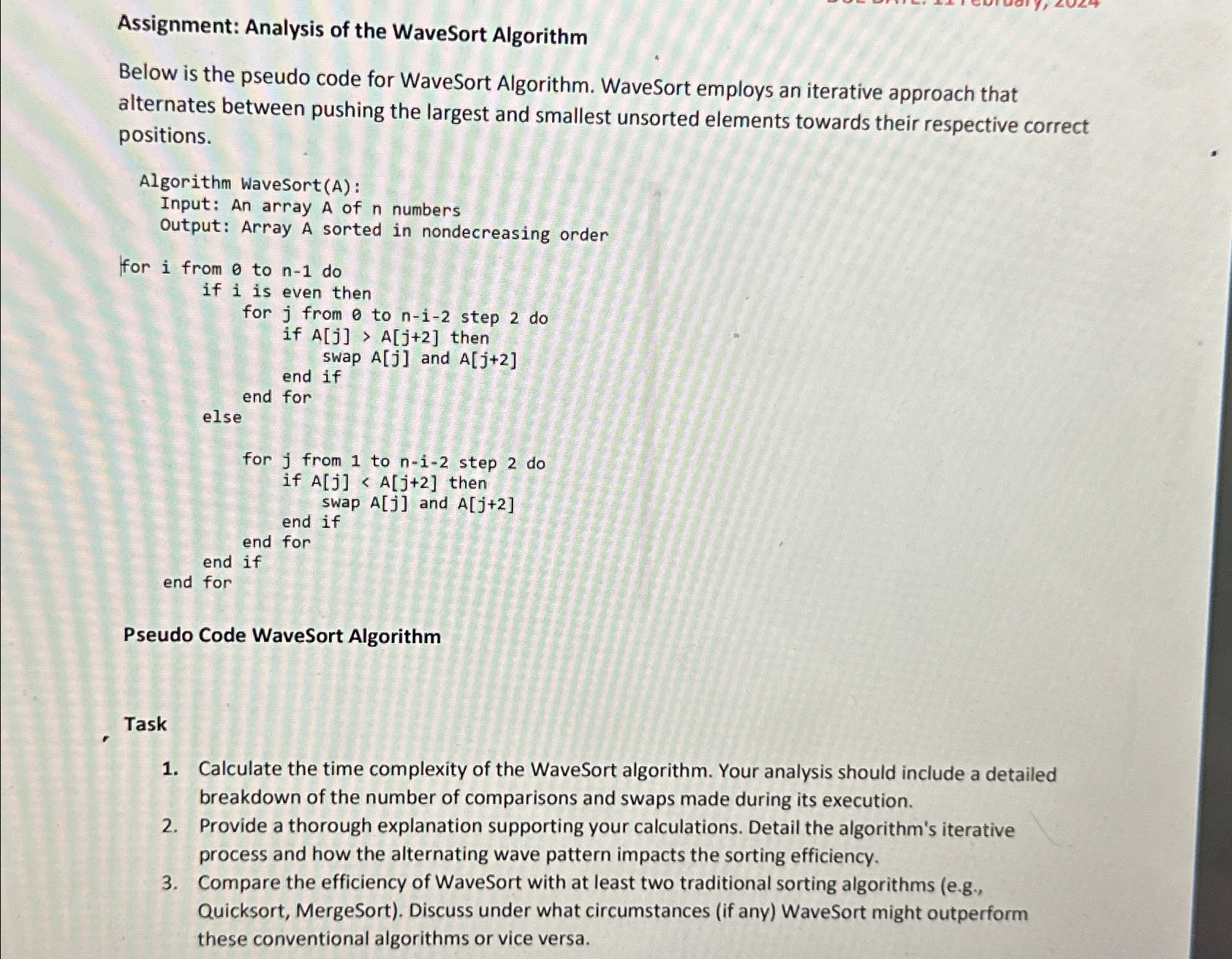
Below is the pseudo code for WaveSort Algorithm. WaveSort employs an iterative approach that alternates between pushing the largest and smallest unsorted elements towards their respective correct positions. Algorithm Wavesort (A): Input: An array A of n numbers Output: Array A sorted in nondecreasing order for i from 0 to n1 do if 1 is even then for j from to ni2 step 2 do if A[j]>A[j+2] then Swap A[j] and A[j+2] end if end for else for j from 1 to ni2 step 2 do if A[j]
Step by Step Solution
There are 3 Steps involved in it

Get step-by-step solutions from verified subject matter experts
 Study Help