







Question: ASSIGNMENT (Based on Horstmann, Big Java - Project 2.1) The GregorianCalendar class describes a point in time, as measured by the Gregorian calendar, a standard
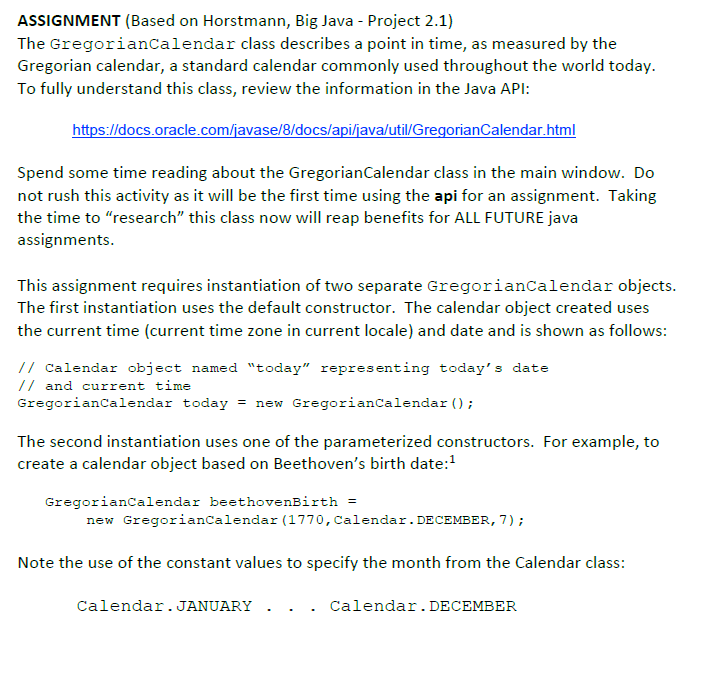
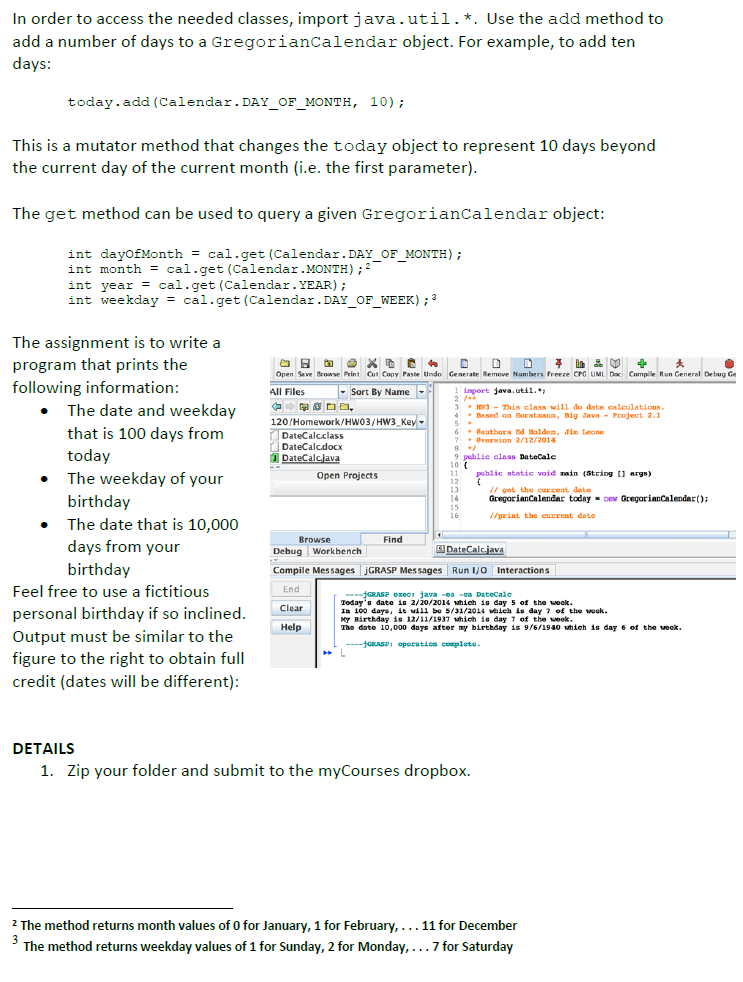
ASSIGNMENT (Based on Horstmann, Big Java - Project 2.1) The GregorianCalendar class describes a point in time, as measured by the Gregorian calendar, a standard calendar commonly used throughout the world today To fully understand this class, review the information in the Java API: til/Gr Spend some time reading about the GregorianCalendar class in the main window. Do not rush this activity as it will be the first time using the api for an assignment. Taking the time to "research" this class now will reap benefits for ALL FUTURE java assignments This assignment requires instantiation of two separate GregorianCalendar objects. The first instantiation uses the default constructor. The calendar object created uses the current time (current time zone in current locale) and date and is shown as follows // calendar object named "today" representing today's date // and current time GregorianCalendar today new Gregoria n Calendar.. The second instantiation uses one of the parameterized constructors. For example, to create a calendar object based on Beethoven's birth date:1 GregorianCalendar beethovenBirth = new GregorianCalendar (1770,Calendar.DECEMBER, 7) Note the use of the constant values to specify the month from the Calendar class: calendar. JANUARY Calendar. DECEMBER ASSIGNMENT (Based on Horstmann, Big Java - Project 2.1) The GregorianCalendar class describes a point in time, as measured by the Gregorian calendar, a standard calendar commonly used throughout the world today To fully understand this class, review the information in the Java API: til/Gr Spend some time reading about the GregorianCalendar class in the main window. Do not rush this activity as it will be the first time using the api for an assignment. Taking the time to "research" this class now will reap benefits for ALL FUTURE java assignments This assignment requires instantiation of two separate GregorianCalendar objects. The first instantiation uses the default constructor. The calendar object created uses the current time (current time zone in current locale) and date and is shown as follows // calendar object named "today" representing today's date // and current time GregorianCalendar today new Gregoria n Calendar.. The second instantiation uses one of the parameterized constructors. For example, to create a calendar object based on Beethoven's birth date:1 GregorianCalendar beethovenBirth = new GregorianCalendar (1770,Calendar.DECEMBER, 7) Note the use of the constant values to specify the month from the Calendar class: calendar. JANUARY Calendar. DECEMBER
Step by Step Solution
There are 3 Steps involved in it

Get step-by-step solutions from verified subject matter experts
 Study Help