



Question: Assignment: Chapter 09 Insuring Your Health $4,479 2017 4,704 2016 2018 4,824 2019 5,049 Total Except for an occasional minor illness requiring a doctor's attention,
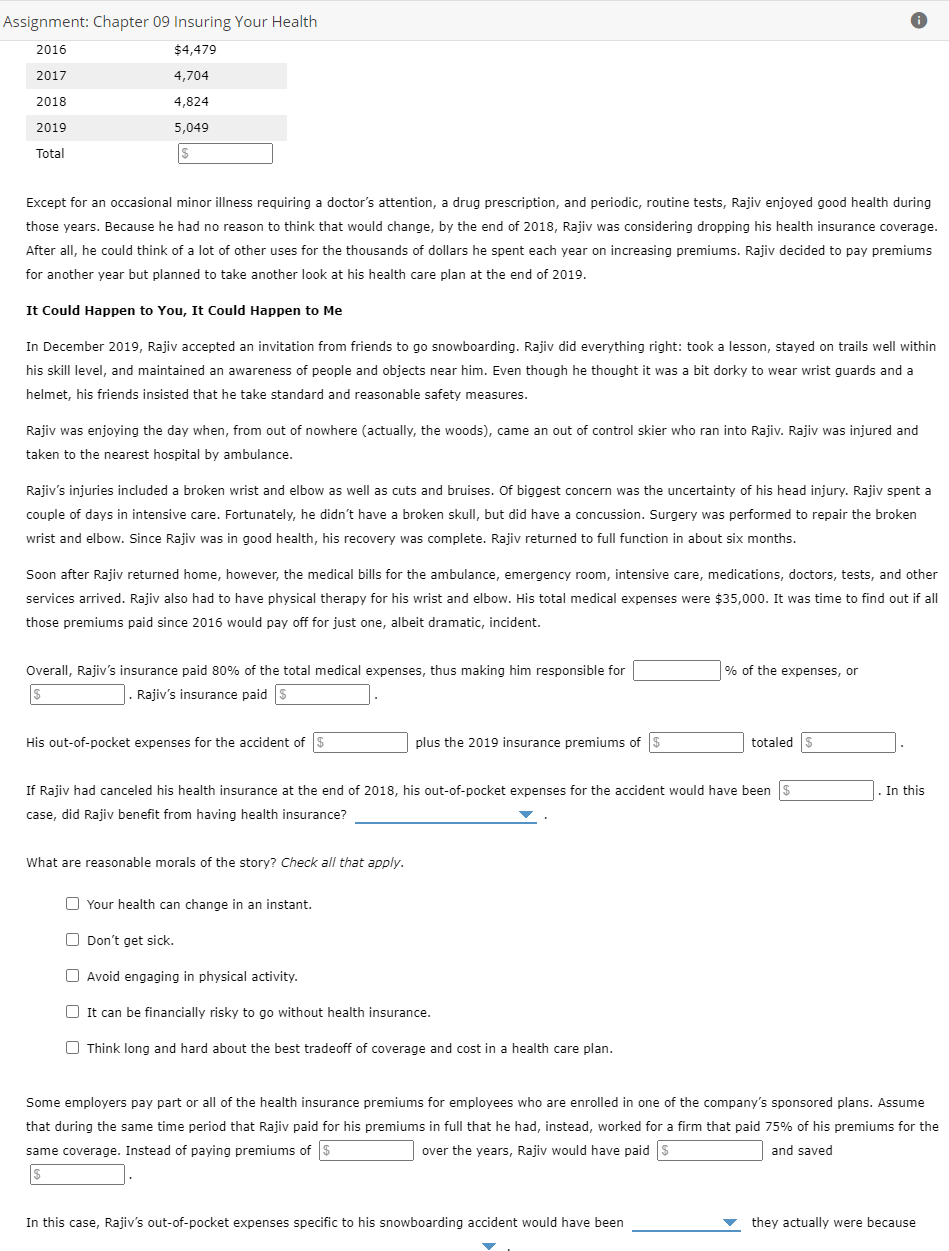
Assignment: Chapter 09 Insuring Your Health $4,479 2017 4,704 2016 2018 4,824 2019 5,049 Total Except for an occasional minor illness requiring a doctor's attention, a drug prescription, and periodic, routine tests, Rajiv enjoyed good health during those years. Because he had no reason to think that would change, by the end of 2018, Rajiv was considering dropping his health insurance coverage. After all, he could think of a lot of other uses for the thousands of dollars he spent each year on increasing premiums. Rajiv decided to pay premiums for another year but planned to take another look at his health care plan at the end of 2019. It Could Happen to You, It Could Happen to Me In December 2019, Rajiv accepted an invitation from friends to go snowboarding. Rajiv did everything right: took a lesson, stayed on trails well within his skill level, and maintained an awareness of people and objects near him. Even though he thought it was a bit dorky to wear wrist guards and a helmet, his friends insisted that he take standard and reasonable safety measures. Rajiv was enjoying the day when, from out of nowhere (actually, the woods), came an out of control skier who ran into Rajiv. Rajiv was injured and taken to the nearest hospital by ambulance. Rajiv's injuries included a broken wrist and elbow as well as cuts and bruises. Of biggest concern was the uncertainty of his head injury. Rajiv spent a couple of days in intensive care. Fortunately, he didn't have a broken skull, but did have a concussion. Surgery was performed to repair the broken wrist and elbow. Since Rajiv was in good health, his recovery was complete. Rajiv returned to full function in about six months. Soon after Rajiv returned home, however, the medical bills for the ambulance, emergency room, intensive care, medications, doctors, tests, and other services arrived. Rajiv also had to have physical therapy for his wrist and elbow. His total medical expenses were $35,000. It was time to find out if all those premiums paid since 2016 would pay off for just one, albeit dramatic, incident. % of the expenses, or Overall, Rajiv's insurance paid 80% of the total medical expenses, thus making him responsible for $ . Rajiv's insurance paid $ His out-of-pocket expenses for the accident of $ plus the 2019 insurance premiums of $ totaled s In this If Rajiv had canceled his health insurance at the end of 2018, his out-of-pocket expenses for the accident would have been case, did Rajiv benefit from having health insurance? What are reasonable morals of the story? Check all that apply. Your health can change in an instant. O Don't get sick. Avoid engaging in physical activity. It can be financially risky to go without health insurance. Think long and hard about the best tradeoff of coverage and cost in a health care plan. Some employers pay part or all of the health insurance premiums for employees who are enrolled in one of the company's sponsored plans. Assume that during the same time period that Rajiv paid for his premiums in full that he had, instead, worked for a firm that paid 75% of his premiums for the same coverage. Instead of paying premiums of $ over the years, Rajiv would have paid $ and saved $ In this case, Rajiv's out-of-pocket expenses specific to his snowboarding accident would have been they actually were because Assignment: Chapter 09 Insuring Your Health $4,479 2017 4,704 2016 2018 4,824 2019 5,049 Total Except for an occasional minor illness requiring a doctor's attention, a drug prescription, and periodic, routine tests, Rajiv enjoyed good health during those years. Because he had no reason to think that would change, by the end of 2018, Rajiv was considering dropping his health insurance coverage. After all, he could think of a lot of other uses for the thousands of dollars he spent each year on increasing premiums. Rajiv decided to pay premiums for another year but planned to take another look at his health care plan at the end of 2019. It Could Happen to You, It Could Happen to Me In December 2019, Rajiv accepted an invitation from friends to go snowboarding. Rajiv did everything right: took a lesson, stayed on trails well within his skill level, and maintained an awareness of people and objects near him. Even though he thought it was a bit dorky to wear wrist guards and a helmet, his friends insisted that he take standard and reasonable safety measures. Rajiv was enjoying the day when, from out of nowhere (actually, the woods), came an out of control skier who ran into Rajiv. Rajiv was injured and taken to the nearest hospital by ambulance. Rajiv's injuries included a broken wrist and elbow as well as cuts and bruises. Of biggest concern was the uncertainty of his head injury. Rajiv spent a couple of days in intensive care. Fortunately, he didn't have a broken skull, but did have a concussion. Surgery was performed to repair the broken wrist and elbow. Since Rajiv was in good health, his recovery was complete. Rajiv returned to full function in about six months. Soon after Rajiv returned home, however, the medical bills for the ambulance, emergency room, intensive care, medications, doctors, tests, and other services arrived. Rajiv also had to have physical therapy for his wrist and elbow. His total medical expenses were $35,000. It was time to find out if all those premiums paid since 2016 would pay off for just one, albeit dramatic, incident. % of the expenses, or Overall, Rajiv's insurance paid 80% of the total medical expenses, thus making him responsible for $ . Rajiv's insurance paid $ His out-of-pocket expenses for the accident of $ plus the 2019 insurance premiums of $ totaled s In this If Rajiv had canceled his health insurance at the end of 2018, his out-of-pocket expenses for the accident would have been case, did Rajiv benefit from having health insurance? What are reasonable morals of the story? Check all that apply. Your health can change in an instant. O Don't get sick. Avoid engaging in physical activity. It can be financially risky to go without health insurance. Think long and hard about the best tradeoff of coverage and cost in a health care plan. Some employers pay part or all of the health insurance premiums for employees who are enrolled in one of the company's sponsored plans. Assume that during the same time period that Rajiv paid for his premiums in full that he had, instead, worked for a firm that paid 75% of his premiums for the same coverage. Instead of paying premiums of $ over the years, Rajiv would have paid $ and saved $ In this case, Rajiv's out-of-pocket expenses specific to his snowboarding accident would have been they actually were because
Step by Step Solution
There are 3 Steps involved in it

Get step-by-step solutions from verified subject matter experts