







Question: Assignment: Finding Zeros Graphically Write a program to estimate the proper launch angle for a projectile launched with velocity magnitude v i m s ,
Assignment: Finding Zeros Graphically Write a program to estimate the proper launch
angle for a projectile launched with velocity magnitude at a target
m below, and away from the launch point by graphically determining the
zeros of Equation You will provide the initial values when prompted.
As always,
from pylab import
Define a function which will pass an array of launch angles and return an
array of values for the expression on the left side of the equal sign of Equation
each element of which corresponds to an element of the launch angle array.
Make the program input values all float types for and
Note: The input instruction in python returns only strings, whereas in
python it returned a "best guess" as to the type. In python then, the in
struction needs its return type changed the technical term is "cast" So for
example, if you want the input stored as an integer:
aninteger intinputtype a number
or as a float real number:
afloat floatinputtype another number
Create an array of launch angle values between and the curve
blows up at try it using the linspace function.
Plot each returned function value ordinate against launch angle abscissa
the horizontal or axis:
plottheta functiontheta
labels
show
Read from the plot using the zoom and pan utility in the plot window, if
necessary the angles where the curve crosses zero on the ordinate axis
Grid lines, which may help the determination, can be added to the plot with
the instruction gridTrue before issuing the show instruction. Report this
value which will be in radians to two decimal places for:
and
Then play around and see which initial values near these never give zeros
and therefore can never reach the target. Report the values you come up with.
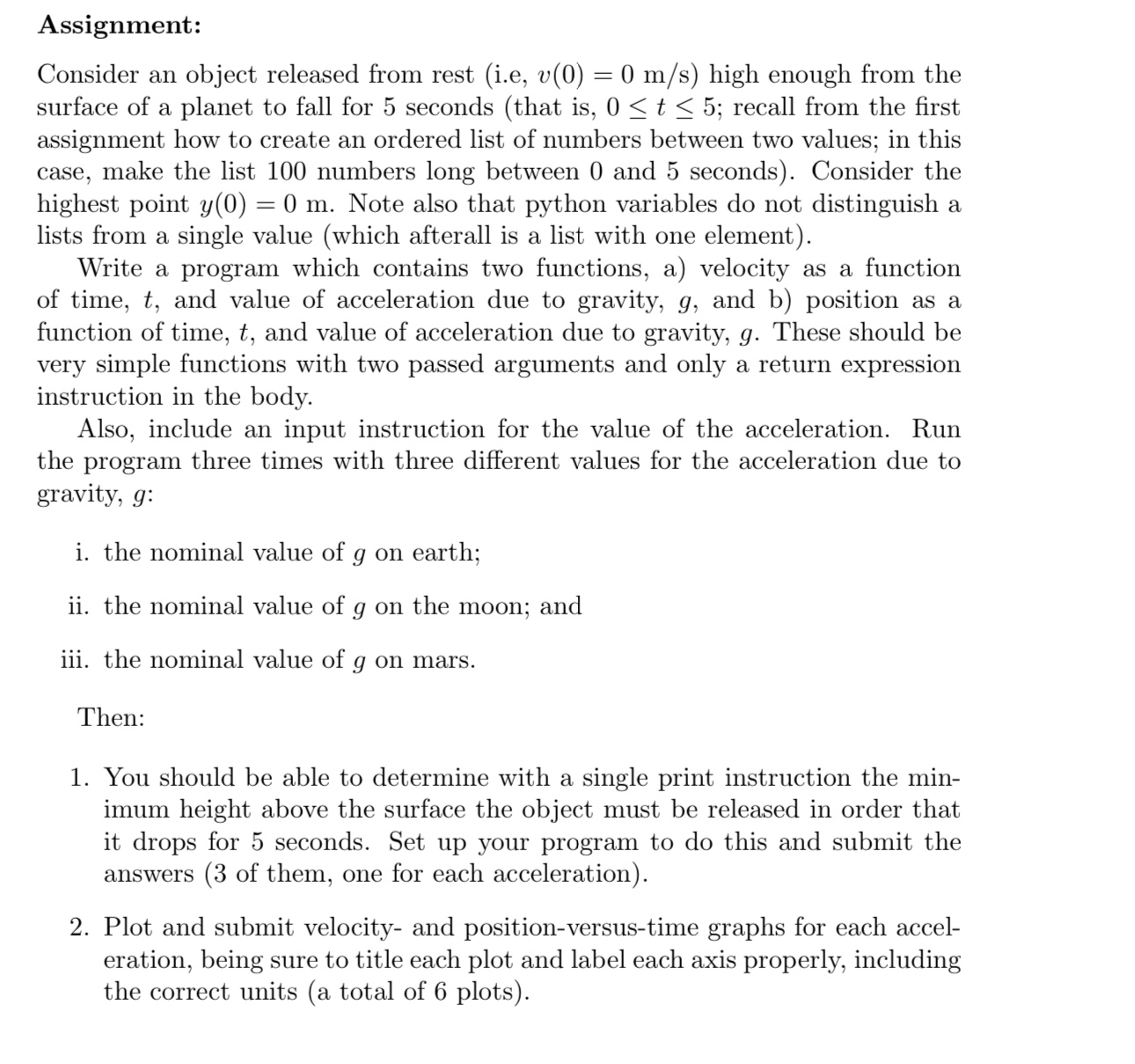
Consider an object released from rest ie high enough from the
surface of a planet to fall for seconds that is; recall from the first
assignment how to create an ordered list of numbers between two values; in this
case, make the list numbers long between and seconds Consider the
highest point Note also that python variables do not distinguish a
lists from a single value which afterall is a list with one element
Write a program which contains two functions, a velocity as a function
of time, and value of acceleration due to gravity, and b position as a
function of time, and value of acceleration due to gravity, These should be
very simple functions with two passed arguments and only a return expression
instruction in the body.
Also, include an input instruction for the value of the acceleration. Run
the program three times with three different values for the acceleration due to
gravity, :
i the nominal value of on earth;
ii the nominal value of on the moon; and
iii. the nominal value of on mars.
Then:
You should be able to determine with a single print instruction the min
imum height above the surface the object must be released in order that
it drops for seconds. Set up your program to do this and submit the
answers of them, one for each acceleration
Plot and submit velocity and positionversustime graphs for each accel
eration, being sure to title each plot and label each axis properly, including
the correct units a total of plots
Step by Step Solution
There are 3 Steps involved in it
1 Expert Approved Answer
Step: 1 Unlock

Question Has Been Solved by an Expert!
Get step-by-step solutions from verified subject matter experts
Step: 2 Unlock
Step: 3 Unlock
 Study Help