Question: Assignment Instructions: Login to Saudi Digital Library (SDL). Search for the journal article entitled as Implementing a Holographic Organization Design: The Case of GABO:mi by
Assignment Instructions:
- Login to Saudi Digital Library (SDL).
- Search for the journal article entitled as Implementing a Holographic Organization Design: The Case of GABO:mi by Jacobi, E. (2015) in South Asian Journal of Business and Management Cases. 4 (1), 2 13.
- Read the research article thoroughly alongside Chapter 12 in your textbook and answer the questions for the assignment.
- Besides this research paper use other relevant material to support your answers.
Assignment Question(s):
Part 1:
- Q.1 What is a holographic organization? Describe its characteristics. (1 Mark) (Words 150-200)
- Q.2 How important is the collective organizational learning in the development of a new organization design (i.e. the holographic design)? (1 Mark) (Words 150-200)
- Q.3 Compare a holographic design to a matrix-based structure. What similar advantages could you identify for organizations implementing these structures? (1.5 Marks) (Words 200-300)
Part 2:
Q.4 Please refer to table 12.5 in Chapter 12 of your textbook. Then, provide an example of an organization that uses a customer-centric structure. Please justify your answer. (1.5 Marks) (Words 200-300)


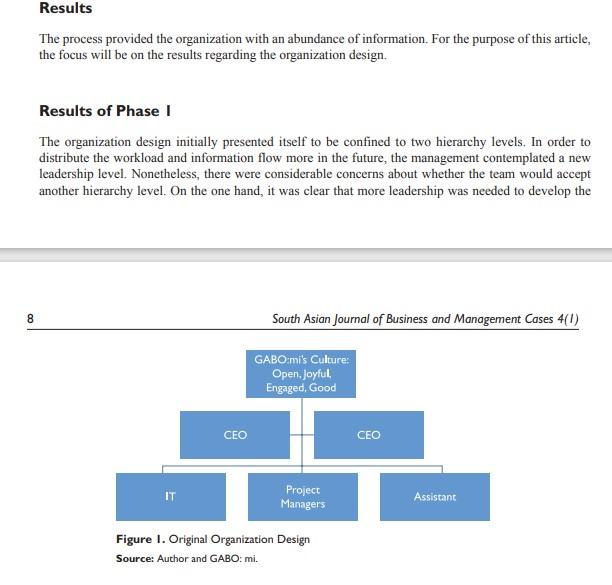
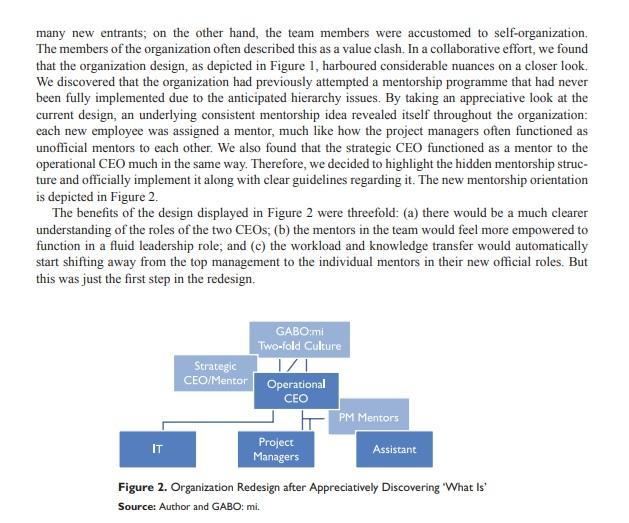

Implementing a Holographic Organization Design: The Case of GABO:mi South Asian Journal of Business and Management Cases 4(0)2-13 2015 Birla Institute of Management Technology SAGE Publications sagepub.in/home.nav DOI: 10.1177/2277977915574034 http://bmc.sagepub.com SSAGE Erika Jacobi Abstract This case describes the implementation of a holographic organization design at a European research project management firm. The case firm, GABO:mi, underwent a phase of rapid growth. Their head- count nearly doubled, which left them challenged to the maintenance of the flexible self-organization of their teams. During a collaboratively conducted change initiative, the organization determined that a holographic organization design would best serve their business objectives. A six-phase change initia- tive was conducted to help the case firm identify their unique success factors and decide how to bring these factors forward into the new organization design. The change process leveraged a collaborative, appreciative and systemic approach throughout all phases, from assessment to implementation. The process itself, thereby, closely resembled the organization design that was later implemented. Keywords Holographic organization design, appreciative intelligence, organizational development, organizational change Introduction This article provides a thorough analysis of the collectively conducted organization redesign of a rapidly growing European research project management firm. As a result of this change initiative, the case firm, GABO:mi, implemented a holographic organization design, which helped maintain the neces- sary information flow amongst all functions and preserved the capability of their teams to self-organize despite a rapidly growing headcount. Undergoing a second wave of rapid growth, GABO:mi faced the challenge of maintaining the existing flexible self-organization and information management aspects, preserving the organization's vibrant culture and continuing to meet the high-quality standards demanded by the organization's objectives. The change initiative followed an appreciative, systemic and collaborative approach. The appreciative assessment (Cooperrider, 1990; Thatchenkery, 2005; Watkins, Mohr & Kelly, 2001) focused on the organization's key success factors and organizational values. The underlying objective of this appreciative assessment was to identify factors that were working extraordinarily well and to not only preserve them but also to enhance them systemically. The self- described vibrant organizational culture supported both collaboration and self-organization. The goal of the change initiative was to collectively understand the crucial success factors of the organization and to increase the overall awareness of how best these factors can be utilized in the new organization design. Data collection included all members as well as all levels of the organization. The constellations for the interviews varied depending on the project phase. The appreciative interviews were conducted under the axiom that whatever information was retrieved would be considered important for the planned organization redesign (Cameron, 2008; Cameron, Dutton & Quinn, 2003; Dutton, 2003; Seligman, 2011; Thatchenkery, 2005, 2011; Thatchenkery & Metzker, 2006). The collected data were analyzed to increase the collective awareness of how core organizational success factors could be implemented to ensure that the parts reflected the whole and vice versa. The data revealed relatively early on that a holographic organization model (Johannessen & Hauan, 1993; Mapes, 2000; Morgan, 2006) would be the best choice for the case company. The remainder of the process was used to understand and develop the most effective holographic organization design for GABO.mi. Ultimately, leveraging the organization's collective intelligence along with the results from the appreciative assessment led to the successful implementation of a tailored holographic organization design. This tailored holographic organization design allowed the case company to double its headcount in under a year. The vital information flow was maintained if not improved, despite significant growth of the organization, which had been one of the main goals of the change initiative. The case described in this article provides a threefold example of showing first that the information systems can determine the design and structure of an organization (Galbraith & Lawler, 1993). Second, it shows that collective organizational learning has an immediate effect on the organization's structure, culture, information and politics (Travica, 1999). Third, it shows the successful use of an appreciative, collaborative and systemic approach to develop and implement a new organization design in general and a holographic organization design in particular. Holographic Organizations Holographic Organizations The notion of looking at organization from an information system perspective is relatively novel (Travica, 1999). Galbraith (1973) was one of the first researchers to establish a link between organization design, generation and maintenance of information and the uncertainty level under which organi- zations function. In relatively stable conditions, hierarchical structures move problems up until the necessary information for their resolution is found (Travica, 1999). Organizations that typically deal with high levels of uncertainty and volatility, however, require a higher level of differentiation (Ashby, 1960; Lawrence & Lorsch, 1967) and a more flexible organization design (e.g., Mintzberg, 1993). Morgan (2006) contends that two notions are essential for the information approach to organizations: the framework of organizational learning (Argyris & Schn, 1995) and the concept of self-organization. To demonstrate how information can consistently be gained, managed and leveraged (Travica, 1999) in an organization, Morgan (2006) introduces the metaphor of the brain epitomizing the notion of a hologram. 4 South Asian Journal of Business and Management Cases 4(1) Organization Seen as a Brain The brain has the capability to function fully for its most important purposes even if 90 per cent of it has been removed (Morgan, 2006). The brain consists of individual cells each of which carry the same information (Johannessen & Hauan, 1993, Mapes, 2000; Morgan, 2006). Information can be passed on to a neighbouring cell, which can then replace the information lost by the others. This flexible struc- ture results in the capability to continuously self-organize and allows for survival, even at the cost of effectiveness. With its unique structure, which allows for duplication of information, the brain bears a resemblance to a hologram. Showing a similar connectivity, its parts reflect the whole. The connectivity for both the brain cells and individual parts of the hologram is abundant, creating a system that continuously exchanges information exponentially regardless of where this information originates or is controlled. 2006 Jacobi foster accountability, trust, sharing and to allow for role ambiguity; (b) the need for close monitoring of how information is sought, shared and communicated across boundaries because information flow rules all decision-making: (c) greater need for special dispersion than structure, formalization and hierarchy; and finally (d) the need for internal politics to be governed by expert power rather than structural and hierarchical power (Travica, 1999, p. 28). In the following, we will see how the case firm cocreated and successfully implemented a holo- graphic, brain-like organization design, and how the collective decision impacted all vital areas of the organization starting from recruiting via leadership strategies to motivational structures. The Case GABO:mi is a highly specialized European research project management consulting firm based in Munich, Germany. The company emerged in 2005 as a spin-off of the former parent company GABO. This spin-off had become necessary to stress GABO:mi's heavy focus on European research project management and to establish GABO:mi as a new brand. The consulting firm helps research groups apply for the millions of euros research grants available annually from the European Union (EU). The applica- tion process can be challenging due to its heavy regulations. GABO:mi provides all services necessary during the initial phase, starting from contract negotiations and financial management to orchestrating all lines of communication as well as the final filing of the application. The consulting firm's business model is built on orchestrating the entire research project. From the start, GABO mi takes the same risks as the research group and is included in the research process until the project receives its grant funds, Due to the nature of their business, the organization relies on the capability to quickly on-board highly specialized project managers who can function as fully engaged all-rounders'. The firm's project man- agers need to have a high capability for self-organization, flexible team collaboration and fluid knowl- edge management. Since these managers work on various projects, it is crucial for them to stay informed on the details of the highly specialized projects in order to be able to take over from one another at any given time. As an organization grows, however, the flow of information often becomes more compli- cated. When GABO:mi started in 2005, there were only a handful of project managers. They soon grew to a headcount of over thirty full-time staff, project and IT managers. Therefore, in 2012, the two chief executive officers (CEOs) of GABO:mi deemed it necessary to restructure the organization as a result of the growing demand in the market. In honour of the collaborative nature of the planned redesign and the fact that it inherently dealt with learning to grow on more than one level, the initiative was named "Growing together. Objectives The overarching goal for the required change process was to help the firm grow in a healthy and sustain- able way by redesigning important organizational structures. The main focus lay on establishing a new leadership level that would help distribute the workload and information flow faster and more efficiently. Thus far, the management had been the centre of knowledge, quality and project manage- ment. With the expected growth, it was clear that the capacity of this workflow design had reached its limits. A new design was needed to support the entire league of highly qualified research project managers to guarantee a smooth information flow and to maintain a high-quality standard during these times of growth and beyond. All initiatives and achievements were to reflect the unique business 6 South Asian Journal of Business and Management Cases 4(1) objectives and organizational climate of the firm. GABO:mi's business objectives and organizational climate were considered to be the components that shaped an outstanding organizational culture, which one could feel while entering the organization, and for which GABO:mi had won awards for three consecutive years. Specific agreed-upon goals were to (a) develop an organization design that is capable of fostering all company objectives effectively and sustainably and that honours the current and future head- count growth; (b) implement effective team and leadership structures that mirror the organizational climate and culture; (c) nurture a mindset within the team and entire organization that is sup- portive of the necessary changes and nature of business in the research project management field; and (d) sustain a healthy growth process as well as the organizational values 'open, joyful, connected, engaged, and good' Approach After extensive preliminary conversations with the management we decided on a collective, systemic and appreciative approach. On a practical level, the reasons were to (a) choose a collective approach encompassing the participation of all members of the organization in order to match the level of senior- LR ity, capability to self-organize and leam collectively which the organization evidentially harboured; (b) choose an appreciative approach to fully and collectively understand the current success factors, values and culture of the organization before aiming to change them, and (c) choose a systemic approach in order to effectively mirror the identified success factors in the rather fluid project teams. Conceptually, the notion of conducting a cocreative and participatory change process is based on a postmodern understanding that reality is a social construct in which a common language, identity and sense-making (Gergen, 2009; Weick, 1969, 1988, 1993, 1995) determine the collective action Since reality is a social construct in this perspective, a change of this reality in a collective way can be conducive to a successful outcome of the change process and can provide new opportunities for all members. The systemic approach we applied is based on the understanding that an organization that is seen as a system is composed of interrelated structured components that cooperate with each other in behavioural processes. As such, problems and opportunities are always parts of the overall system and mirror it at the same time (Bertalanffy, 1969; Gmr, Bartelt & Kissling, 2010; Meadows, 2008). The appreciative approach applied in this case aimed to leverage the organization's ability to see the positive potential unfolding within the present situation and to develop the capacity to act on it in order to realize its full potential (Cooperrider, 1990; Dutton, 2003; Johnson & Leavitt, 2001; Thatchenkery, 2005, 2011; Thatchenkery & Metzker, 2006; Watkins et al., 2001). Since it was clear from the beginning that staff and owners wanted to preserve as much as possible from their organizational culture and existing work process, the focus on learning how to collectively appreciate the best of what is' was emphasized throughout the entire process (Cooperrider, 1990; Watkins et al., 2001). Method The project was divided into six phases to capture as many nuances as possible of the multi-vocality (Boje, 1991, 1995) of the organization. Phase 1 started with an appreciative assessment of the provided collection of written data: the history and prehistory of the organization, the economical details, financial figures, hiring profiles, objectives, philosophy, goals, demographics, incidents and human resource Jacobi 7 endeavours were analyzed to identify vital patterns and indispensable success factors of the organization. In phase 2, we had several 4-6-h-long sessions with the owners who also functioned as the CEOs of the firm. We discussed their perspectives on success factors, values, life-giving factors, issues, perspec- tives and limitations. Our sessions consisted of a semi-structured interview procedure that followed an appreciative and systemic analysis outline. After every session, we prepared a written summary of the results and reported it to the CEOs. The results were discussed each time until a common understanding of the vital features was achieved. Phase 3 consisted of similar semi-structured interviews with staff, project and IT managers grouped by availability, seniority, frequency of project collaboration and position or field of expertise. The set questions examined (a) what each group thought to be unique about the organization; (b) what they appreciated about the system; (c) how they would describe their everyday procedures and ways of collaboration; (d) which components were perceived as vital to keep the required information and work flow alive; (e) which factors were challenging to the employees, and (f) what suggestions the employees had at that point to mitigate these challenges. In addition, in this phase of the project, we focused on sharing and holding each other to the systemic, collective and appreciative approacha procedure that we used to help inform and educate each other on a new way of communicating and viewing incidents. Phase 4 consisted of a day-long off-site meeting with the entire organization. We shared the results of phases 1, 2 and 3. Participants openly communicated their collective concerns, hopes and aspirations. After briefing the entire organization on what the participants considered the current situation, culture, values, success factors, risks, and challenges to be, the various groups discussed and agreed upon important goals. Participants floated in and out of the various groups in a World Cafe (Brown & Isaacs, 2005) manner. Once again, we shared and agreed upon the results. We closed the session with the understanding that, for the moment, the management would reserve the right to take the information and fine-tune the collectively developed solution that they thought would be most suitable. The staff widely echoed and welcomed this approach In phase 5, we developed a solid prototype of the new organization design. We asked all stakeholders if and how they could see themselves in their new roles. We discussed possible pitfalls and advantages of the new roles. Images for communicating the selected procedures and design to the entire group were found and prepared. After a test period of approximately 3 months, the prototype was discussed in detail, to then be fine-tuned and implemented in phase 6. Results The process provided the organization with an abundance of information. For the purpose of this article, the focus will be on the results regarding the organization design. Results of Phase 1 The organization design initially presented itself to be confined to two hierarchy levels. In order to distribute the workload and information flow more in the future, the management contemplated a new leadership level. Nonetheless, there were considerable concerns about whether the team would accept another hierarchy level. On the one hand, it was clear that more leadership was needed to develop the 00 8 South Asian Journal of Business and Management Cases 4(1) GABO:mi's Culture: Open. Joyful Engaged, Good CEO CEO IT Project Managers Assistant Figure 1. Original Organization Design Source: Author and GABO: mi. many new entrants; on the other hand, the team members were accustomed to self-organization. The members of the organization often described this as a value clash. In a collaborative effort, we found that the organization design, as depicted in Figure 1, harboured considerable nuances on a closer look. We discovered that the organization had previously attempted a mentorship programme that had never been fully implemented due to the anticipated hierarchy issues. By taking an appreciative look at the current design, an underlying consistent mentorship idea revealed itself throughout the organization: each new employee was assigned a mentor, much like how the project managers often functioned as unofficial mentors to each other. We also found that the strategic CEO functioned as a mentor to the operational CEO much in the same way. Therefore, we decided to highlight the hidden mentorship struc- ture and officially implement it along with clear guidelines regarding it. The new mentorship orientation is depicted in Figure 2. The benefits of the design displayed in Figure 2 were threefold: (a) there would be a much clearer understanding of the roles of the two CEOs; (b) the mentors in the team would feel more empowered to function in a fluid leadership role; and (c) the workload and knowledge transfer would automatically start shifting away from the top management to the individual mentors in their new official roles. But this was just the first step in the redesign. GABO:mi Two-fold Culture Strategic CEO/Mentor Operational CEO PM Mentors Project Assistant Managers IT Figure 2. Organization Redesign after Appreciatively Discovering 'What Is Source: Author and GABO: mi. Jacobi 9 Next, we revisited the cultural values of the organization, which so far had been defined as 'open, joyful, connected, engaged and good'. We analyzed these values from the perspective of honouring what was truly needed and practiced within the organization. We discovered that the overall values depicted only one side of the required and applied skill set. When we took a closer look, we found that the organization and its members needed a skill and value set that had to be twofold. In daily practice, the required skill set varied depending on the actual phase of the projects. Therefore, the two sets of cultural values were crystallized as follows: 1. For the mostly virtual, international project work: openness, diversity, internationality, virtuality, mobility, flexibility, social language and communication skills and independent and autonomous ability to self-organize and connect to a team and to the customer. 2. For compliance with the EU fund application guidelines and further research related work: precision, absolute love for detail, compliance with authority and guidelines, 'working by the book", detailed know-how and expert language and communication skills. Appreciating the variety and differences in the organizational culture led us to understand that both skill sets were needed as a basis for the organization's talent development, hiring and promotion strate- gies. A wide discrepancy between the required skill sets and values became evident as did the need for stressing the relevance of both sets of values in order to maintain a high level of quality in future. Results of Phase 2 During phase 2, an overwhelming majority of the participants confirmed the organizational culture to be *joyful, open, connected, engaged, and good. Every group noted that the organizational culture inspired every member to strive towards achieving the best possible results. The members of the organization perceived this as the main source of a deep connectedness to the organization, which continuously fuelled a vibrant organizational climate. However, the participants pointed out that the required learning curve from project to project was steep and the new project managers in the organization felt that they needed more support. All participants of the inquiry voiced a deep concern regarding the heavy workload the operational CEO functioned under. While the top of the organization had been worried that the very senior staff and project managers would be unhappy over another layer of leadership, more than 80 per cent of the team requested an additional leadership level during this phase. The two-level hierar- chy was collectively perceived as a bottleneck to the required information flow. While all members of the organization stated that they felt extraordinarily connected to the organization, projects and to one side of the brain, one set of values was needed pared to the right and project management aspect of the job and another set of values for the work that ensures compliance with the rules and regula- tions of the EU. The new-entry project managers were to be integrated soon into the mentoring process as the group believed that the best learning for both the individual and the collective could come only through helping each other. To bridge the time for them to become mentors, they were consistently encouraged to introduce new ideas for the on-boarding system. All members in the new or modified roles, such as the top management and the information traffic controllers, were given the chance to develop into their new roles through a coaching process. The rest of the team organized their own learning and development plans as they had done in the past. Recruiting and on-boarding processes were changed to include the amended values and required skill sets. New-entry employees started working on a booklet that would introduce the entire process to future employees and took responsibility for being their mentors. The organization chart was amended to the version shown in Figure 3. The levels in this graph do not indicate hierarchies; they are only to mirror the floors the people happen to work on. The mentorship roles change fluidly, which is indicated by the arrows. Strategic CEO/ Mentor to Oper. CEO C Operational CEO Mentor to QM C Figure 3. Holographic Organization Design for GABO:mi - First Model Source: Author and GABO: mi. Notes: X = project manager, * = rotating mentor, curved arrows = constant role shift between project managers and mentors and fluid information flow, C = information flow controllers, QM = Quality Management. Jacobi Management and employees alike considered the principal achievements in this change initiative to be that its results were so widely accepted by all employees and that it provided the opportunity for the organization to grow further in the future. Additional benefits were seen in the broadened capability of learning to learn as a collective, keeping the information flow alive and creating the right balance between connectivity and redundancy as well as self-organization and mentoring. The organization and its members have continued to function successfully in a highly specialized as well as in a general way, a capability which was highlighted through the implementation of the holographic, brain-like organization design. Since then, GABO:mi has doubled in size and kept the same quality standards, economic success and most of all the same organizational climate and overall values open, joyful, connected engaged, and good' Conclusion This analysis of a European research project management firm in a niche segment outlines how an organization can be seen and function holographically like a brain. The implemented organization design displayed the five characteristics of a holographic organization: (a) all parts are reflected in the whole; (b) the organization self-organizes; (c) the organization creates connectivity and redundancy; (d) it finds ways to learn as a whole; and (c) the organization displays a requisite variety (Ashby, 1960) to fully mirror all required demands of the environment it functions in. The appreciative, systemic and colla- borative change initiative leveraged to design and implement this holographic organization model crystallized what was already working well and identified how these unique success factors could be reflected in all parts of the organization. Implementation of the streamlined and tailored holographic organization design had a wide-ranging impact on other areas of the organization as well. Two sets of newly highlighted organizational values, depicted as the two sides of the brain, became part of the new on-boarding and mentoring programme. The leadership culture and team culture and the existing initiatives were adapted accordingly to help the organization learn as a collective. The newly implemented system allowed GABO:mi to maintain its typical work style of flexible team self-organization and constant vital information flow while building a sustainable platform for the organization's growth. chy was collectively perceived as a bottleneck to the required information flow. While all members of the organization stated that they felt extraordinarily connected to the organization, projects and to one another, the new-entry project managers reported that they could see numerous ways of reducing the anxiety and uncertainty level during the on-boarding phase. Additionally, the members of the organization detailed the precise course for their projects. The entire group recognized how much the external project set-up resembled the overall needed internal project set-up. They later used their codiscovered project outline as the basis for the future organization design that mirrored all cells of the existing system. Results of Phases 3-6 The new organization design was prototyped as a result of the off-site meeting. The strategic CEO would take an official advisory role as a mentor to the operational CEO. The operational CEO would function 10 South Asian Journal of Business and Management Cases 4(1) as the head quality auditor to mentor another senior project manager in the same role. Four senior members of the team were appointed to function as overall mentors and information flow controllers on each floor of the GABO:mi building. To ensure a leadership model that mirrored the self-regulating and non-hierarchical organizational culture and values, the information flow controllers were compared with air traffic controllers. Their task was to ensure the information flow and to keep the two quality auditors as well as all floor members informed at all timesto ensure the safe 'take off and landing of every project without obtaining any disciplinary leadership functions. The information flow controllers were to self-coordinate amongst each other, carrying the collected information from floor to floor. Additionally, they would help coordinate the regular mentorship process, which was as fluid as ever and achieved in a self-regulatory way. The overall mentors and information traffic controllers would be fully involved in a reduced number of projects to honour the fluidity of their roles. The other project managers would func- tion as mentors to the less senior project managers or to each other as needed and as self-assigned. We paid special attention to the mentorship of the amended situational company values, which were com- pared to the right and left side of the brain; one set of values was needed for the project management aspect of the job and another set of values for the work that ensures compliance with the rules and regula









 Study Help