







Question: Assignment Instructions Problem : Let's start by practicing using logical operators and being careful about the order of execution when we use multiple of them
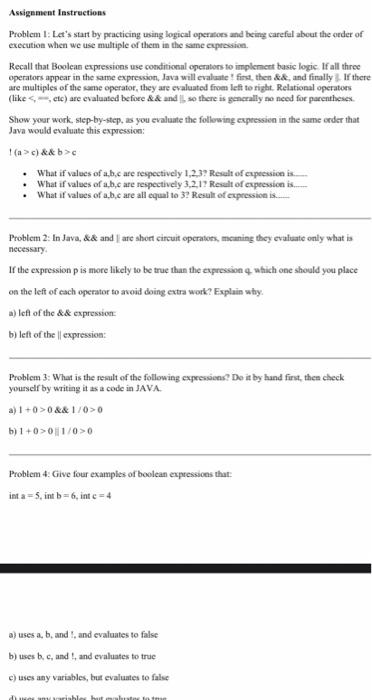
Assignment Instructions Problem : Let's start by practicing using logical operators and being careful about the order of execution when we use multiple of them in the same expression Recall that Boolean expressions use conditional operations to implement basic logic If all three operators appear in the same expression, Java will evaluate fin, then &&, and finally. If there are multiples of the same operator, they are evaluated from left to right. Relational operators (likesete) are evaluated before && and so there is generally no need for parenthesex Show your work, step-by-step, as you evaluate the following expression in the same order that Java would evaluate this expression a>c) &&b> What if values of a.b.c are respectively 1.2.3. Result of expression is.. What if values of a.b,c are respectively 3.2.17 Result of expression is... What if values of u.b,c are all equal to 32 Result of expression is... necessary Problem 2: In Java, && and are short circuit operators, meaning they evaluate only what is If the expression p is more likely to be true than the expression q which one should you place on the left of cach operator to avoid doing extra work? Explain why. a) left of the && expression b) left of the || expression Problem 3: What is the result of the following expenses? Do it by hand first, then check yourself by writing it as a code in JAVA a) 1+0>0 &&1/0>0 b) 1+0 >01/0> Problem 4: Give four examples of boolean expressions that int a = 5, int b = 6, inte=4 a) uses a, b, and !, and evaluates to false b) uses b, c, and, and evaluates to true c) uses any variables, but evaluates to false de marihl hunt in the
Step by Step Solution
There are 3 Steps involved in it

Get step-by-step solutions from verified subject matter experts
 Study Help