







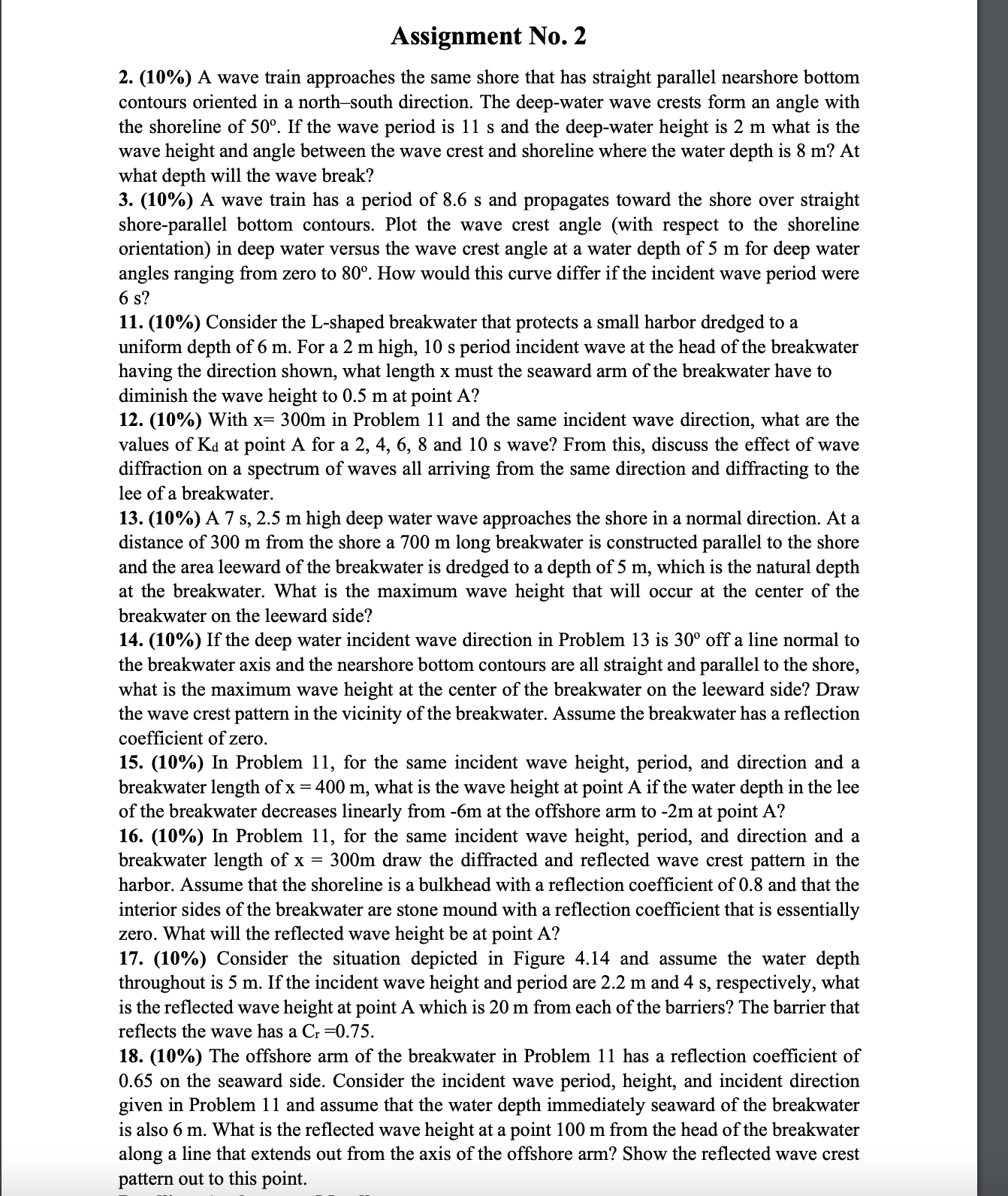
Question: Assignment No . 2 ( 1 0 % ) A wave train approaches the same shore that has straight parallel nearshore bottom contours oriented in
Assignment No
A wave train approaches the same shore that has straight parallel nearshore bottom
contours oriented in a northsouth direction. The deepwater wave crests form an angle with
the shoreline of If the wave period is and the deepwater height is what is the
wave height and angle between the wave crest and shoreline where the water depth is At
what depth will the wave break?
A wave train has a period of and propagates toward the shore over straight
shoreparallel bottom contours. Plot the wave crest angle with respect to the shoreline
orientation in deep water versus the wave crest angle at a water depth of for deep water
angles ranging from zero to How would this curve differ if the incident wave period were
Consider the shaped breakwater that protects a small harbor dredged to a
uniform depth of For a high, period incident wave at the head of the breakwater
having the direction shown, what length must the seaward arm of the breakwater have to
diminish the wave height to at point
With in Problem and the same incident wave direction, what are the
values of at point A for a and wave? From this, discuss the effect of wave
diffraction on a spectrum of waves all arriving from the same direction and diffracting to the
lee of a breakwater.
A high deep water wave approaches the shore in a normal direction. At a
distance of from the shore a long breakwater is constructed parallel to the shore
and the area leeward of the breakwater is dredged to a depth of which is the natural depth
at the breakwater. What is the maximum wave height that will occur at the center of the
breakwater on the leeward side?
If the deep water incident wave direction in Problem is off a line normal to
the breakwater axis and the nearshore bottom contours are all straight and parallel to the shore,
what is the maximum wave height at the center of the breakwater on the leeward side? Draw
the wave crest pattern in the vicinity of the breakwater. Assume the breakwater has a reflection
coefficient of zero.
In Problem for the same incident wave height, period, and direction and a
breakwater length of what is the wave height at point if the water depth in the lee
of the breakwater decreases linearly from at the offshore arm to at point
In Problem for the same incident wave height, period, and direction and a
breakwater length of draw the diffracted and reflected wave crest pattern in the
harbor. Assume that the shoreline is a bulkhead with a reflection coefficient of and that the
interior sides of the breakwater are stone mound with a reflection coefficient that is essentially
zero. What will the reflected wave height be at point
Consider the situation depicted in Figure and assume the water depth
throughout is If the incident wave height and period are and respectively, what
is the reflected wave height at point A which is from each of the barriers? The barrier that
reflects the wave has a
The offshore arm of the breakwater in Problem has a reflection coefficient of
on the seaward side. Consider the incident wave period, height, and incident direction
given in Problem and assume that the water depth immediately seaward of the breakwater
is also What is the reflected wave height at a point from the head of the breakwater
along a line that extends out from the axis of the offshore arm? Show the reflected wave crest
pattern out to this point.
Step by Step Solution
There are 3 Steps involved in it
1 Expert Approved Answer
Step: 1 Unlock

Question Has Been Solved by an Expert!
Get step-by-step solutions from verified subject matter experts
Step: 2 Unlock
Step: 3 Unlock
 Study Help