Question: Assignment Overview Unit 4 - Individual Project ASSIGNMENT DESCRIPTION Deliverable Length: 2 pages OBJECTIVES As indicated by its title, Unit 4 focuses on high- performance
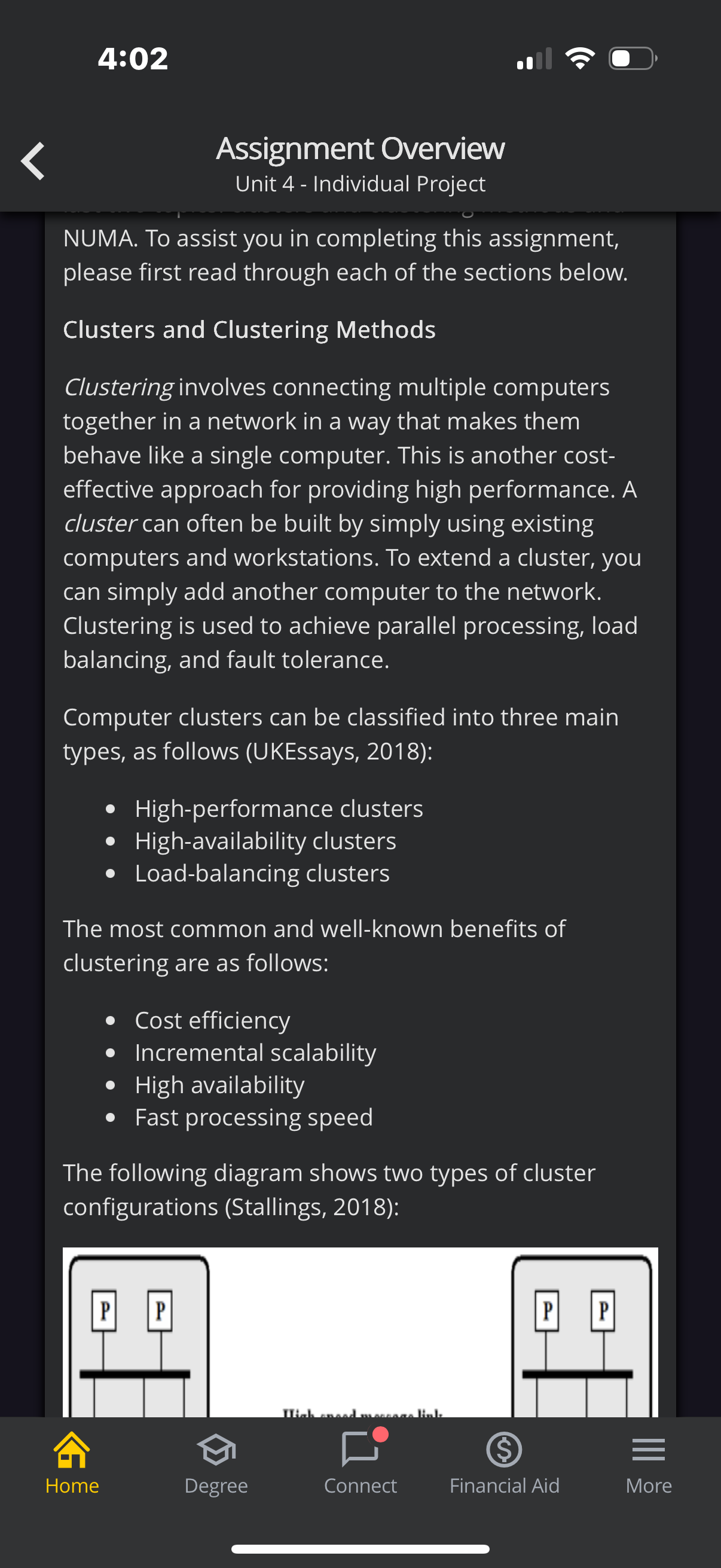
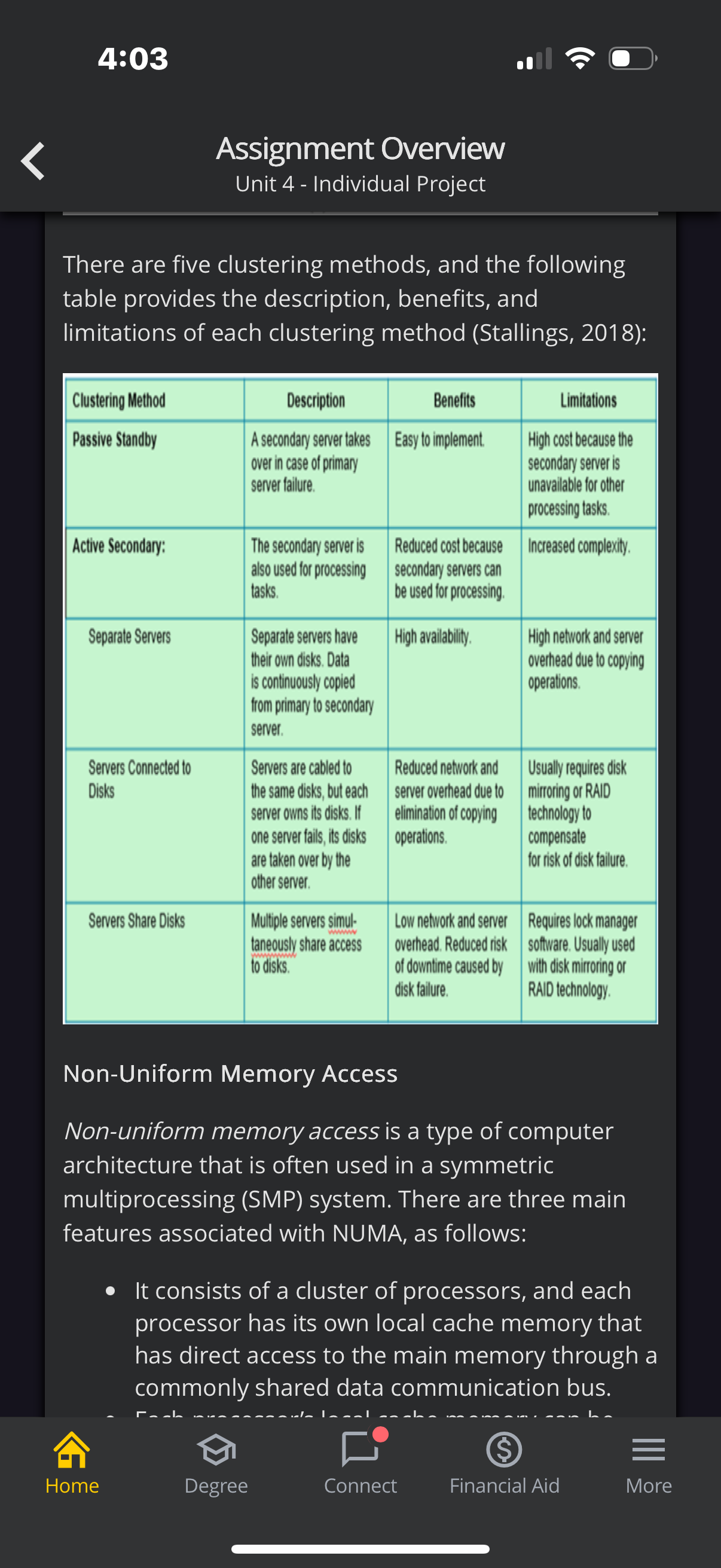
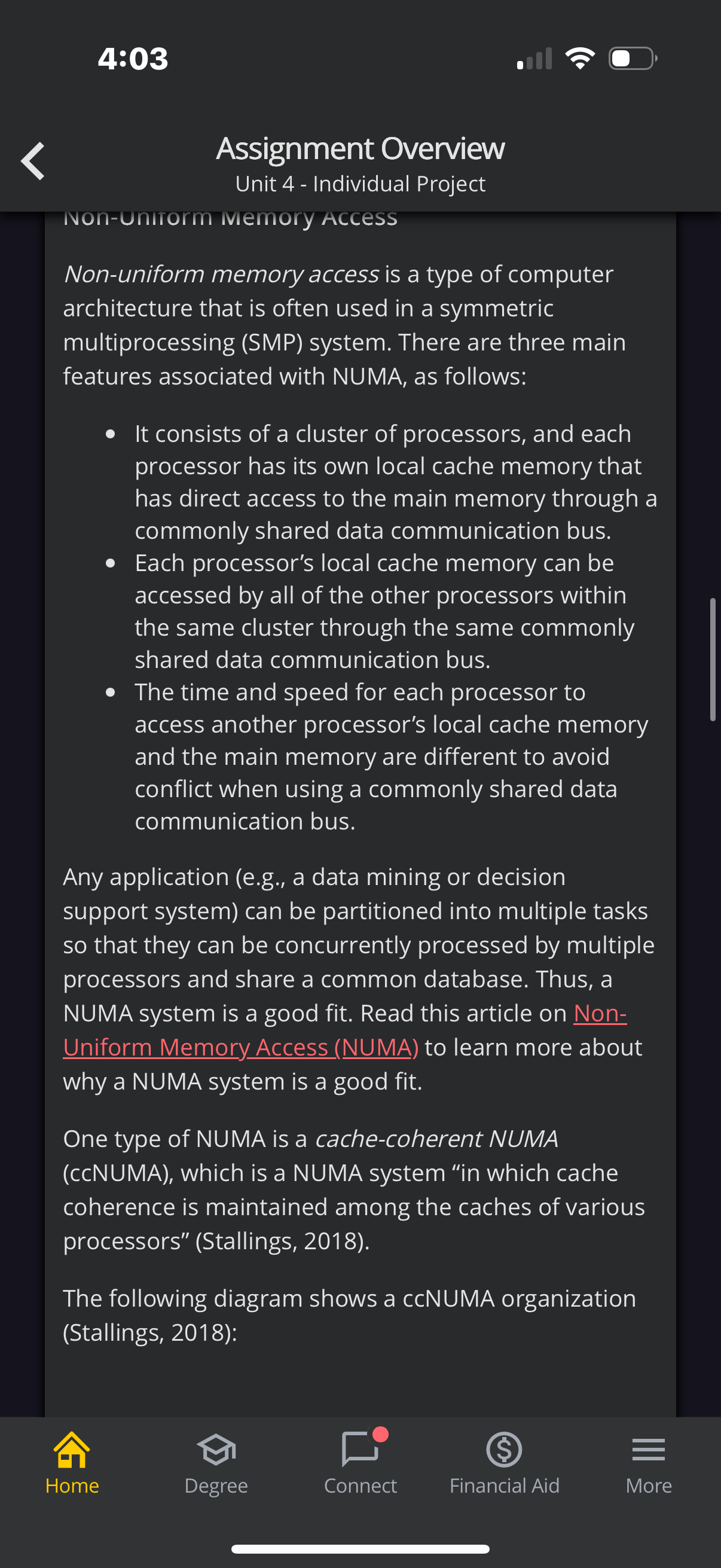
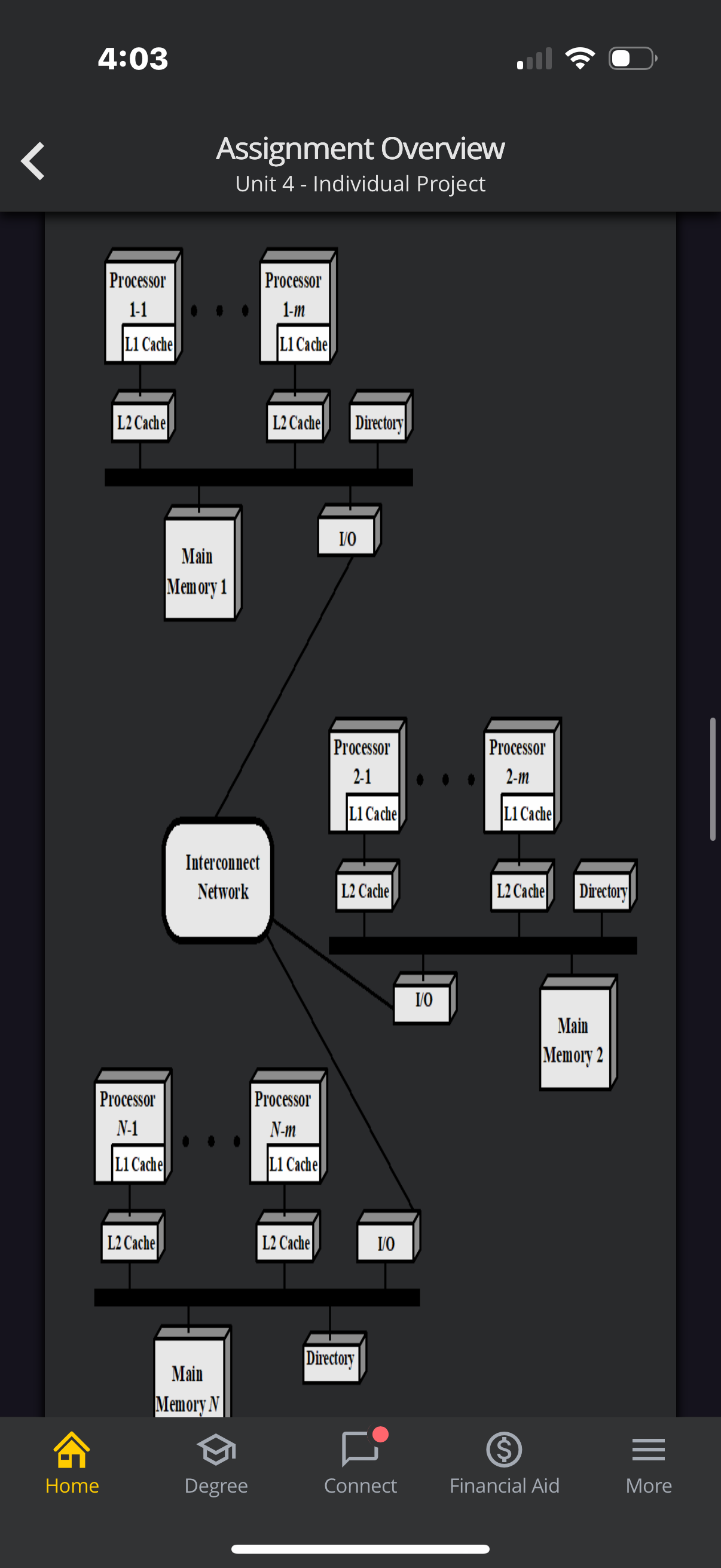
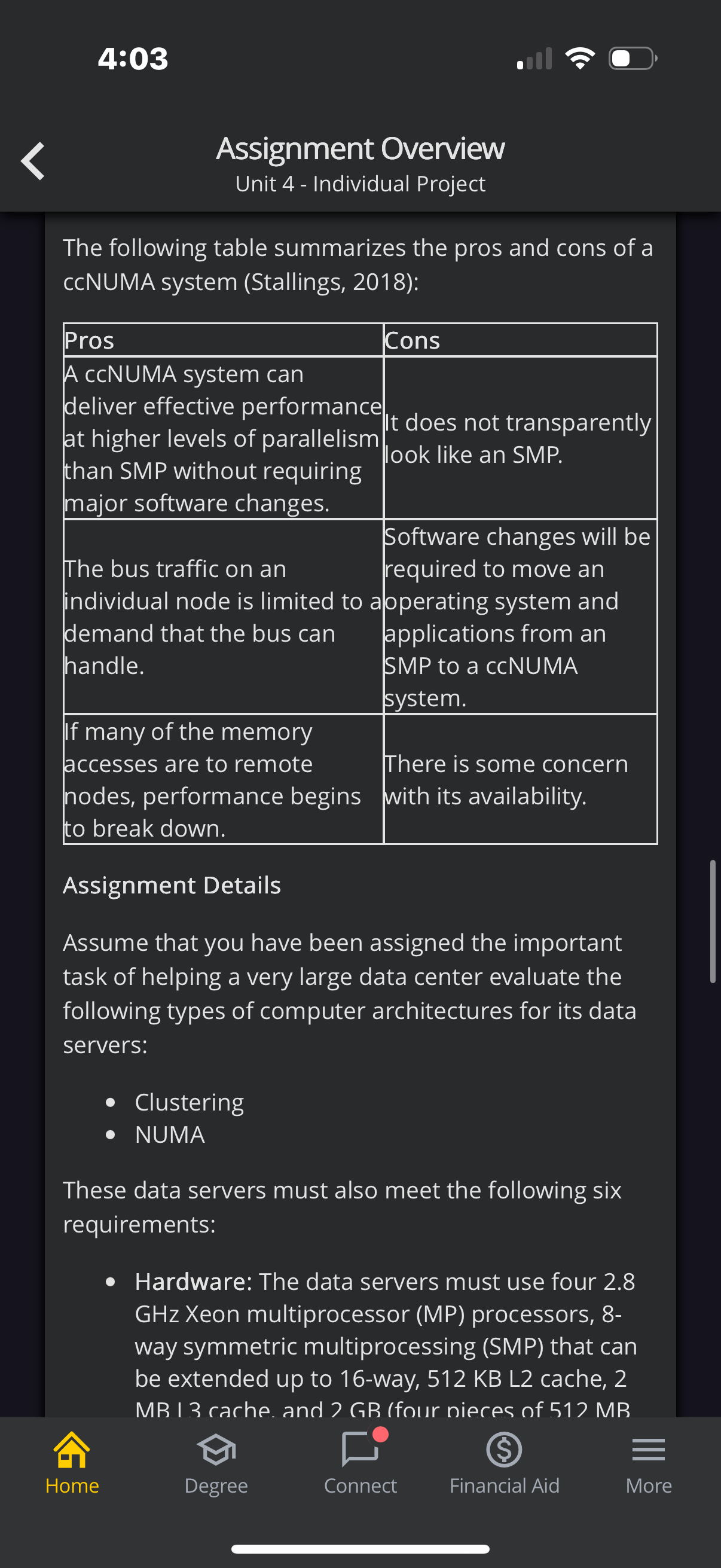
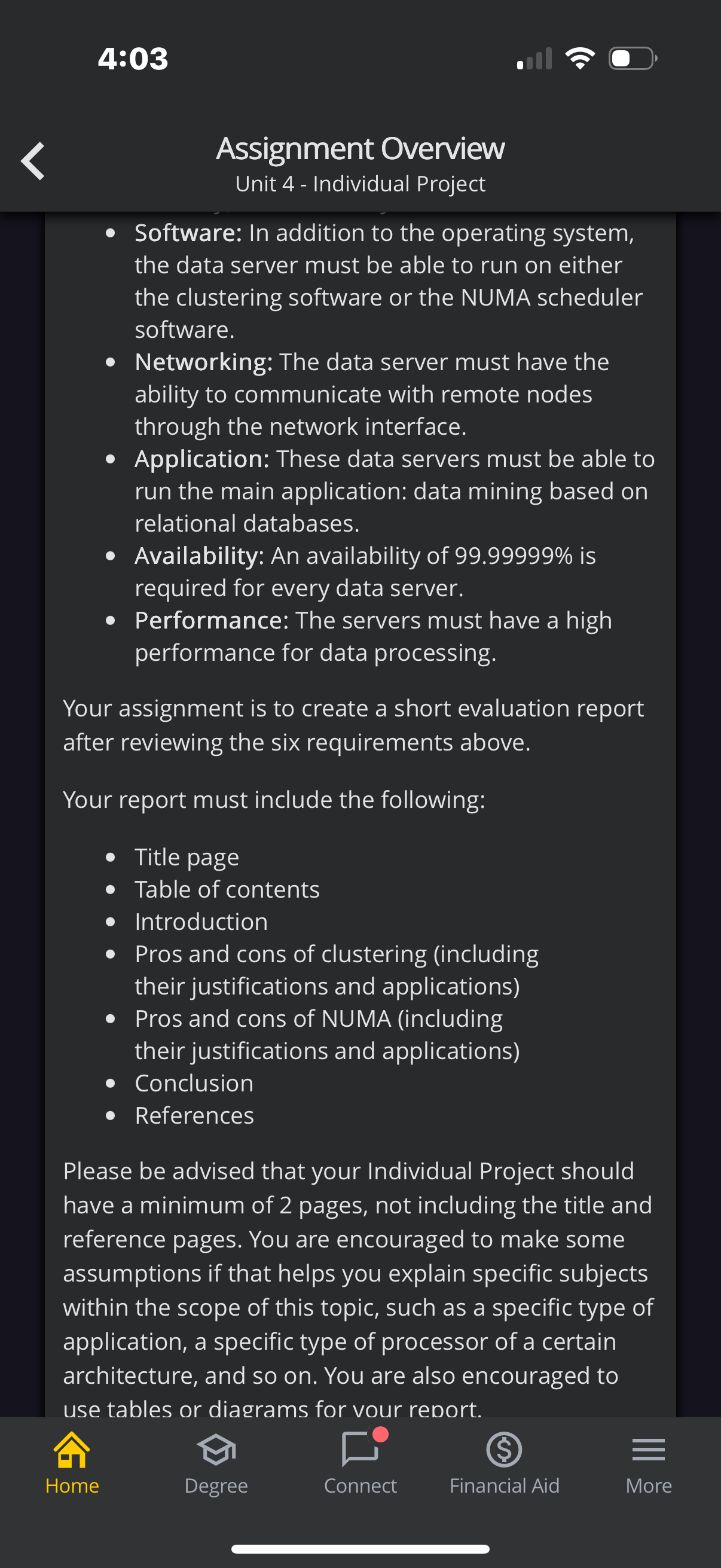
Assignment Overview Unit 4 - Individual Project ASSIGNMENT DESCRIPTION Deliverable Length: 2 pages OBJECTIVES As indicated by its title, Unit 4 focuses on high- performance computer architectures. Unit 4 covers four topics, as follows: Reduced instruction set computers (RISCs) Flynn's taxonomy: Multiprocessing and parallel processing computer architectures Clusters and clustering methods Non-uniform memory access (NUMA) Because the first two topics were already covered by the previous Discussion Board assignment, this Individual Project assignment focuses mainly on the last two topics: clusters and clustering methods and NUMA. To assist you in completing this assignment, please first read through each of the sections below. Clusters and Clustering Methods Clustering involves connecting multiple computers together in a network in a way that makes them behave like a single computer. This is another cost- effective approach for providing high performance. A cluster can often be built by simply using existing computers and workstations. To extend a cluster, you can simply add another computer to the network. Clustering is used to achieve parallel processing, load balancing, and fault tolerance. Computer clusters can be classified into three main 2) 1S) = S) Home DY ereanero Connect Financial Aid Assignment Overview Unit 4 - Individual Project NUMA. To assist you in completing this assignment, please first read through each of the sections below. Clusters and Clustering Methods Clustering involves connecting multiple computers together in a network in a way that makes them behave like a single computer. This is another cost- effective approach for providing high performance. A cluster can often be built by simply using existing computers and workstations. To extend a cluster, you can simply add another computer to the network. Clustering is used to achieve parallel processing, load balancing, and fault tolerance. Computer clusters can be classified into three main types, as follows (UKEssays, 2018): e High-performance clusters e High-availability clusters e Load-balancing clusters The most common and well-known benefits of clustering are as follows: Cost efficiency Incremental scalability High availability Fast processing speed The following diagram shows two types of cluster configurations (Stallings, 2018): Connect Financial Aid 4:03 Assignment Overview Unit 4 - Individual Project There are five clustering methods, and the following table provides the description, benefits, and limitations of each clustering method (Stallings, 2018): Clustering Method Description Benefits Limitations Passive Standby A secondary server takes Easy to implement. High cost because the over in case of primary secondary server is server failure. unavailable for other processing tasks. Active Secondary: The secondary server is Reduced cost because Increased complexity. also used for processing secondary servers can tasks be used for processing. Separate Servers Separate servers have High availability. High network and server their own disks. Data overhead due to copying is continuously copied operations. from primary to secondary server. Servers Connected to Servers are cabled to Reduced network and Usually requires disk Disks the same disks, but each server overhead due to mirroring or RAID server owns its disks. If elimination of copying technology to one server fails, its disks operations. compensate are taken over by the for risk of disk failure. other server. Servers Share Disks Multiple servers simul- Low network and server Requires lock manager laneously share access overhead. Reduced risk software. Usually used to disks. of downtime caused by with disk mirroring or disk failure. RAID technology. Non-Uniform Memory Access Non-uniform memory access is a type of computer architecture that is often used in a symmetric multiprocessing (SMP) system. There are three main features associated with NUMA, as follows: . It consists of a cluster of processors, and each processor has its own local cache memory that has direct access to the main memory through a commonly shared data communication bus. $ Home Degree Connect Financial Aid MoreAssignment Overview Unit 4 - Individual Project INVIEIDUETEUETTE NICHOL Y FALL O SS Non-uniform memory access is a type of computer architecture that is often used in a symmetric multiprocessing (SMP) system. There are three main features associated with NUMA, as follows: e It consists of a cluster of processors, and each processor has its own local cache memory that has direct access to the main memory through a commonly shared data communication bus. Each processor's local cache memory can be accessed by all of the other processors within the same cluster through the same commonly shared data communication bus. e The time and speed for each processor to access another processor's local cache memory and the main memory are different to avoid conflict when using a commonly shared data communication bus. Any application (e.g., a data mining or decision support system) can be partitioned into multiple tasks so that they can be concurrently processed by multiple processors and share a common database. Thus, a NUMA system is a good fit. Read this article on to learn more about why a NUMA system is a good fit. One type of NUMA is a cache-coherent NUMA (cCNUMA), which is a NUMA system \"in which cache coherence is maintained among the caches of various processors\" (Stallings, 2018). The following diagram shows a cCNUMA organization (Stallings, 2018): B = S) DY ereanero Connect Financial Aid 4:03 K Assignment Overview Unit 4 - Individual Project Processor Processor 1-1 1-m L1 Cache L1 Cache L2 Cache L2 Cache Directory VO Main Memory 1 Processor Processor 2-1 2-m L1 Cache L1 Cache Interconnect Network L2 Cache L2 Cache Directory V/O Main Memory 2 Processor Processor N-1 N-m L1 Cache L1 Cache L2 Cache L2 Cache VO Directory Main Memory N $ Home Degree Connect Financial Aid More4:03 Assignment Overview Unit 4 - Individual Project The following table summarizes the pros and cons of a CCNUMA system (Stallings, 2018): Pros Cons A CCNUMA system can deliver effective performance at higher levels of parallelism It does not transparently ook like an SMP. than SMP without requiring major software changes. Software changes will be The bus traffic on an equired to move an individual node is limited to aoperating system and demand that the bus can applications from an handle. SMP to a ccNUMA system. If many of the memory accesses are to remote There is some concern nodes, performance begins with its availability. to break down. Assignment Details Assume that you have been assigned the important task of helping a very large data center evaluate the following types of computer architectures for its data servers: . Clustering . NUMA These data servers must also meet the following six requirements: . Hardware: The data servers must use four 2.8 GHz Xeon multiprocessor (MP) processors, 8- way symmetric multiprocessing (SMP) that can be extended up to 16-way, 512 KB L2 cache, 2 MR 1 3 cache. and 2 GB (four pieces of 512 MR Home Degree Connect Financial Aid More4:03 K Assignment Overview Unit 4 - Individual Project . Software: In addition to the operating system, the data server must be able to run on either the clustering software or the NUMA scheduler software. Networking: The data server must have the ability to communicate with remote nodes through the network interface. . Application: These data servers must be able to run the main application: data mining based on relational databases. . Availability: An availability of 99.99999% is required for every data server. Performance: The servers must have a high performance for data processing. Your assignment is to create a short evaluation report after reviewing the six requirements above. Your report must include the following: Title page Table of contents . Introduction . Pros and cons of clustering (including their justifications and applications) . Pros and cons of NUMA (including their justifications and applications) Conclusion . References Please be advised that your Individual Project should have a minimum of 2 pages, not including the title and reference pages. You are encouraged to make some assumptions if that helps you explain specific subjects within the scope of this topic, such as a specific type of application, a specific type of processor of a certain architecture, and so on. You are also encouraged to use tables or diagrams for vour report. Home Degree Connect Financial Aid More
Step by Step Solution
There are 3 Steps involved in it
1 Expert Approved Answer
Step: 1 Unlock
Question Has Been Solved by an Expert!
Get step-by-step solutions from verified subject matter experts
Step: 2 Unlock
Step: 3 Unlock
Students Have Also Explored These Related Accounting Questions!









 Study Help