Question: Assignment Question(s): Please refer to the case study titled Planned Change at The San Diego County Regional Airport Authority given on Page number 31, Chapter
Assignment Question(s):
Please refer to the case study titled Planned Change at The San Diego County Regional Airport Authority given on Page number 31, Chapter 2 in your textbook and answer the following questions:
- Critically discuss the organizational development process at San Diego Airport and describe its stages. (3 marks)
- Which model of planned change has been used in the case of San Diego airport from your point of view? If you were the person in charge, which model of change would you choose? and why? (3 marks)
- Discuss the main challenges faced by the transition team during the planning and implementation phases. (2 marks)
- Discuss the key success factors that played a major role in accomplishing the task in your opinion. (2 marks)
- Discuss the impact of the change on the overall performance of the Airport. (2 marks)
- Critically evaluate the change process and if you were the consultant what would you have done differently? (3 marks)
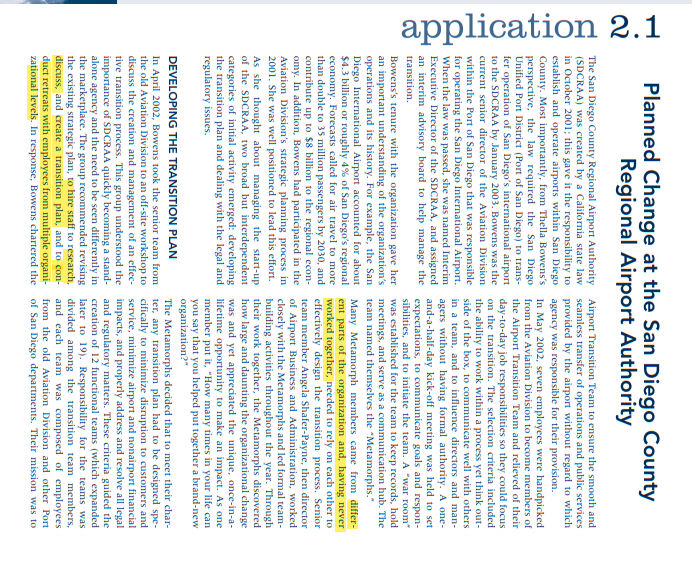
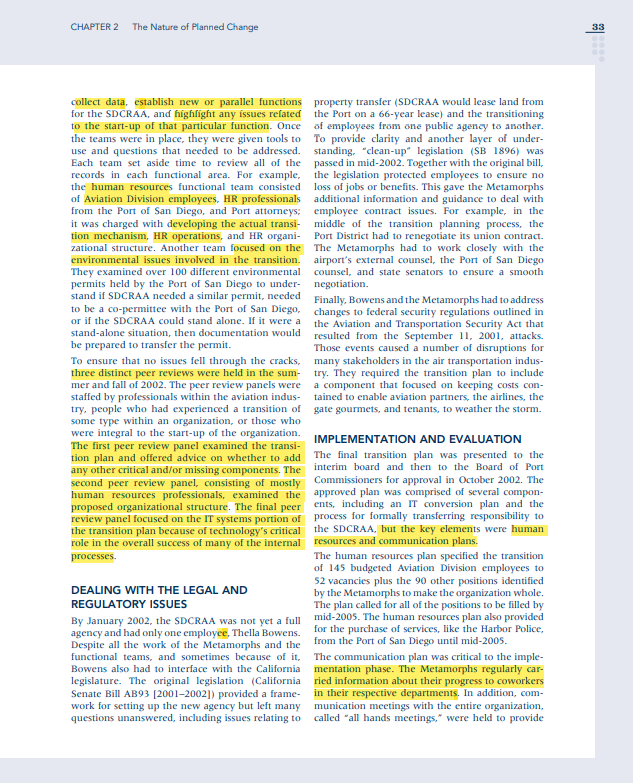
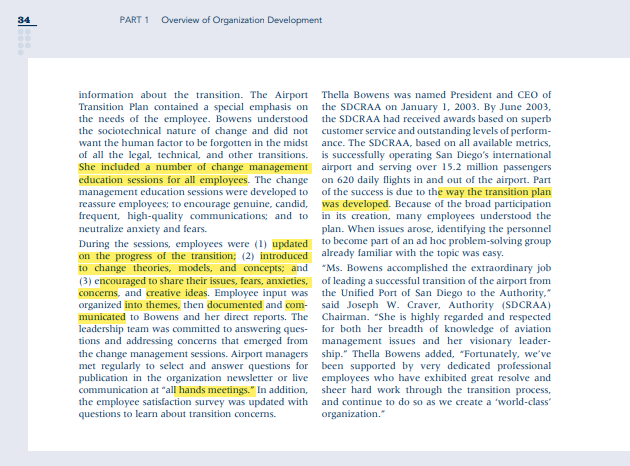
Planned Change at the San Diego County Regional Airport Authority The San Diego County Regional Airport Authority Airport Transition Team to ensure the smooth and (SDCRAA) was created by a California state law seamless transfer of operations and public services in October 2001; this gave it the responsibility to provided by the airport without regard to which establish and operate airports within San Diego agency was responsible for their provision. County. Most importantly, from Thella Bowens's In May 2002, seven employees were handpicked perspective, the law required the San Diego from the Aviation Division to become members of Unified Port District (Port of San Diego) to trans- the Airport Transition Team and relieved of their fer operation of San Diego's international airport day-to-day job responsibilities so they could focus to the SDCRAA by January 2003. Bowens was the on the transition. The selection criteria included current senior director of the Aviation Division on the transition. The selection criteria included within the Port of San Diego that was responsible side of the box, to communicate well with others for operating the San Diego International Airport. in a team, and to influence directors and manAs she thought about managing the start-up their work together, the Metamorphs discovered of the SDCRAA, two broad but interdenendent how large and daunting the organizational change categories of initial activity emerged: developing was and yet appreciated the unique, once-in-athe transition plan and dealing with the legal and lifetime opportunity to make an impact. As one regulatory issues. member put it, "How many times in your life can you say that you helped put together a brand-new organization?" DEVELOPINGTHETRANSITIONPLANInApril2002,Bowenstooktheseniorteamfromter,anytransitionplanhadtobedesignedspe-TheMetamorphsdecidedthattomeettheirchar- the old Aviation Division to an off-site workshop to cifically to minimize disruption to customers and discuss the creation and management of an effec- service, minimize airport and nonairport financial tive transition process. This group understood the impacts, and properly address and resolve all legal importance of SDCRAA quickly becoming a stand- and regulatory matters. These criteria guided the alone agency and the need to be seen differently in creation of 12 functional teams (which expanded the marketplace. The group recommended revising later to 19). Responsibility for the teams was the existing strategic plan, to hire staff to research, divided among the transition team members, duct retreats with employees from multiple organi- from the old Aviation Division and other Port zational levels. In response, Bowens chartered the of San Diego departments. Their mission was to collect data, establish new or parallel functions property transfer (SDCRAA would lease land from for the SDCRAA, and highfight any issues refated the Port on a 66-year lease) and the transitioning to the start-up of that particular function. Once of employees from one public agency to anther. the teams were in place, they were given tools to To provide clarity and another layer of underuse and questions that needed to be addressed. standing. "clean-up" legislation (SB 1896) was Each team set aside time to review all of the passed in mid-2002. Together with the original bill, records in each functional area. For example, the legislation protected employees to ensure no of Aviation Division employees. HR professionals additional information and guidance to deal with from the Port of San Diego, and Port attorneys: employee contract issues. For example, in the it was charged with developing the actual transi- middle of the transition planning process, the tion mechanism, HR operations, and HR organi- Port District had to renegotiate its union contract. zational structure. Another team focused on the The Metamorphs had to work closely with the environmental issues involved in the transition. airport's external counsel, the Port of San Diego They examined over 100 different environmental counsel, and state senators to ensure a smooth permits held by the Port of San Diego to under- negotiation. stand if SDCRAA needed a similar permit, needed Finally, Bowens and the Metamorphs had to address to be a co-permittee with the Port of San Diego, changes to federal security regulations outlined in or if the SDCRAA could stand alone. If it were a the Aviation and Transportation Security Act that bepreparedtotransferthepermit.ToentscausedanumberofdisruptionsforThesultedfromtheSeptember11,2001,attacks. To ensure that no issues fell through the cracks, many stakeholders in the air transportation industhree distinct peer reviews were held in the sum- try. They required the transition plan to include mer and fall of 2002. The peer review panels were a component that focused on keeping costs constaffed by professionals within the aviation indus- tained to enable aviation partners, the airlines, the try, people who had experienced a transition of gate gourmets, and tenants, to weather the storm. some type within an organization, or those who were integral to the start-up of the organization. The first peer review panel examined the transi- tion plan and offered advice on whether to add The final transition plan was presented to the any other critical and/or missing components. The interim board and then to the Board of Port second peer review panel, consisting of mostly Commissioners for approval in October 2002. The human resources professionals, examined the approved plan was comprised of several componhuman resources professionals, examined the approved plan was comprised of several compon- proposed organizational structure. The final peer ents, including an IT conversion plan and the review panel focused on the IT systems portion of process for formally transferring responsibility to the transition plan because of technology's critical the SDCRAA, but the key elements were human role in the overall success of many of the internal The human resources plan specified the transition of 145 budgeted Aviation Division employees to 52 vacancies plus the 90 other positions identified DEALINGWITHTHELEGALANDREGULATORYISSUESByJanuary2002,theSDCRAAwasnotyetafullforthepurchaseofservices,liketheHarborPolice,bytheMetamorphstomaketheorganizationwhole.Theplancalledforallofthepositionstobefilledbymid-2005.Thehumanresourcesplanalsoprovided agency and had only one employee, Thella Bowens. for the purchase of services, like the Harbor Police, functional teams, and sometimes because of it, The communication plan was critical to the impleBowens also had to interface with the California mentation phase. The Metamorphs regularly carlegislature. The original legislation (California ried information about their progress to coworkers Senate Bill AB93 [2001-2002]) provided a frame- in their respective departments. In addition, comwork for setting up the new agency but left many munication meetings with the entire organization, questions unanswered, including issues relating to called "all hands meetings," were held to provide information about the transition. The Airport Thella Bowens was named President and CEO of Transition Plan contained a special emphasis on the SDCRAA on January 1, 2003. By June 2003, the needs of the employee. Bowens understood the SDCRAA had received awards based on superb the sociotechnical nature of change and did not customerservice and outstanding levels of performwant the human factor to be forgotten in the midst ance. The SDCRAA, based on all available metrics, of all the legal, technical, and other transitions. is successfully operating San Diego's international She included a number of change management airport and serving over 15.2 million passengers education sessions for all employees. The change on 620 daily flights in and out of the airport. Part management education sessions were developed to of the success is due to the way the transition plan frequent, high-quality communications; and to in its creation, many employees understood the neutralize anxiety and fears. (tan. When issues arose, identifying the personnel During the sessions, employees were (1) updated to become part of an ad hoc problem-solving group on the progress of the transition; (2) introduced already familiar with the topic was easy. to change theories, models, and concepts; and "Ms. Bowens accomplished the extraordinary job (3) encouraged to share their issues, fears, anxieties, of leading a successful transition of the airport from concerns, and creative ideas. Employee input was the Unified Port of San Diego to the Authority, organized into themes, then documented and com- said Joseph W. Craver, Authority (SDCRAA) municated to Bowens and her direct reports. The Chairman. "She is highly regarded and respected leadership team was committed to answering ques- for both her breadth of knowledge of aviation tions and addressing concerns that emerged from management issues and her visionary leaderthe change management sessions. Airport managers ship." Thella Bowens added, "Fortunately, we've met regularly to select and answer questions for been supported by very dedicated professional publication in the organization newsletter or live employees who have exhibited great resolve and communication at "all hands meetings." In addition, sheer hard work through the transition process, the employee satisfaction survey was updated with and continue to do so as we create a 'world-class' questions to learn about transition concerns









 Study Help