







Question: Assignment - Time value of Money 2. Simple versus compound interest Financial contracts involving investments, mortgages, loans, and so on are based on either a
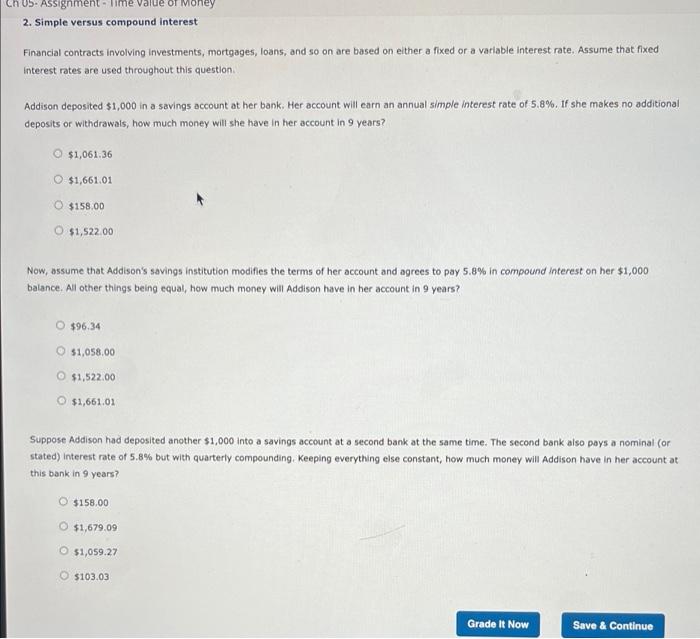
Assignment - Time value of Money 2. Simple versus compound interest Financial contracts involving investments, mortgages, loans, and so on are based on either a fixed or a variable interest rate. Assume that fixed interest rates are used throughout this question. Addison deposited $1,000 in a savings account at her bank. Her account will earn an annual simple interest rate of 5.8%. If she makes no additional deposits or withdrawals, how much money will she have in her account in 9 years? $1,061.36 $1,661.01 O $158.00 O $1,522.00 Now, assume that Addison's savings institution modifies the terms of her account and agrees pay 5.8% in compound interest on her $1,000 balance. All other things being equal, how much money will Addison have in her account in 9 years? O $96.34 $1,058.00 O $1,522.00 O $1,661.01 Suppose Addison had deposited another $1,000 into a savings account at a second bank at the same time. The second bank also pays a nominal (or stated) interest rate of 5.8% but with quarterly compounding. Keeping everything else constant, how much money will Addison have in her account at this bank in 9 years? O $158.00 Grade It Now Save & Continue $1,679.09 $1,059.27 $103.03
Step by Step Solution
There are 3 Steps involved in it

Get step-by-step solutions from verified subject matter experts
 Study Help