Question: Assignment - to be submitted on 26 February 2027 Case Study- Waste Management in Ghana Ghana has been battling with domestic and industrial waste for
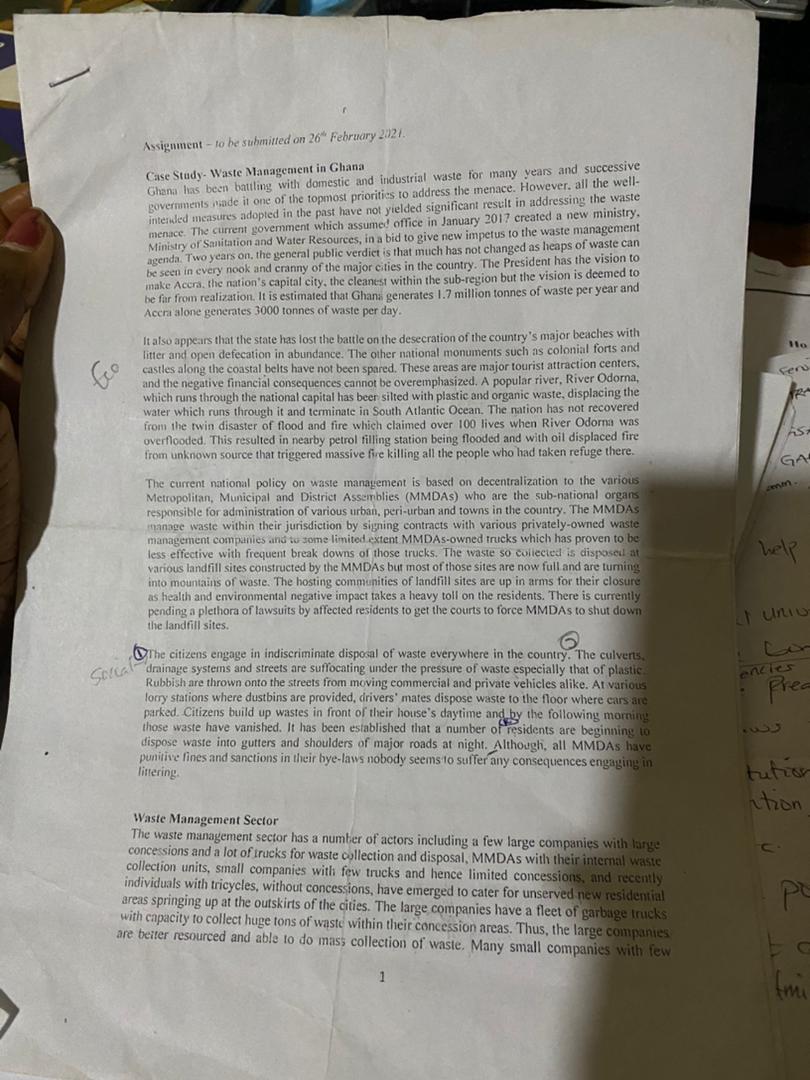
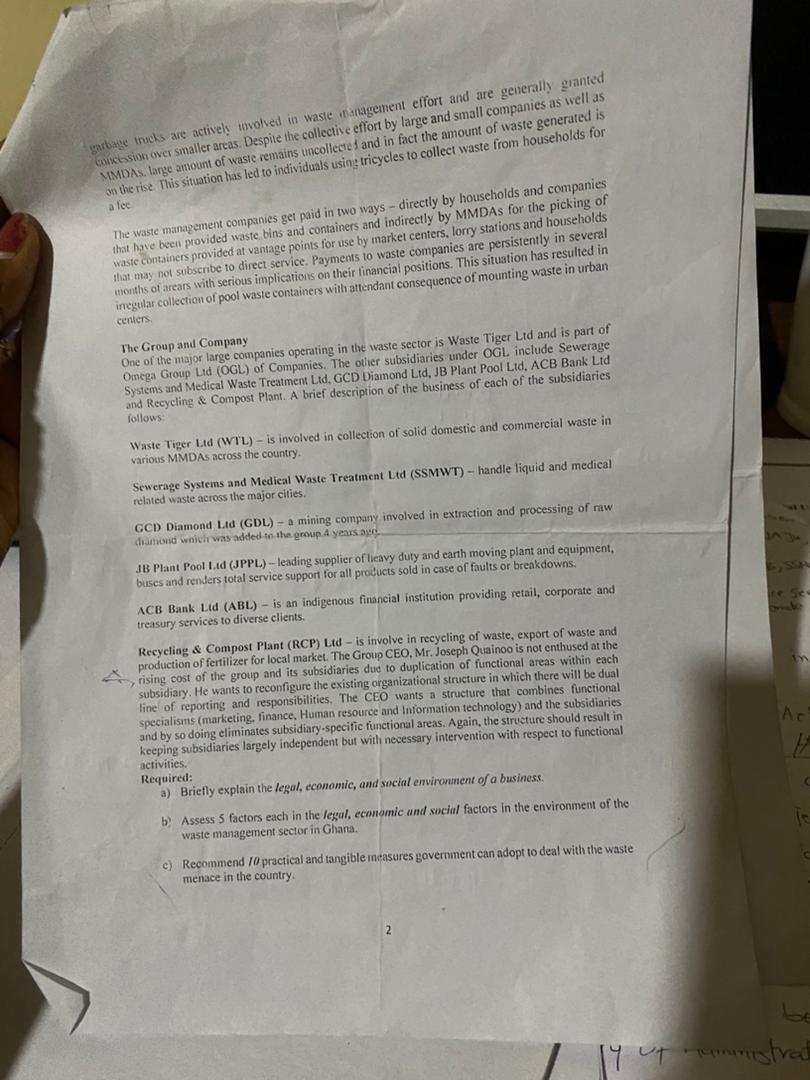
Assignment - to be submitted on 26 February 2027 Case Study- Waste Management in Ghana Ghana has been battling with domestic and industrial waste for many years and successive governments iade it one of the topmost priorities to address the menace. However, all the well- internded measures adopted in the past have not yielded significant result in addressing the waste menace. The current goverment which assumed office in January 2017 created a new ministry, Ministry of Sanitation and Water Resources, in a bid to give new impetus to the waste management agenda. Two years on the general public verdict is that much has not changed as heaps of waste can be seen in every nook and cranny of the major cities in the country. The President has the vision to make Accra, the nation's capital city, the cleanest within the sub-region but the vision is deemed to be far from realization. It is estimated that Ghana generates 1.7 million tonnes of waste per year and Accra alone generates 3000 tonnes of waste per day. Ilo AS GA It also appears that the state has lost the battle on the desecration of the country's major beaches with litter and open defecation in abundance. The other national monuments such as colonial forts and castles along the coastal belts have not been spared. These areas are major tourist attraction centers, and the negative financial consequences cannot be overemphasized. A popular river, River Odorna, which runs through the national capital has beer silted with plastic and organic waste, displacing the water which runs through it and terminate in South Atlantic Ocean. The nation has not recovered from the twin disaster of flood and fire which claimed over 100 lives when River Odorna was overflooded. This resulted in nearby petrol filling station being flooded and with oil displaced fire from unknown source that triggered massive fire killing all the people who had taken refuge there. The current national policy on waste management is based on decentralization to the various Metropolitan Municipal and District Assemblies (MMDA) who are the sub-national organs responsible for administration of various urban, peri-urban and towns in the country. The MMDAS manage waste within their jurisdiction by signing contracts with various privately-owned waste management companies and to some limited extent MMDA5-owned trucks which has proven to be less effective with frequent break downs of those trucks. The waste so collected is disposeul at various landfill sites constructed by the MMDAs but most of those sites are now full and are turning into mountains of waste. The hosting communities of landfill sites are up in arms for their closure as health and environmental negative impact takes a heavy toll on the residents. There is currently pending a plethora of lawsuits by affected residents to get the courts to force MMDAs to shut down the landfill sites. Auriu encies Prea The citizens engage in indiscriminate disposal of waste everywhere in the country. The culverts. SNC drainage systems and streets are suffocating under the pressure of waste especially that of plastic Rubbish are thrown onto the streets from moving commercial and private vehicles alike. At various lorry stations where dustbins are provided, drivers' mates dispose waste to the floor where cars are parked. Citizens build up wastes in front of their house's daytime and by the following morning those waste have vanished. It has been established that a number of residents are beginning to dispose waste into gutters and shoulders of major roads at night. Although, all MMDAs have punitive fines and sanctions in their bye-laws nobody seems to suffer any consequences engaging in littering tution nition Waste Management Sector The waste management sector has a number of actors including a few large companies with large concessions and a lot of trucks for waste collection and disposal, MMDAs with their internal waste collection units, small companies with few trucks and hence limited concessions, and recently individuals with tricycles, without concessions, have emerged to cater for unserved new residential areas springing up at the outskirts of the cities. The large companies have a fleet of garbage trucks with capacity to collect huge tons of waste within their concession areas. Thus, the large companies are beiter resourced and able to do mass collection of waste. Many small companies with few po Ami garbage trucks are actively involved in waste management effort and are generally granted Concession over smaller areas. Despite the collective effort by large and small companies as well as MMDAs large amount of waste remains uncollected and in fact the amount of waste generated is on the rise. This situation has led to individuals using tricycles to collect waste from households for alec The waste management companies get paid in two ways - directly by households and companies that have been provided waste bins and containers and indirectly by MMDAs for the picking of waste containers provided at vantage points for use by market centers, lorry stations and households that may not subscribe to direct service. Payments to waste companies are persistently in several months of arears with serious implications on their financial positions. This situation has resulted in irregular collection of pool waste containers with attendant consequence of mounting waste in urban centers The Group and Company One of the major large companies operating in the waste sector is Waste Tiger Lid and is part of Omega Group Ltd (OGL) of Companies. The other subsidiaries under OGL include Sewerage Systems and Medical Waste Treatment Ltd, GCD Diamond Ltd, JB Plant Pool Ltd. ACB Bank Ltd and Recycling & Compost Plant. A brief description of the business of each of the subsidiaries follows Waste Tiger Ltd (WIL) - is involved in collection of solid domestic and commercial waste in various MMDAs across the country. Sewerage Systems and Medical Waste Treatment Ltd (SSMWT) - handle liquid and medical related waste across the major cities GCD Diamond Ltd (GDL) - a mining company involved in extraction and processing of raw diamond which was added to the group 4 years ago JB Plant Pool Ltd (JPPL) - leading supplier of leavy duty and earth moving plant and equipment, buses and renders total service support for all products sold in case of faults or breakdowns. ACB Bank Ltd (ABL) - is an indigenous financial institution providing retail, corporate and treasury services to diverse clients. A Recycling & Compost Plant (RCP) Ltd - is involve in recycling of waste, export of waste and production of fertilizer for local market. The Group CEO, Mr. Joseph Quainoo is not enthused at the rising cost of the group and its subsidiaries due to duplication of functional areas within each subsidiary. He wants to reconfigure the existing organizational structure in which there will be dual line of reporting and responsibilities. The CEO wants a structure that combines functional specialisans (marketing, finance, Human resource and Information technology) and the subsidiaries and by so doing eliminates subsidiary-specific functional areas. Again, the structure should result in keeping subsidiaries largely independent but with necessary intervention with respect to functional activities Required: a) Briefly explain the legal, economic and social environment of a business, b) Assess 5 factors each in the legal, economic and social factors in the environment of the waste management sector in Ghana. c) Recommend 10 practical and tangible measures government can adopt to deal with the waste menace in the country, 2 - ustral Assignment - to be submitted on 26 February 2027 Case Study- Waste Management in Ghana Ghana has been battling with domestic and industrial waste for many years and successive governments iade it one of the topmost priorities to address the menace. However, all the well- internded measures adopted in the past have not yielded significant result in addressing the waste menace. The current goverment which assumed office in January 2017 created a new ministry, Ministry of Sanitation and Water Resources, in a bid to give new impetus to the waste management agenda. Two years on the general public verdict is that much has not changed as heaps of waste can be seen in every nook and cranny of the major cities in the country. The President has the vision to make Accra, the nation's capital city, the cleanest within the sub-region but the vision is deemed to be far from realization. It is estimated that Ghana generates 1.7 million tonnes of waste per year and Accra alone generates 3000 tonnes of waste per day. Ilo AS GA It also appears that the state has lost the battle on the desecration of the country's major beaches with litter and open defecation in abundance. The other national monuments such as colonial forts and castles along the coastal belts have not been spared. These areas are major tourist attraction centers, and the negative financial consequences cannot be overemphasized. A popular river, River Odorna, which runs through the national capital has beer silted with plastic and organic waste, displacing the water which runs through it and terminate in South Atlantic Ocean. The nation has not recovered from the twin disaster of flood and fire which claimed over 100 lives when River Odorna was overflooded. This resulted in nearby petrol filling station being flooded and with oil displaced fire from unknown source that triggered massive fire killing all the people who had taken refuge there. The current national policy on waste management is based on decentralization to the various Metropolitan Municipal and District Assemblies (MMDA) who are the sub-national organs responsible for administration of various urban, peri-urban and towns in the country. The MMDAS manage waste within their jurisdiction by signing contracts with various privately-owned waste management companies and to some limited extent MMDA5-owned trucks which has proven to be less effective with frequent break downs of those trucks. The waste so collected is disposeul at various landfill sites constructed by the MMDAs but most of those sites are now full and are turning into mountains of waste. The hosting communities of landfill sites are up in arms for their closure as health and environmental negative impact takes a heavy toll on the residents. There is currently pending a plethora of lawsuits by affected residents to get the courts to force MMDAs to shut down the landfill sites. Auriu encies Prea The citizens engage in indiscriminate disposal of waste everywhere in the country. The culverts. SNC drainage systems and streets are suffocating under the pressure of waste especially that of plastic Rubbish are thrown onto the streets from moving commercial and private vehicles alike. At various lorry stations where dustbins are provided, drivers' mates dispose waste to the floor where cars are parked. Citizens build up wastes in front of their house's daytime and by the following morning those waste have vanished. It has been established that a number of residents are beginning to dispose waste into gutters and shoulders of major roads at night. Although, all MMDAs have punitive fines and sanctions in their bye-laws nobody seems to suffer any consequences engaging in littering tution nition Waste Management Sector The waste management sector has a number of actors including a few large companies with large concessions and a lot of trucks for waste collection and disposal, MMDAs with their internal waste collection units, small companies with few trucks and hence limited concessions, and recently individuals with tricycles, without concessions, have emerged to cater for unserved new residential areas springing up at the outskirts of the cities. The large companies have a fleet of garbage trucks with capacity to collect huge tons of waste within their concession areas. Thus, the large companies are beiter resourced and able to do mass collection of waste. Many small companies with few po Ami garbage trucks are actively involved in waste management effort and are generally granted Concession over smaller areas. Despite the collective effort by large and small companies as well as MMDAs large amount of waste remains uncollected and in fact the amount of waste generated is on the rise. This situation has led to individuals using tricycles to collect waste from households for alec The waste management companies get paid in two ways - directly by households and companies that have been provided waste bins and containers and indirectly by MMDAs for the picking of waste containers provided at vantage points for use by market centers, lorry stations and households that may not subscribe to direct service. Payments to waste companies are persistently in several months of arears with serious implications on their financial positions. This situation has resulted in irregular collection of pool waste containers with attendant consequence of mounting waste in urban centers The Group and Company One of the major large companies operating in the waste sector is Waste Tiger Lid and is part of Omega Group Ltd (OGL) of Companies. The other subsidiaries under OGL include Sewerage Systems and Medical Waste Treatment Ltd, GCD Diamond Ltd, JB Plant Pool Ltd. ACB Bank Ltd and Recycling & Compost Plant. A brief description of the business of each of the subsidiaries follows Waste Tiger Ltd (WIL) - is involved in collection of solid domestic and commercial waste in various MMDAs across the country. Sewerage Systems and Medical Waste Treatment Ltd (SSMWT) - handle liquid and medical related waste across the major cities GCD Diamond Ltd (GDL) - a mining company involved in extraction and processing of raw diamond which was added to the group 4 years ago JB Plant Pool Ltd (JPPL) - leading supplier of leavy duty and earth moving plant and equipment, buses and renders total service support for all products sold in case of faults or breakdowns. ACB Bank Ltd (ABL) - is an indigenous financial institution providing retail, corporate and treasury services to diverse clients. A Recycling & Compost Plant (RCP) Ltd - is involve in recycling of waste, export of waste and production of fertilizer for local market. The Group CEO, Mr. Joseph Quainoo is not enthused at the rising cost of the group and its subsidiaries due to duplication of functional areas within each subsidiary. He wants to reconfigure the existing organizational structure in which there will be dual line of reporting and responsibilities. The CEO wants a structure that combines functional specialisans (marketing, finance, Human resource and Information technology) and the subsidiaries and by so doing eliminates subsidiary-specific functional areas. Again, the structure should result in keeping subsidiaries largely independent but with necessary intervention with respect to functional activities Required: a) Briefly explain the legal, economic and social environment of a business, b) Assess 5 factors each in the legal, economic and social factors in the environment of the waste management sector in Ghana. c) Recommend 10 practical and tangible measures government can adopt to deal with the waste menace in the country, 2 - ustral




