







Question: 1/2 5. The country of Economia has two industries. In the Clothing industry, the marginal product of labor is always 1. In the Steel
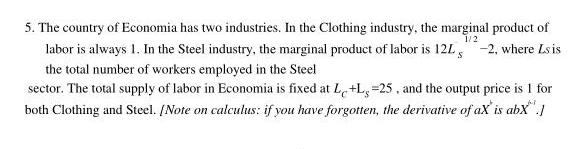
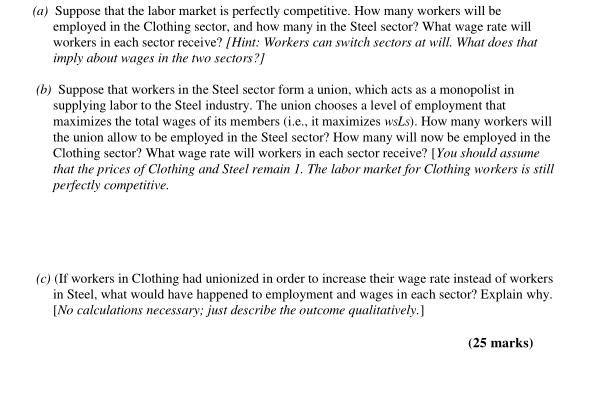
1/2 5. The country of Economia has two industries. In the Clothing industry, the marginal product of labor is always 1. In the Steel industry, the marginal product of labor is 12L -2, where Ls is the total number of workers employed in the Steel sector. The total supply of labor in Economia is fixed at L+L-25, and the output price is 1 for both Clothing and Steel. [Note on calculus: if you have forgotten, the derivative of ax is abX".] (a) Suppose that the labor market is perfectly competitive. How many workers will be employed in the Clothing sector, and how many in the Steel sector? What wage rate will workers in each sector receive? [Hint: Workers can switch sectors at will. What does that imply about wages in the two sectors?] (b) Suppose that workers in the Steel sector form a union, which acts as a monopolist in supplying labor to the Steel industry. The union chooses a level of employment that maximizes the total wages of its members (i.e., it maximizes wsLs). How many workers will the union allow to be employed in the Steel sector? How many will now be employed in the Clothing sector? What wage rate will workers in each sector receive? [You should assume that the prices of Clothing and Steel remain 1. The labor market for Clothing workers is still perfectly competitive. (c) (If workers in Clothing had unionized in order to increase their wage rate instead of workers in Steel, what would have happened to employment and wages in each sector? Explain why. [No calculations necessary; just describe the outcome qualitatively.] (25 marks)
Step by Step Solution
There are 3 Steps involved in it
192 b In competitive labor market in age both sectors That is ... View full answer

Get step-by-step solutions from verified subject matter experts
 Study Help