







Question: Assignment Write a MATLAB program that numerically solves the unsteady, two-dimensional Poiseuille flow for p-, v-1, dP/dx--8, and h with initial conditions (0,y)-0, and compare
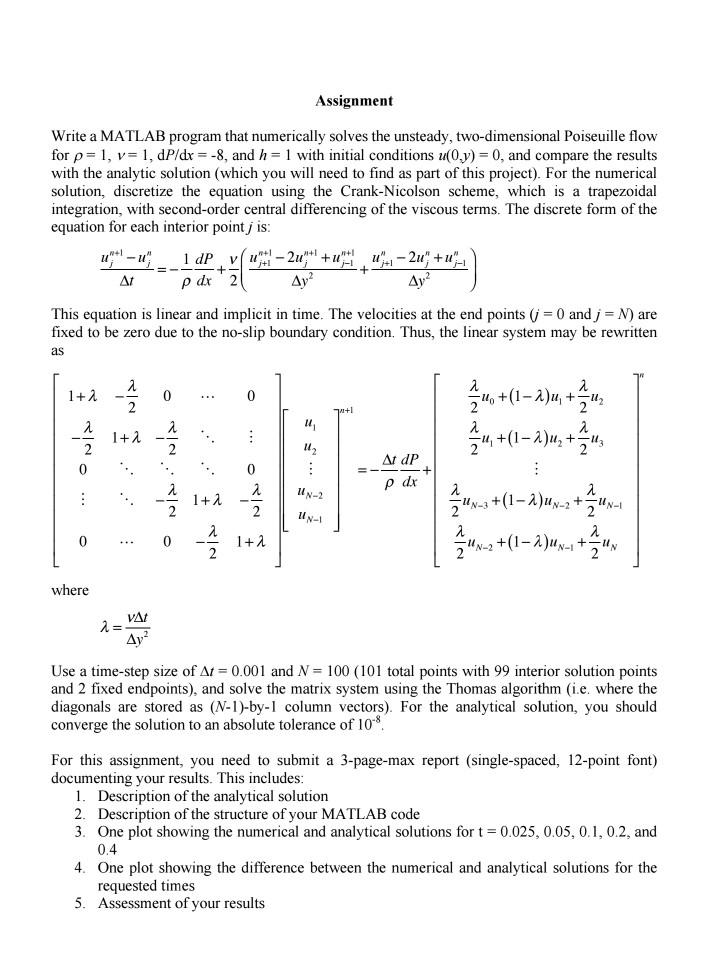
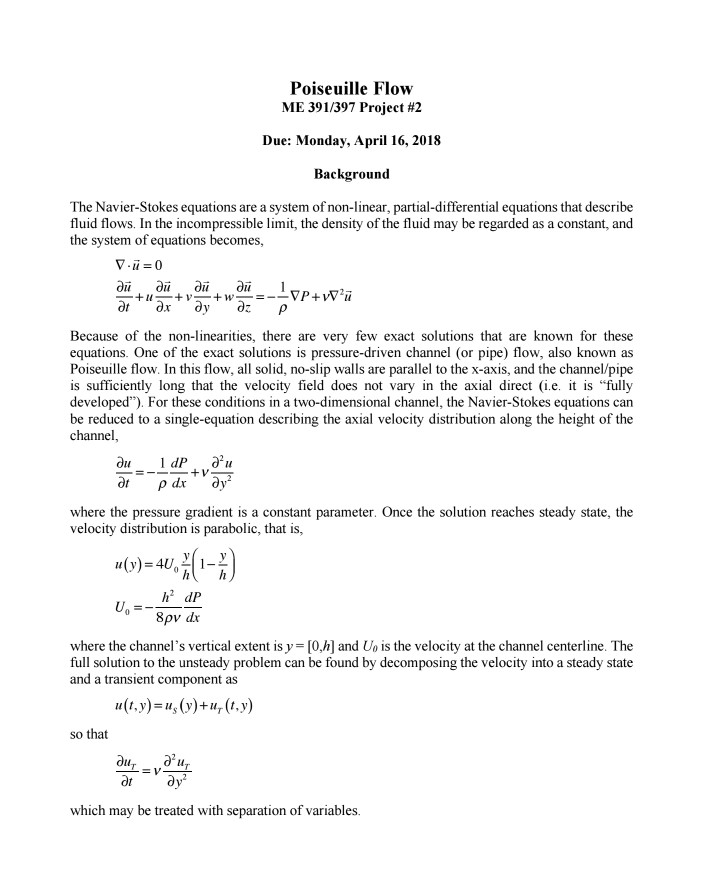
Assignment Write a MATLAB program that numerically solves the unsteady, two-dimensional Poiseuille flow for p-, v-1, dP/dx--8, and h with initial conditions (0,y)-0, and compare the results with the analytic solution (which you will need to find as part of this project). For the numerical solution, discretize the equation using the Crank-Nicolson scheme, which is a trapezoidal integration, with second-order central differencing of the viscous terms. The discrete form of the equation for each interior point j is At Ay This equation is linear and implicit in time. The velocities at the end points 0 and j N) are fixed to be zero due to the no-slip boundary condition. Thus, the linear system may be rewritten as 1104(1-2)111 +7"2 211 I +(1-2)112 +2113 At dP dx N-3 N-I N-I N-I where Use a time-step size of ?1-0.001 and N-100 (101 total points with 99 interior solution points and 2 fixed endpoints), and solve the matrix system using the Thomas algorithm i.e. where the diagonals are stored as (N-1)-by-1 column vectors). For the analytical solution, you should converge the solution to an absolute tolerance of 10 For this assignment, you need to submit a 3-page-max report (single-spaced, 12-point font) documenting your results. This includes 1. 2. 3. Description of the analytical solution Description of the structure of your MATLAB code One plot showing the numerical and analytical solutions for t 0.025, 0.05, 0.1, 0.2, and 0.4 4. One plot showing the difference between the numerical and analytical solutions for the requested times Assessment of your results 5. Assignment Write a MATLAB program that numerically solves the unsteady, two-dimensional Poiseuille flow for p-, v-1, dP/dx--8, and h with initial conditions (0,y)-0, and compare the results with the analytic solution (which you will need to find as part of this project). For the numerical solution, discretize the equation using the Crank-Nicolson scheme, which is a trapezoidal integration, with second-order central differencing of the viscous terms. The discrete form of the equation for each interior point j is At Ay This equation is linear and implicit in time. The velocities at the end points 0 and j N) are fixed to be zero due to the no-slip boundary condition. Thus, the linear system may be rewritten as 1104(1-2)111 +7"2 211 I +(1-2)112 +2113 At dP dx N-3 N-I N-I N-I where Use a time-step size of ?1-0.001 and N-100 (101 total points with 99 interior solution points and 2 fixed endpoints), and solve the matrix system using the Thomas algorithm i.e. where the diagonals are stored as (N-1)-by-1 column vectors). For the analytical solution, you should converge the solution to an absolute tolerance of 10 For this assignment, you need to submit a 3-page-max report (single-spaced, 12-point font) documenting your results. This includes 1. 2. 3. Description of the analytical solution Description of the structure of your MATLAB code One plot showing the numerical and analytical solutions for t 0.025, 0.05, 0.1, 0.2, and 0.4 4. One plot showing the difference between the numerical and analytical solutions for the requested times Assessment of your results 5
Step by Step Solution
There are 3 Steps involved in it

Get step-by-step solutions from verified subject matter experts
 Study Help