







Question: Assume a complex-valued and square (N x N) matrix H = (|1), (2), 13), . . ., [N) ). This corre- sponds to our Hamiltonian
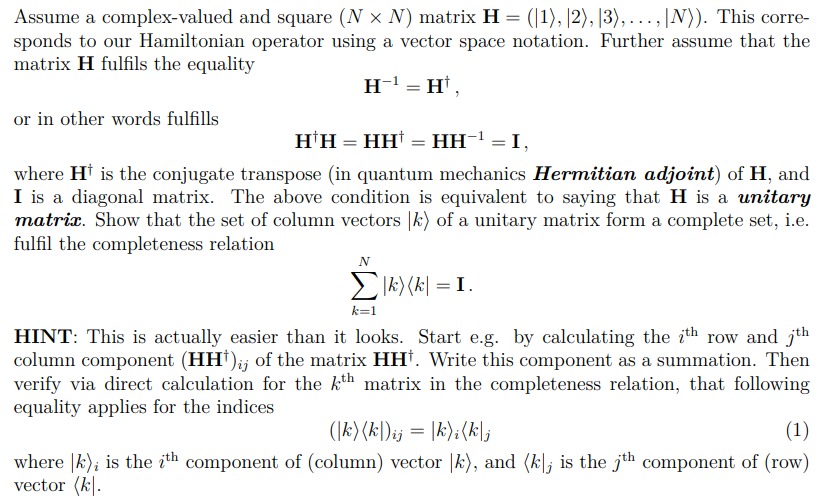
Assume a complex-valued and square (N x N) matrix H = (|1), (2), 13), . . ., [N) ). This corre- sponds to our Hamiltonian operator using a vector space notation. Further assume that the matrix H fulfils the equality H -1 = H, or in other words fulfills H H = HH = HH- = I, where H is the conjugate transpose (in quantum mechanics Hermitian adjoint) of H, and I is a diagonal matrix. The above condition is equivalent to saying that H is a unitary matrix. Show that the set of column vectors |k) of a unitary matrix form a complete set, i.e. fulfil the completeness relation N Elk) (K) = I. k =1 HINT: This is actually easier than it looks. Start e.g. by calculating the ith row and jth column component (HH );; of the matrix HH. Write this component as a summation. Then verify via direct calculation for the t matrix in the completeness relation, that following equality applies for the indices (1k) (kl)ij = 1k)ilkli (1) where k); is the it component of (column) vector |), and (k|; is the gth component of (row) vector (k)
Step by Step Solution
There are 3 Steps involved in it

Get step-by-step solutions from verified subject matter experts
 Study Help