







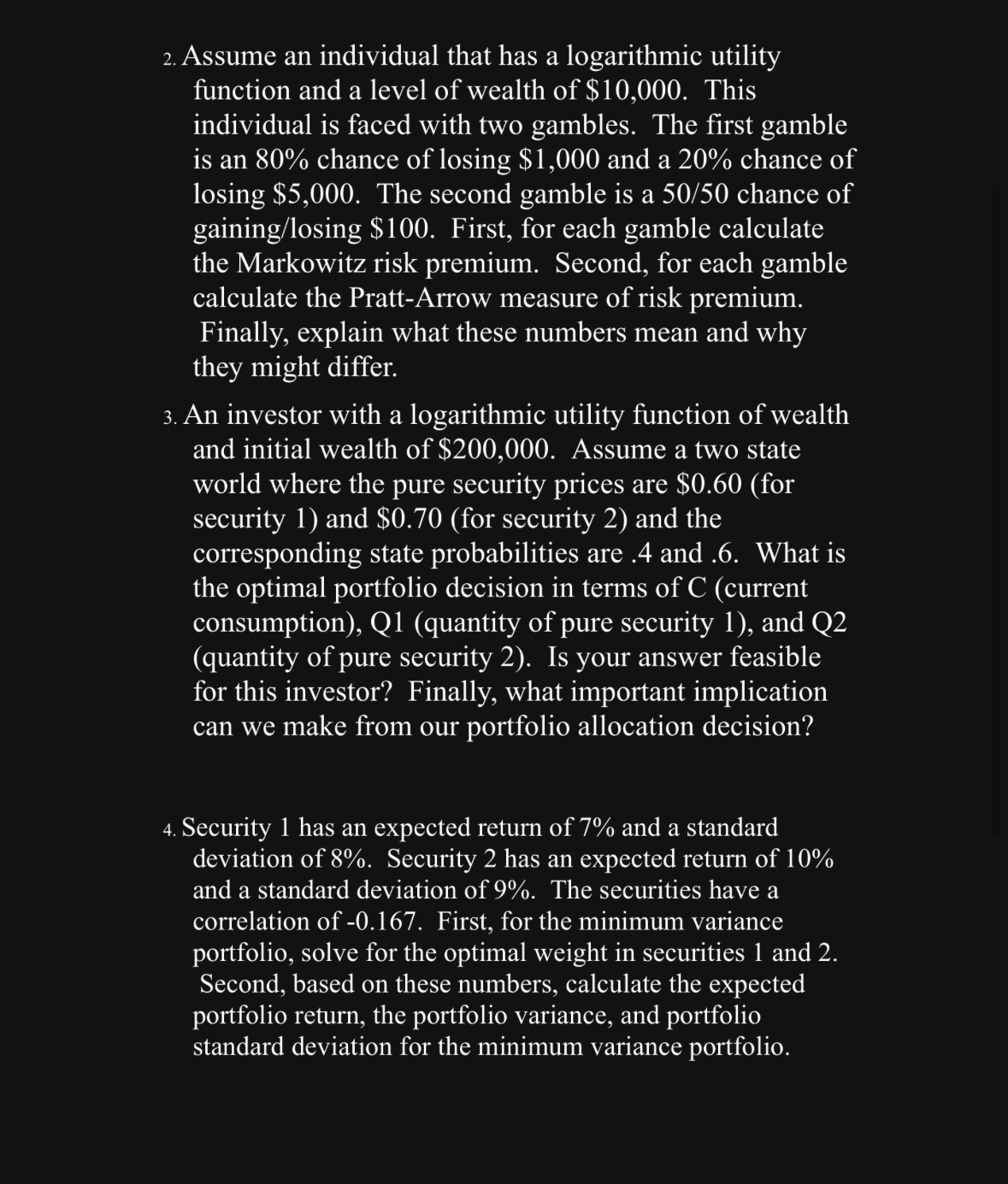
Question: Assume an individual that has a logarithmic utility function and a level of wealth of $ 1 0 , 0 0 0 . This individual
Assume an individual that has a logarithmic utility
function and a level of wealth of $ This
individual is faced with two gambles. The first gamble
is an chance of losing $ and a chance of
losing $ The second gamble is a chance of
gaininglosing $ First, for each gamble calculate
the Markowitz risk premium. Second, for each gamble
calculate the PrattArrow measure of risk premium.
Finally, explain what these numbers mean and why
they might differ.
An investor with a logarithmic utility function of wealth
and initial wealth of $ Assume a two state
world where the pure security prices are $for
security and $for security and the
corresponding state probabilities are and What is
the optimal portfolio decision in terms of C current
consumption Qquantity of pure security and Q
quantity of pure security Is your answer feasible
for this investor? Finally, what important implication
can we make from our portfolio allocation decision?
Security has an expected return of and a standard
deviation of Security has an expected return of
and a standard deviation of The securities have a
correlation of First, for the minimum variance
portfolio, solve for the optimal weight in securities and
Second, based on these numbers, calculate the expected
portfolio return, the portfolio variance, and portfolio
standard deviation for the minimum variance portfolio.
Step by Step Solution
There are 3 Steps involved in it
1 Expert Approved Answer
Step: 1 Unlock

Question Has Been Solved by an Expert!
Get step-by-step solutions from verified subject matter experts
Step: 2 Unlock
Step: 3 Unlock
 Study Help