



Question: Assume C variables i, j, and k are defined as given below. Which of the following assembly language sequences correctly implement the operation i=j-k? a)
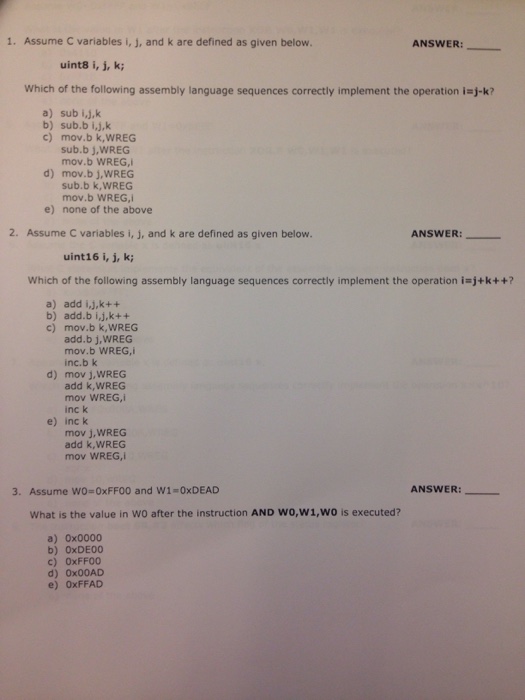
Assume C variables i, j, and k are defined as given below. Which of the following assembly language sequences correctly implement the operation i=j-k? a) supsilonb i, j, k b) sub.b i, j, k c) mov.b k, WREG sub.b j, WREG mov.b WREG, i d) mov.b j, WREG sub.b k, WREG mov.b WREG, i e) none of the above Assume C variables i, j, and k are defined as given below. Which of the following assembly language sequences correctly implement the operation i = j + k ++? a) add i, j, k++ b) add.b i, j, k++ c) mov.b k, WREG add.b j, WREG mov.b WREG, i inc.b k d) mov j, WREG add k, WREG mov WREG, i inc k e) inc k mov j, WREG add k, WREG mov WREG, i Assume W0=0 times FF00 and W1=0 times DEAD What is the value in W0 after the instruction AND W0, W1, W0 is executed? a) 0 times 0000 b) 0 times DE00 C) 0 times FF00 d) 0 times 00AD e) 0 times FFAD
Step by Step Solution
There are 3 Steps involved in it

Get step-by-step solutions from verified subject matter experts