



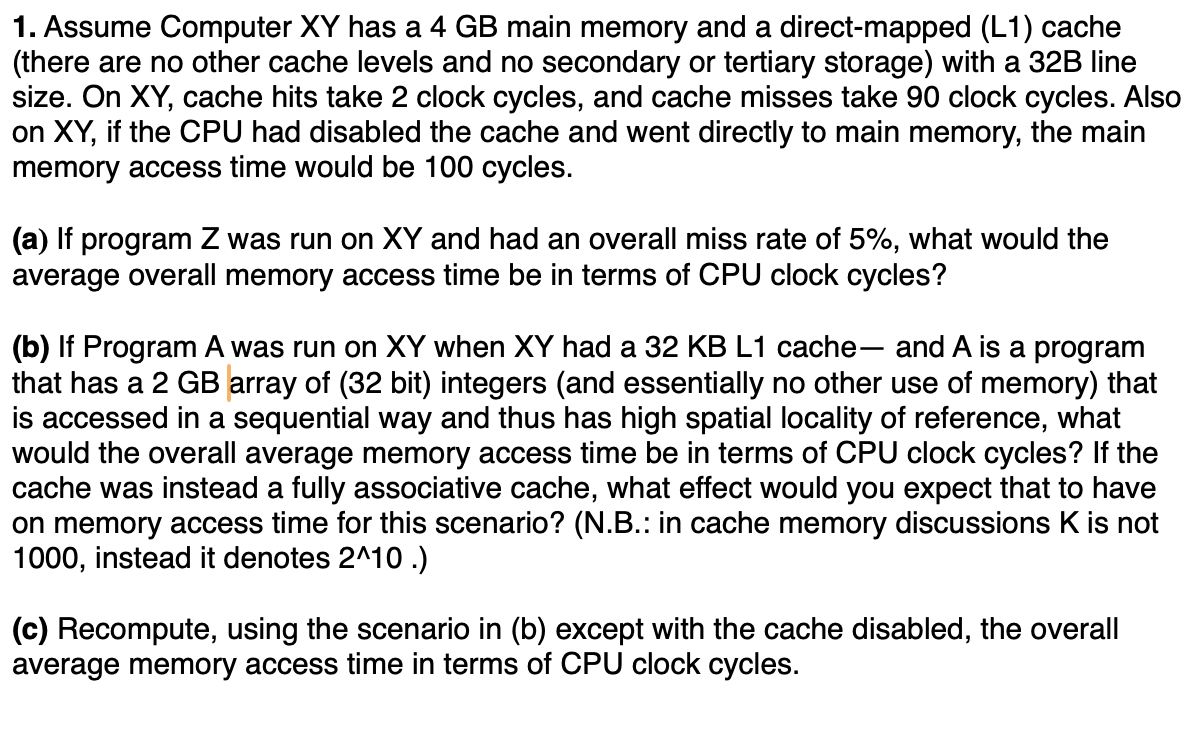
Question: Assume Computer XY has a 4 GB main memory and a direct - mapped ( L 1 ) cache ( there are no other cache
Assume Computer XY has a GB main memory and a directmapped L cache there are no
other cache levels and no secondary or tertiary storage with a B line size. On XY cache hits take
clock cycles, and cache misses take clock cycles. Also on XY if the CPU had disabled the cache and
went directly to main memory, the main memory access time would be cycles.
a If program Z was run on XY and had an overall miss rate of what would the average overall
memory access time be in terms of CPU clock cycles?Assume Computer XY has a GB main memory and a directmapped L cache
there are no other cache levels and no secondary or tertiary storage with a B line
size. On XY cache hits take clock cycles, and cache misses take clock cycles. Also
on XY if the CPU had disabled the cache and went directly to main memory, the main
memory access time would be cycles.
a If program was run on and had an overall miss rate of what would the
average overall memory access time be in terms of CPU clock cycles?
b If Program A was run on XY when XY had a cache and is a program
that has a GB array of bit integers and essentially no other use of memory that
is accessed in a sequential way and thus has high spatial locality of reference, what
would the overall average memory access time be in terms of CPU clock cycles? If the
cache was instead a fully associative cache, what effect would you expect that to have
on memory access time for this scenario? NB: in cache memory discussions K is not
instead it denotes
c Recompute, using the scenario in b except with the cache disabled, the overall
average memory access time in terms of CPU clock cycles.
Step by Step Solution
There are 3 Steps involved in it
1 Expert Approved Answer
Step: 1 Unlock

Question Has Been Solved by an Expert!
Get step-by-step solutions from verified subject matter experts
Step: 2 Unlock
Step: 3 Unlock