



Question: Assume f=0, g=0 Write an assembly code fragment that implements the following high level statement using the architectures given below. You should preserve the order
Assume f=0, g=0
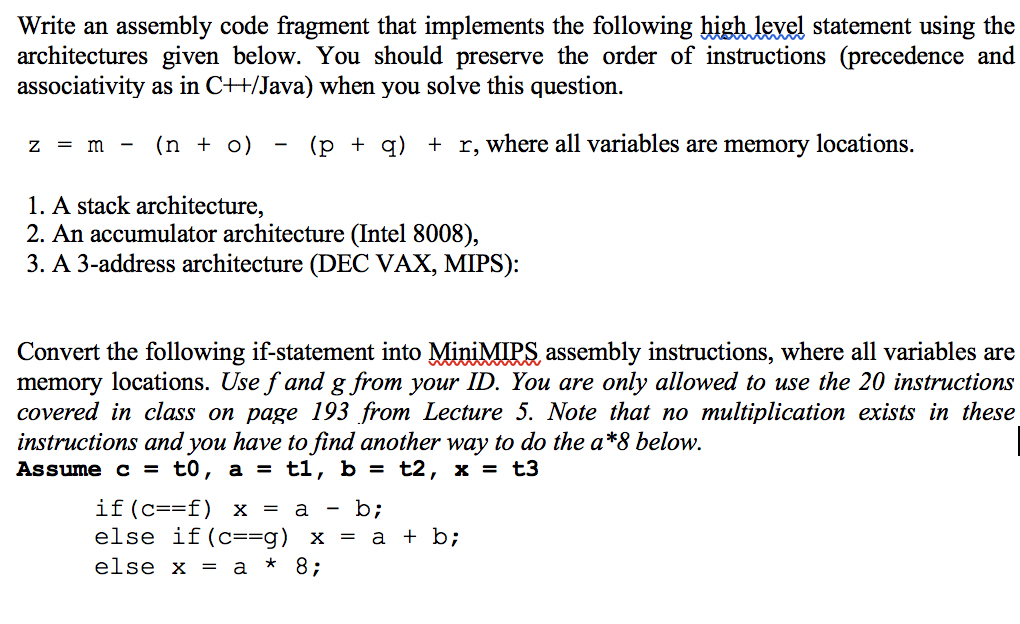
Write an assembly code fragment that implements the following high level statement using the architectures given below. You should preserve the order of instructions (precedence and associativity as in C++/Java) when you solve this question. z - m - (n + o) - (p + )+ r, where all variables are memory locations. 1. A stack architecture, 2. An accumulator architecture (Intel 8008), 3. A 3-address architecture (DEC VAX, MIPS): Convert the following if-statement into MiniMIPS assembly instructions, where all variables are memory locations. Use f and g from your ID. You are only allowed to use the 20 instructions covered in class on page 193 from Lecture 5. Note that no multiplication exists in these instructions and you have to find another way to do the a*8 below. else if(c-g) x a + b; else x - a * 8; Write an assembly code fragment that implements the following high level statement using the architectures given below. You should preserve the order of instructions (precedence and associativity as in C++/Java) when you solve this question. z - m - (n + o) - (p + )+ r, where all variables are memory locations. 1. A stack architecture, 2. An accumulator architecture (Intel 8008), 3. A 3-address architecture (DEC VAX, MIPS): Convert the following if-statement into MiniMIPS assembly instructions, where all variables are memory locations. Use f and g from your ID. You are only allowed to use the 20 instructions covered in class on page 193 from Lecture 5. Note that no multiplication exists in these instructions and you have to find another way to do the a*8 below. else if(c-g) x a + b; else x - a * 8
Step by Step Solution
There are 3 Steps involved in it

Get step-by-step solutions from verified subject matter experts