







Question: Assume n is an integer. Consider the following for loop: for (i = n; i >= 1; i =i-1) ( *** } 1. (10
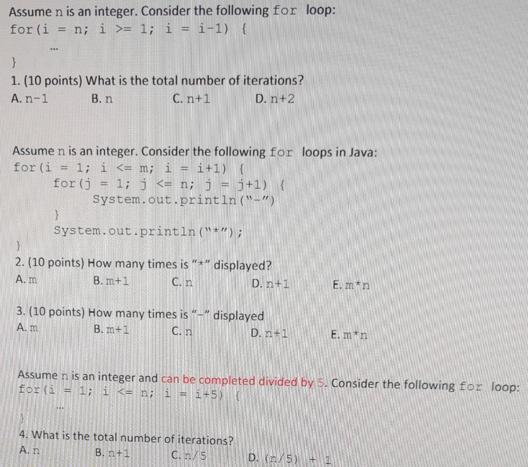
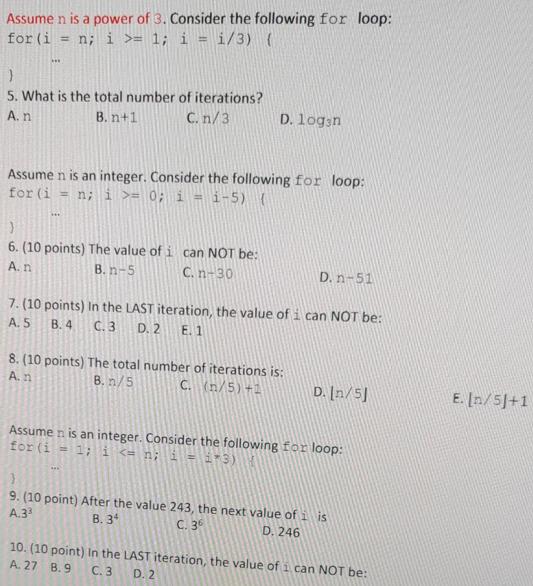
Assume n is an integer. Consider the following for loop: for (i = n; i >= 1; i =i-1) ( *** } 1. (10 points) What is the total number of iterations? A. n-1 B. n C. n+1 D. n+2 Assume n is an integer. Consider the following for loops in Java: for (i = 1; i Assume n is a power of 3. Consider the following for loop: n; i >= 1; i = i/3) ( for (i = *** } 5. What is the total number of iterations? A. n B. n+1 C. n/3 Assume n is an integer. Consider the following for loop: for (i = n; i >= 0; i = 1-5) ( HE D. login } 6. (10 points) The value of i can NOT be: A. n B. n-5 C. n-30 D. n-51 7. (10 points) In the LAST iteration, the value of i can NOT be: A. 5 B. 4 C. 3 D. 2 E. 1 8. (10 points) The total number of iterations is: A. n B. n/5 C. (n/5)+1 D. [n/5] Assume n is an integer. Consider the following for loop: for(i= 1; i
Step by Step Solution
3.50 Rating (157 Votes )
There are 3 Steps involved in it
Here are the stepbystep workings 1 10 points What is the total number of iterations for in i1 ii1 i ... View full answer

Get step-by-step solutions from verified subject matter experts
 Study Help