



Question: Assume that a CPU can perform a multiplication operation in 10 ns, an addition operation in I ns, and a n operation in 2 ns.
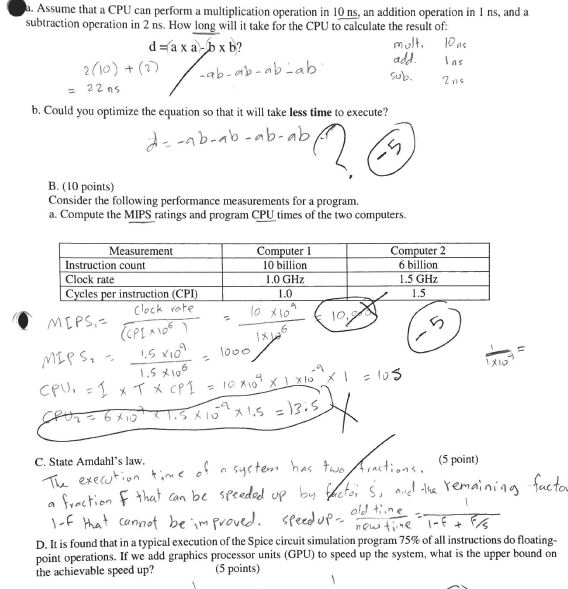
Assume that a CPU can perform a multiplication operation in 10 ns, an addition operation in I ns, and a n operation in 2 ns. How long wil take for the CPU to calculate the result of mult as add Sub 2(10) + ( /ab-ab-ab-ab 22 ns b. Could you optimize the equation so that it will take less time to execute? d-nbab-ab-ab B. (10 points) Consider the following performance measurements for a program. a. Compute the MIPS ratings and program CPU times of the two computers. Measurement Com r 2 Instruction count Clock rate Cycles per instruction (CPI Computer 1 10 billion 1.0 GHz 6 billion 1.5 GHz Clock ate 15 106 C. State Amdahl's law (5 point) actions D. It is found that in a typical execution of the Spice circuit simulation program 75% of all instructions do floating- point operations. If we add graphics processor units (GPU) to speed up the system, what is the upper bound on the achievable speed up? (5 points)
Step by Step Solution
There are 3 Steps involved in it

Get step-by-step solutions from verified subject matter experts