







Question: Assume that errors are normally distributed. What should the outlier detection limits be if the probability that one or more data points will falsely be
Assume that errors are normally distributed. What should the outlier detection limits be if the probability that one or more data points will falsely be designated as outliers must be no more than 0.01 (assuming, of course, that the model is valid)? Data is below screenshot.
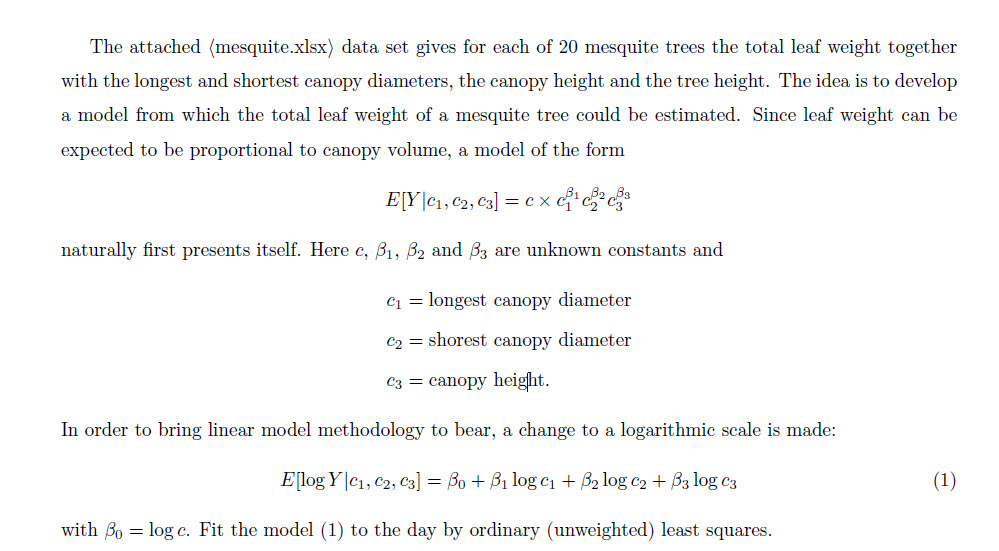
The attached {mesquitexlsx} data set gives for each of 20 mesquite trees the total leaf weight together 1with the longest and shortest canopy diameters, the canopy height and the tree height. The idea is to develop a model from which the total leaf weight of a mesquite tree could be estimated. Since leaf weight can be expected to be proportional to canopy volume, a model of the form Eirlcm, Cal = c x aces naturally rst presents itself. Here c, l, 232 and ,63 are unknown constants and c1 = longest canopy diameter .92 = shorest canopy diameter .93 = canopy heigiht. In order to bring linear model methodology to bear, a change to a logarithmic scale is made: EogY|ch c2, c3] 2 g + )31 log c1 + [32 log :32 + ,33 log c3 (1) 1with g 2 log c. Fit the model (1) to the day by ordinary (unweighted) least squares
Step by Step Solution
There are 3 Steps involved in it

Get step-by-step solutions from verified subject matter experts
 Study Help