







Question: Assume that the function Test() is defined in Java as follows. public int Test (int n) { if (n return n; return n%10 + Test(n/10);
Assume that the function Test() is defined in Java as follows.
public int Test (int n) {
if (n 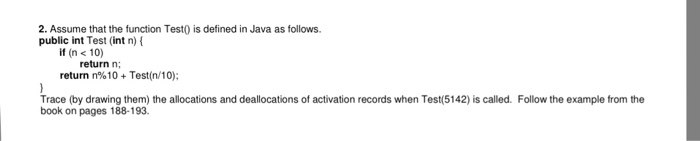
2. Assume that the function Test0 is defined in Java as follows. public int Test (int n) if (n 10) return n; return n%10 Test (n/10) Trace (by drawing them) the allocations and deallocations of activation records when Test(5142) is called. Follow the example from the book on pages 188-193. 2. Assume that the function Test0 is defined in Java as follows. public int Test (int n) if (n 10) return n; return n%10 Test (n/10) Trace (by drawing them) the allocations and deallocations of activation records when Test(5142) is called. Follow the example from the book on pages 188-193 return n;
return n%10 + Test(n/10);
}
Trace (by drawing them) the allocations and deal locations of activation of activation records when Test(5142) is called. Follow the example from the book on pages 188-193. (SML)
Step by Step Solution
There are 3 Steps involved in it
1 Expert Approved Answer
Step: 1 Unlock

Question Has Been Solved by an Expert!
Get step-by-step solutions from verified subject matter experts
Step: 2 Unlock
Step: 3 Unlock
 Study Help