







Question: Assume that X = { x ( 1 ) , . . . , x ( m ) } is a dataset of m samples
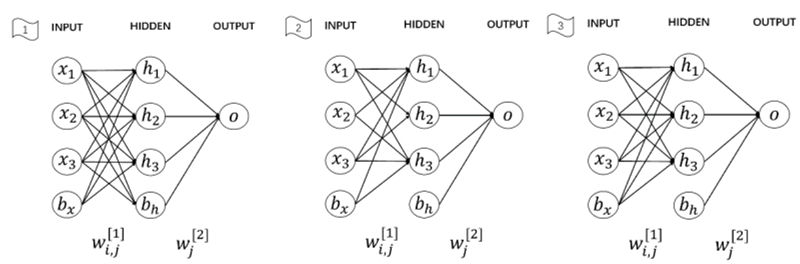
Assume that is a dataset of samples with features. The samples are classified into categories with labels We want to perform binary classification using a simple neural network. Assume that the three features are and the three neurons in the hidden layer are and the output neuron is the bias for input layer is and that for the hidden layer is Let the weight from to be for and the weight from to be Suppose we use the sigmoid function
as the activation function for and the loss function:
where is the result of the output neuron for example
The figure: The illustration of three connected neural networks consists of INPUT, HIDDEN and OUTPUT layers, as well as the related weight and bias.
a First, please distinguish which neural network is correct and suitable for the binary classification task from the above figure and derive the final output for one training sample using forward propagation based on the given architecture. Your answer should be written in terms of and the sigmoid function.
bBased on the previous background Second, for the correct neural network, if use a leaming rate of please derive the updating formula for Your answer shoule be written in terms of if you use some additional symbols, please add some note for them
Step by Step Solution
There are 3 Steps involved in it
1 Expert Approved Answer
Step: 1 Unlock

Question Has Been Solved by an Expert!
Get step-by-step solutions from verified subject matter experts
Step: 2 Unlock
Step: 3 Unlock
 Study Help