







Question: Assume that you decided to use external sources to fill this position. Which external sources (choose two or three out of the chapter) would you
Assume that you decided to use external sources to fill this position. Which external sources (choose two or three out of the chapter) would you use? Why? The position is Redfin real estate agent Length: about a half page-single spaced Discuss why those sources are the best ones? Why some of other sources are not good? Make strong arguments based on the textbook or any other articles. One of the important factors to consider is yield ratio and cost per hire. Include this factor in your discussion in addition to any other important considerations. ***** Remember, when you answer the question above, you must consider the unique characteristics of the job you chose and the unique characteristics of the organization (e.g., size, industry, etc.) you chose. The same recruitment strategy can be highly effective or disastrous depending on the type of job and organization. So, in answering each question, you must discuss why your decision makes sense given the unique characteristics of the job and organization. Without this consideration in your answer, you would not receive a high score!
IMPORTANT NOTES:
PLEASE WRITE HALF A PAGE LONG. DON'T COPY FROM OTHER POSTS! CITE YOUR WORK
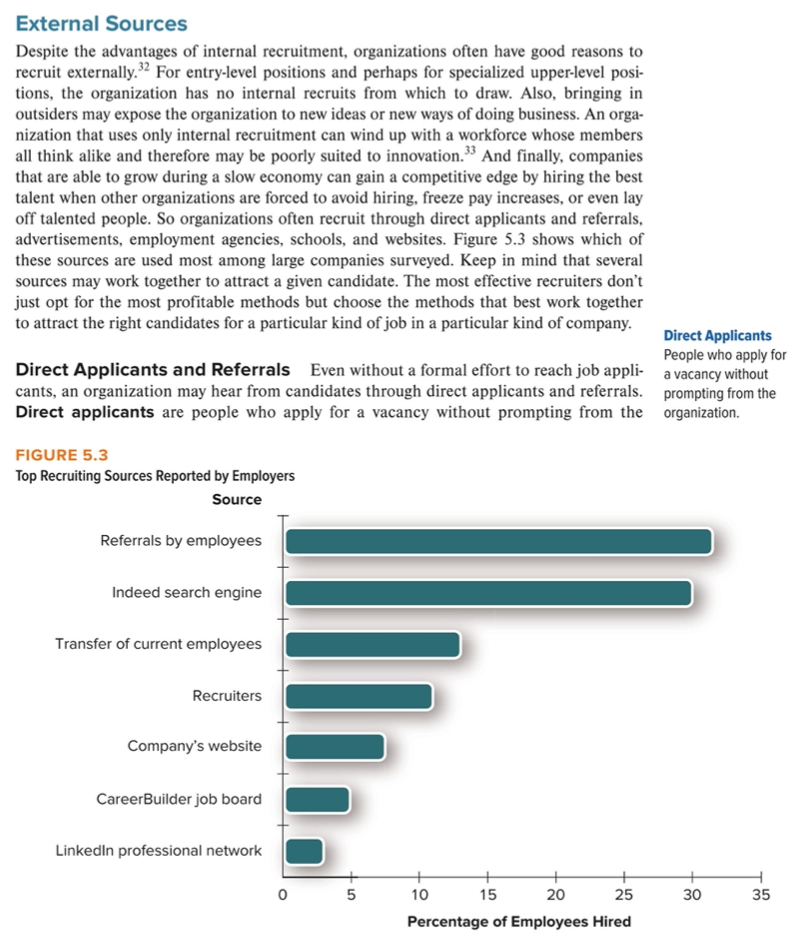
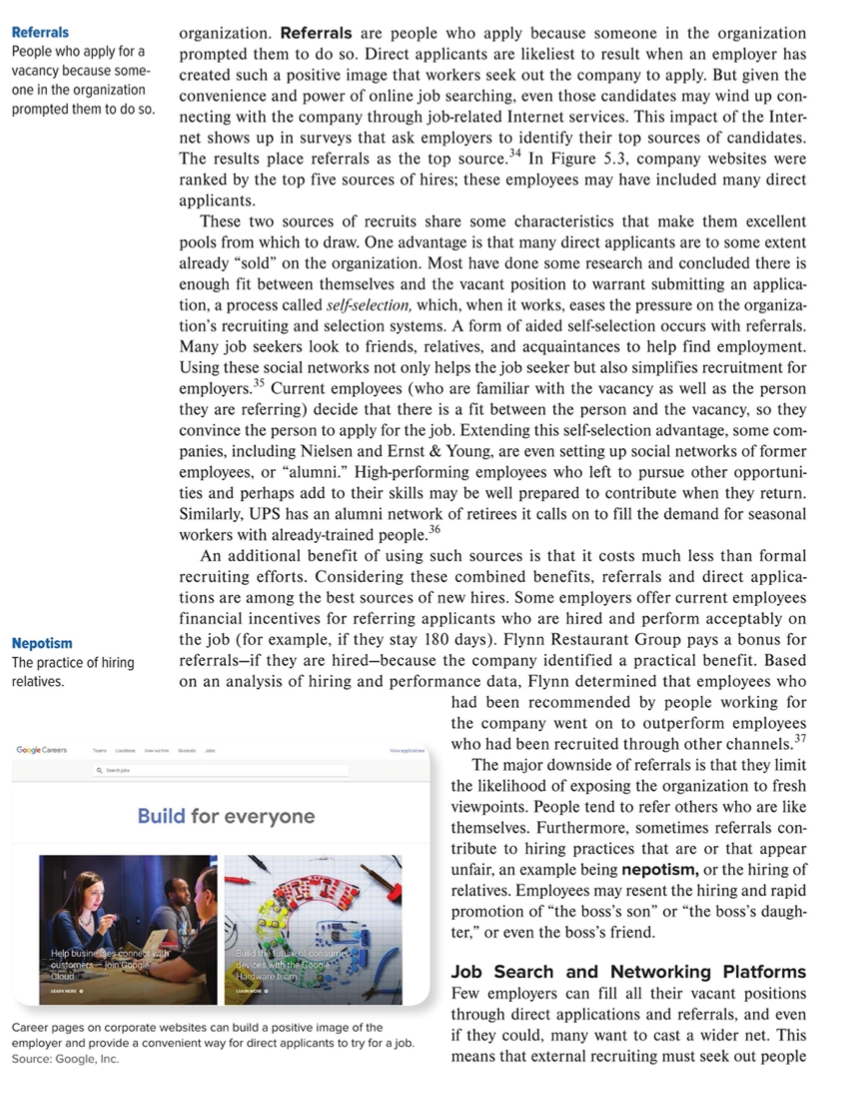
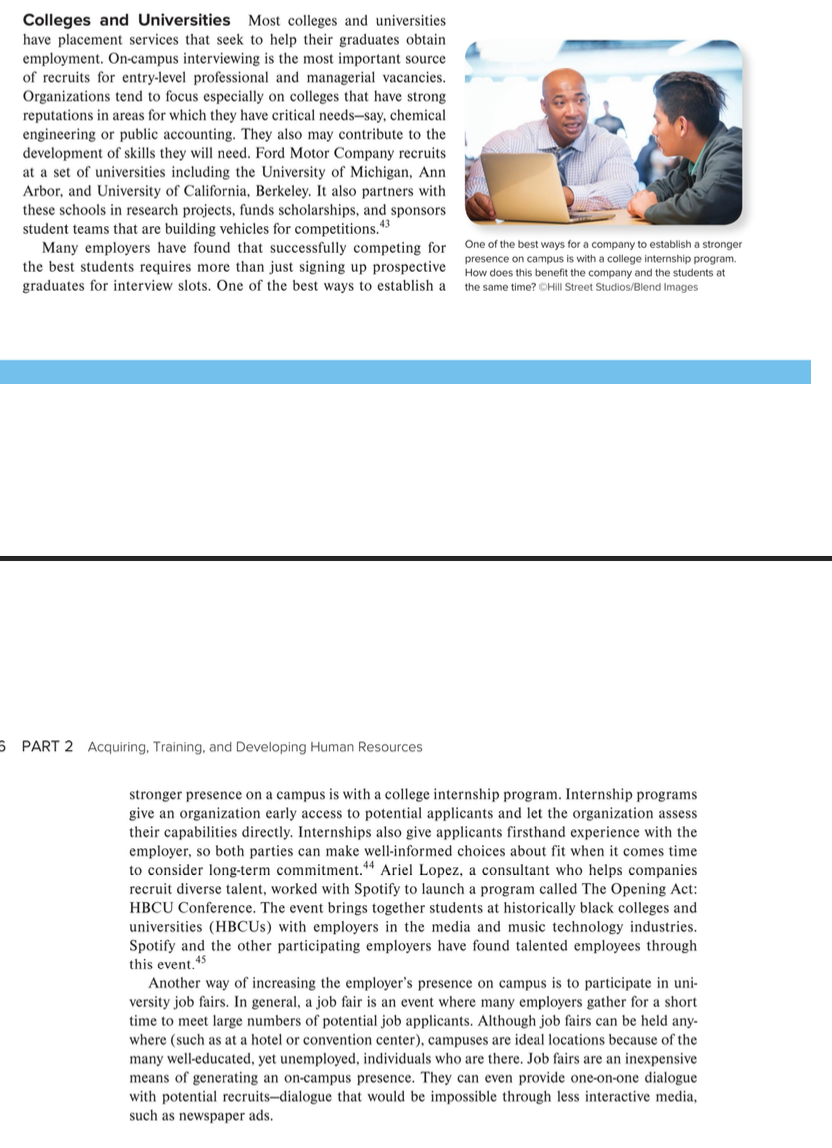
External Sources Despite the advantages of internal recruitment, organizations often have good reasons to recruit externally. 2 For entry-level positions and perhaps for specialized upper-level posi- tions, the organization has no internal recruits from which to draw. Also, bringing in outsiders may expose the organization to new ideas or new ways of doing business. An orga- nization that uses only internal recruitment can wind up with a workforce whose members all think alike and therefore may be poorly suited to innovation.33 And finally, companies that are able to grow during a slow economy can gain a competitive edge by hiring the best talent when other organizations are forced to avoid hiring, freeze pay increases, or even lay off talented people. So organizations often recruit through direct applicants and referrals, advertisements, employment agencies, schools, and websites. Figure 5.3 shows which of these sources are used most among large companies surveyed. Keep in mind that several sources may work together to attract a given candidate. The most effective recruiters don't just opt for the most profitable methods but choose the methods that best work together to attract the right candidates for a particular kind of job in a particular kind of company. Direct Applicants and Referrals Even without a formal effort to reach job appli- cants, an organization may hear from candidates through direct applicants and referrals. Direct applicants are people who apply for a vacancy without prompting from the FIGURE 5.3 Top Recruiting Sources Reported by Employers Source Referrals by employees Indeed search engine Transfer of current employees Recruiters Company's website CareerBuilder job board LinkedIn professional network 10 25 15 20 Percentage of Employees Hired 0 5 Direct Applicants People who apply for a vacancy without prompting from the organization. 30 35 organization. Referrals are people who apply because someone in the organization prompted them to do so. Direct applicants are likeliest to result when an employer has created such a positive image that workers seek out the company to apply. But given the convenience and power of online job searching, even those candidates may wind up con- necting with the company through job-related Internet services. This impact of the Inter- net shows up in surveys that ask employers to identify their top sources of candidates. The results place referrals as the top source. 34 In Figure 5.3, company websites were ranked by the top five sources of hires; these employees may have included many direct applicants. These two sources of recruits share some characteristics that make them excellent pools from which to draw. One advantage is that many direct applicants are to some extent already "sold" on the organization. Most have done some research and concluded there is enough fit between themselves and the vacant position to warrant submitting an applica- tion, a process called self-selection, which, when it works, eases the pressure on the organiza- tion's recruiting and selection systems. A form of aided self-selection occurs with referrals. Many job seekers look to friends, relatives, and acquaintances to help find employment. Using these social networks not only helps the job seeker but also simplifies recruitment for employers.5 Current employees (who are familiar with the vacancy as well as the person they are referring) decide that there is a fit between the person and the vacancy, so they convince the person to apply for the job. Extending this self-selection advantage, some com- panies, including Nielsen and Ernst & Young, are even setting up social networks of former employees, or "alumni." High-performing employees who left to pursue other opportuni- ties and perhaps add to their skills may be well prepared to contribute when they return. Similarly, UPS has an alumni network of retirees it calls on to fill the demand for seasonal 36 workers with already-trained people. An additional benefit of using such sources is that it costs much less than formal recruiting efforts. Considering these combined benefits, referrals and direct applica- tions are among the best sources of new hires. Some employers offer current employees financial incentives for referring applicants who are hired and perform acceptably on the job (for example, if they stay 180 days). Flynn Restaurant Group pays a bonus for referrals-if they are hired-because the company identified a practical benefit. Based on an analysis of hiring and performance data, Flynn determined that employees who had been recommended by people working for the company went on to outperform employees who had been recruited through other channels. 37 Build for everyone The major downside of referrals is that they limit the likelihood of exposing the organization to fresh viewpoints. People tend to refer others who are like themselves. Furthermore, sometimes referrals con- tribute to hiring practices that are or that appear unfair, an example being nepotism, or the hiring of relatives. Employees may resent the hiring and rapid promotion of "the boss's son" or "the boss's daugh- ter," or even the boss's friend. Help businee oustomers in Cloud Job Search and Networking Platforms Few employers can fill all their vacant positions through direct applications and referrals, and even if they could, many want to cast a wider net. This means that external recruiting must seek out people Career pages on corporate websites can build a positive image of the employer and provide a convenient way for direct applicants to try for a job. Source: Google, Inc. Referrals People who apply for a vacancy because some- one in the organization prompted them to do so. Nepotism The practice of hiring relatives. Google Careers who don't know about the job openings and might not even be actively looking for work. The ways they do this used to be based on the tools and methods of advertising, but today's efforts are increasingly looking like information systems and social networks. As the meth- ods shift, the lines between recruiting categories are blurred. But the most popular methods now tend to involve some combination of job search and networking. The number-two source of hiring in Figure 5.3 is Indeed, an example of a job search platform. Another provider of similar services is ZipRecruiter. These services search the rsums that workers have posted on their site and other websites. Employers can specify the criteria they are looking for and have the system filter results and deliver rsums of qualified candidates. Other features of a site such as this include dashboards for employers and job seekers to view matches and keep track of the progress of job applications. The site may offer the capability to ask the candidate additional screening questions. This recruiting method increases the likelihood of finding candidates who closely match the company's specifications, at least among candidates with the skill of preparing a rsum with relevant key terms. In addition, the service may send e-mail alerts to workers who are a close match, encouraging them to apply with a tap on their mobile device. This enables employers to reach out to workers who aren't actively seeking a new job-potentially a high-quality pool of workers.38 By far the majority of companies today use social media as a tool for recruiting, although it is rarely the main tool used.39 A familiar example of a job-related networking site is LinkedIn. Members of LinkedIn post their experience, educational background, and interests, along with their interest in considering job offers. Employers can find employees who match their criteria. They also can host web pages and participate in the news feeds and other interac- tions offered by the site. This makes the site a place to develop a positive image of the com- pany as well as to invite people to apply for jobs. For more on ways to recruit with social media, see the "HRM Social" box. Help-Wanted Advertising Although recruiters are reporting more use of other methods, many still place advertisements in online and offline media. Until recently, job boards such as CareerBuilder and Monster were top ways to recruit, and they still play a role in recruiting. These services are evolving to offer more than an online space for advertise- ments. Workers who are actively interested in a new job can set up a profile to send them notifications when a job matching their criteria is posted. Just as job search sites will gener- ate rsums from candidates who create profiles with the right key terms, online job adver- tisements will reach the right eyes if they contain terms that job seekers will be searching for. Some employers that have a goal to improve diversity are using the services of Textio. This company's software searches a client's job postings and analyzes each to estimate the likelihood that its language will appeal to diverse candidates.4 A variety of media accept advertisements, including help-wanted ads. These include local newspapers, professional and trade publications (online and off), Craigslist, results pages of search engines, and even signs on transit and at workplaces. The goal of choos- ing advertising media is to place messages where qualified job seekers are most likely to see them. The ad should be easy to scan for information and easy to act on. Today's job hunters increasingly want to be able to apply via smartphone by texting a response or using an app. Public Employment Agencies The Social Security Act of 1935 requires that every- one receiving unemployment compensation be registered with a local state employment office. These state employment offices work with the U.S. Employment Service (USES) to try to ensure that unemployed individuals eventually get off state aid and back on employer payrolls. To accomplish this, agencies collect information from the unemployed people about their skills and experience. Employers can register their job vacancies with their local state employment office, and the agency will try to find someone suitable, using its computerized inventory of local unem- ployed individuals. The agency refers candidates to the employer at no charge. The organiza- tion can interview or test them to see if they are suitable for its vacancies. Besides offering access to job candidates at low cost, public employment agencies can be a useful resource for meeting certain diversity objectives. Laws often mandate that the agencies maintain specialized "desks" for minorities, disabled individuals, and war veterans. Employers that feel they currently are underutilizing any of these subgroups of the labor force may find the agencies to be an excellent source. Government-run employment agencies also may partner with nonprofit groups to meet the needs of a community. In California's Alameda and Contra Costa Counties, several agencies have cooperated to form EastBay Works. This organization is dedicated to bring- ing together employers and workers in the two counties. EastBay Works offers a variety of recruiting tools at its website. Employers can post job openings, research the local labor market, and set up a search tool to identify candidates who have skills the employer is look- ing for. Job seekers can visit the site to hunt for jobs, set up a search tool that finds jobs related to the skills in their profile, assess their existing skills, and arrange for training in skills that employers want." 41 Private Employment Agencies In contrast to public employment agencies, which primarily serve the blue-collar labor market, private employment agencies provide much the same service for the white-collar labor market. Workers interested in finding a job can sign up with a private employment agency whether or not they are currently unemployed. Another difference between the two types of agencies is that private agencies charge the employers for providing referrals. Therefore, using a private employment agency is more expensive than using a public agency, but the private agency is a more suitable source for certain kinds of applicants. For managers or professionals, an employer may use the services of a type of private agency called an executive search firm (ESF). People often call these agencies "headhunt- ers" because, unlike other employment agencies, they find new jobs for people almost exclusively already employed. For job candidates, dealing with executive search firms can be sensitive. Typically, executives do not want to advertise their availability, because it could trigger a negative reaction from their current employer. ESFs serve as a buffer, providing confidentiality between the employer and the recruit. That benefit may give an employer access to candidates it cannot recruit in other, more direct ways. Executive recruiters also may specialize in particular industries or business functions, so they can guide their cli- ents toward candidates the clients might not otherwise consider. Catherine Lepard, for example, heads the Americas Retail Practice for the search firm Heidrick & Struggles. In this role, she helps retailers find people prepared to lead a business through the dra- matic changes the industry is undergoing. Often, that means choosing someone who has not spent a career in retail but has learned to navigate different cultures, apply technology, and build agile organizations.42 Colleges and Universities Most colleges and universities have placement services that seek to help their graduates obtain employment. On-campus interviewing is the most important source of recruits for entry-level professional and managerial vacancies. Organizations tend to focus especially on colleges that have strong reputations in areas for which they have critical needs-say, chemical. engineering or public accounting. They also may contribute to the development of skills they will need. Ford Motor Company recruits at a set of universities including the University of Michigan, Ann Arbor, and University of California, Berkeley. It also partners with these schools in research projects, funds scholarships, and sponsors student teams that are building vehicles for competitions.43 Many employers have found that successfully competing for the best students requires more than just signing up prospective graduates for interview slots. One of the best ways to establish a 6 PART 2 Acquiring, Training, and Developing Human Resources One of the best ways for a company to establish a stronger presence on campus is with a college internship program. How does this benefit the company and the students at the same time? Hill Street Studios/Blend Images 44 stronger presence on a campus is with a college internship program. Internship programs give an organization early access to potential applicants and let the organization assess their capabilities directly. Internships also give applicants firsthand experience with the employer, so both parties can make well-informed choices about fit when it comes time to consider long-term commitment.** Ariel Lopez, a consultant who helps companies recruit diverse talent, worked with Spotify to launch a program called The Opening Act: HBCU Conference. The event brings together students at historically black colleges and universities (HBCUs) with employers in the media and music technology industries. Spotify and the other participating employers have found talented employees through this event. 45 Another way of increasing the employer's presence on campus is to participate in uni- versity job fairs. In general, a job fair is an event where many employers gather for a short time to meet large numbers of potential job applicants. Although job fairs can be held any- where (such as at a hotel or convention center), campuses are ideal locations because of the many well-educated, yet unemployed, individuals who are there. Job fairs are an inexpensive means of generating an on-campus presence. They can even provide one-on-one dialogue with potential recruits-dialogue that would be impossible through less interactive media, such as newspaper adsStep by Step Solution
There are 3 Steps involved in it

Get step-by-step solutions from verified subject matter experts
 Study Help