







Question: Assume the following C++ program is executed. As with the examples in the text, the ra1 and ra2 comments indicate the address for the return
Assume the following C++ program is executed. As with the examples in the text, the ra1 and ra2 comments indicate the address for the return from the function call on that line (this is the value that will be placed on the stack for the return address). Let ra0 be the return address from main() to whatever operating system code called it, and this value will be the first value placed on the stack for this exercise. Note that, unlike the texts examples, there are no global variables in this program. The stack values provided are not necessarily the first to go on the stack. Some, such as retVal, are put on the stack near the end of function execution. Fill in the missing stack values in the table on the right below to show the contents of all locations of the stack memory that were changed by the program. Since the stack pointer will be at the bottom of the stack memory area at this point in time, I mean to include all values above the stack pointer that were used by the program at any time during execution. Note that the stack values provided are not necessarily the first that are put on the stack chronologically. Some values, such as retVal, are put on the stack near the end of execution.
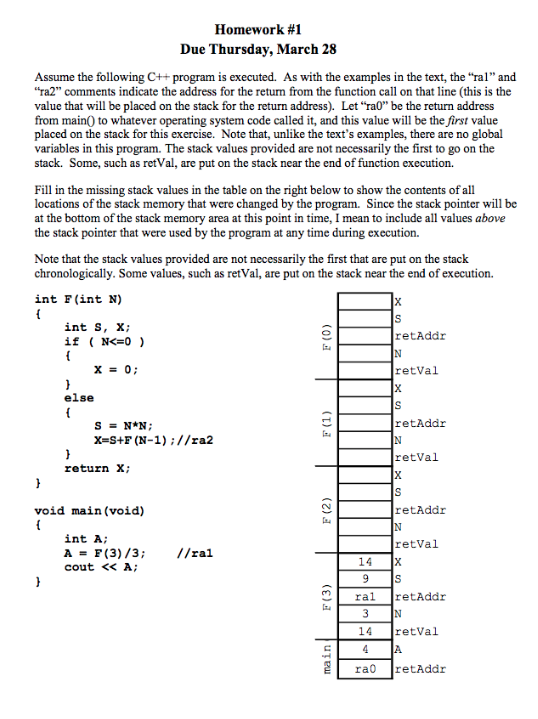
Homework #1 Due Thursday, March 28 Assume the following C++program is executed. As with the examples in the text, the "ral" and ra2" comments indicate the address for the return from the function call on that line (this is the value that will be placed on the stack for the return address). Let "ra0" be the return address from main0 to whatever operating system code called it, and this value will be the first value placed on the stack for this exercise. Note that, unlike the text's examples, there are no global variables in this program. The stack values provided are not necessarily the first to go on the stack. Some, such as retVal, are put on the stack near the end of function execution. Fill in the missing stack values in the table on the right below to show the contents of all locations of the stack memory that were changed by the program. Since the stack pointer will be at the bottom of the stack memory area at this point in time, I mean to include all values above the stack pointer that were used by the program at any time during execution. Note that the stack values provided are not necessarily the first that are put on the stack chronologically. Some values, such as retVal, are put on the stack near the end of execution. int F(int N) int S, X; if ( N
Step by Step Solution
There are 3 Steps involved in it

Get step-by-step solutions from verified subject matter experts
 Study Help