







Question: Assume the function get_reverse from the question above has been defined in a module called numbers_and_digits. Fill in the blanks to complete the code from
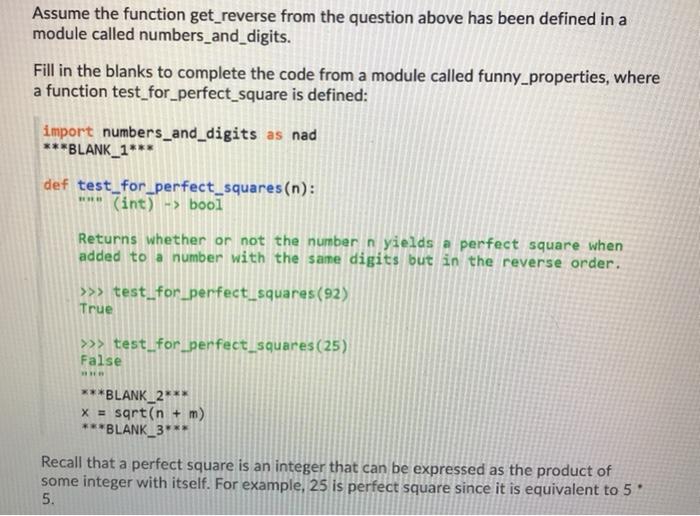
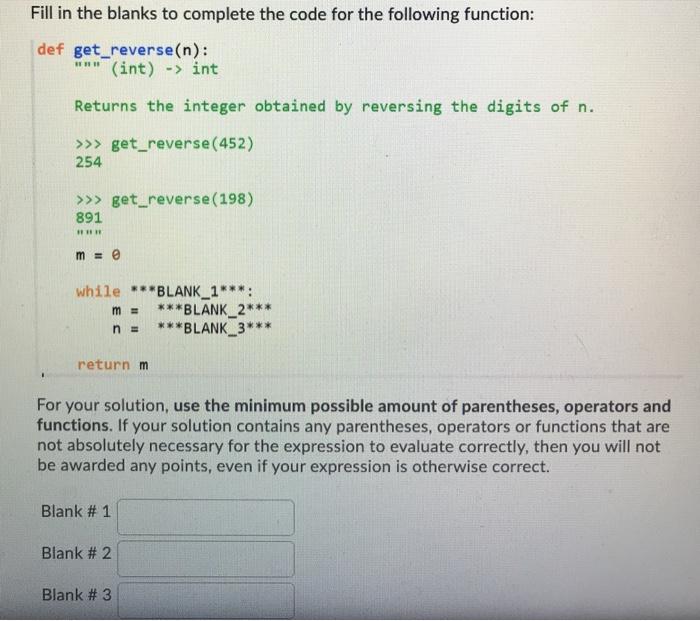
Assume the function get_reverse from the question above has been defined in a module called numbers_and_digits. Fill in the blanks to complete the code from a module called funny_properties, where a function test_for_perfect_square is defined: import numbers_and_digits as nad ***BLANK_1*** def test_for_perfect_squares(n): * (int) -> bool Returns whether or not the number yields a perfect square when added to a number with the same digits but in the reverse order. >>> test for perfect_squares (92) True >>> test_for_perfect_squares (25) False ***BLANK_2*** x = sqrt(n + m) ***BLANK_3*** Recall that a perfect square is an integer that can be expressed as the product of some integer with itself. For example, 25 is perfect square since it is equivalent to 5 5. Fill in the blanks to complete the code for the following function: def get_reverse(n): (int) -> int Returns the integer obtained by reversing the digits of n. >>> get_reverse (452) 254 >>> get_reverse (198) 891 HT m = while ***BLANK_1***: ***BLANK_2*** ***BLANK_3*** m = n = return m 1 For your solution, use the minimum possible amount of parentheses, operators and functions. If your solution contains any parentheses, operators or functions that are not absolutely necessary for the expression to evaluate correctly, then you will not be awarded any points, even if your expression is otherwise correct. Blank # 1 Blank # 2 Blank # 3
Step by Step Solution
There are 3 Steps involved in it

Get step-by-step solutions from verified subject matter experts
 Study Help