







Question: Assume the restaurant has a production technology q = 5L0.40.3 1.1 If Jackie has hired 3 employees L = 3 and bought 8 kitchen
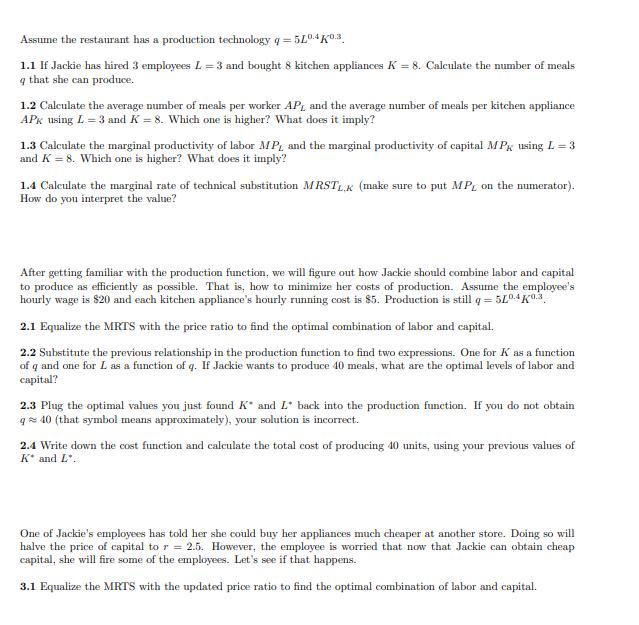
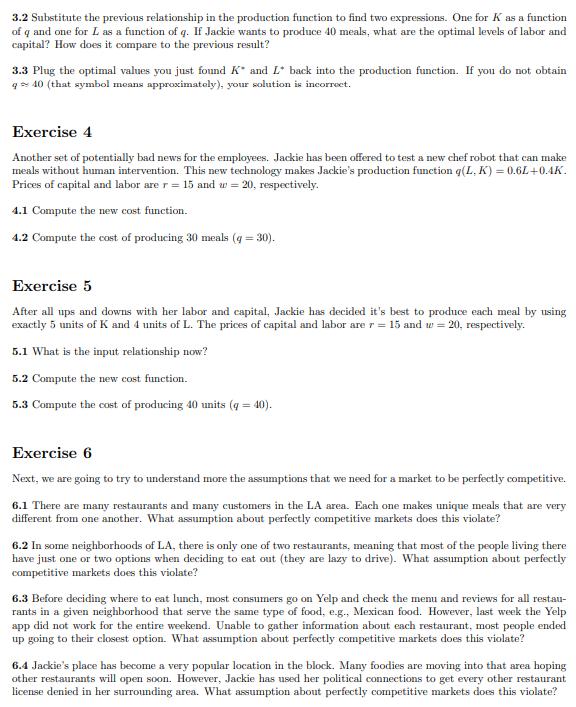
Assume the restaurant has a production technology q = 5L0.40.3 1.1 If Jackie has hired 3 employees L = 3 and bought 8 kitchen appliances K = 8. Calculate the number of meals q that she can produce. 1.2 Calculate the average number of meals per worker AP, and the average number of meals per kitchen appliance APK using L = 3 and K = 8. Which one is higher? What does it imply? 1.3 Calculate the marginal productivity of labor MP, and the marginal productivity of capital MP using L = 3 and K = 8. Which one is higher? What does it imply? 1.4 Calculate the marginal rate of technical substitution MRSTL.K (make sure to put MP on the numerator). How do you interpret the value? After getting familiar with the production function, we will figure out how Jackie should combine labor and capital to produce as efficiently as possible. That is, how to minimize her costs of production. Assume the employee's hourly wage is $20 and each kitchen appliance's hourly running cost is $5. Production is still q = 5L0.4 K0.3 2.1 Equalize the MRTS with the price ratio to find the optimal combination of labor and capital. 2.2 Substitute the previous relationship in the production function to find two expressions. One for K as a function of q and one for L as a function of q. If Jackie wants to produce 40 meals, what are the optimal levels of labor and capital? 2.3 Plug the optimal values you just found K and L* back into the production function. If you do not obtain q 40 (that symbol means approximately), your solution is incorrect. 2.4 Write down the cost function and calculate the total cost of producing 40 units, using your previous values of K* and L. One of Jackie's employees has told her she could buy her appliances much cheaper at another store. Doing so will halve the price of capital to r= 2.5. However, the employee is worried that now that Jackie can obtain cheap capital, she will fire some of the employees. Let's see if that happens. 3.1 Equalize the MRTS with the updated price ratio to find the optimal combination of labor and capital. 3.2 Substitute the previous relationship in the production function to find two expressions. One for K as a function of q and one for L as a function of q. If Jackie wants to produce 40 meals, what are the optimal levels of labor and capital? How does it compare to the previous result? 3.3 Plug the optimal values you just found K and L* back into the production function. If you do not obtain 940 (that symbol means approximately), your solution is incorrect. Exercise 4 Another set of potentially bad news for the employees. Jackie has been offered to test a new chef robot that can make meals without human intervention. This new technology makes Jackie's production function q(L, K) = 0.6L+0.4K. Prices of capital and labor are r= 15 and w= 20, respectively. 4.1 Compute the new cost function. 4.2 Compute the cost of producing 30 meals (g = 30). Exercise 5 After all ups and downs with her labor and capital, Jackie has decided it's best to produce each meal by using exactly 5 units of K and 4 units of L. The prices of capital and labor are r = 15 and w=20, respectively. 5.1 What is the input relationship now? 5.2 Compute the new cost function. 5.3 Compute the cost of producing 40 units (g = 40). Exercise 6 Next, we are going to try to understand more the assumptions that we need for a market to be perfectly competitive. 6.1 There are many restaurants and many customers in the LA area. Each one makes unique meals that are very different from one another. What assumption about perfectly competitive markets does this violate? 6.2 In some neighborhoods of LA, there is only one of two restaurants, meaning that most of the people living there have just one or two options when deciding to eat out (they are lazy to drive). What assumption about perfectly competitive markets does this violate? 6.3 Before deciding where to eat lunch, most consumers go on Yelp and check the menu and reviews for all restau- rants in a given neighborhood that serve the same type of food, e.g., Mexican food. However, last week the Yelp app did not work for the entire weekend. Unable to gather information about each restaurant, most people ended up going to their closest option. What assumption about perfectly competitive markets does this violate? 6.4 Jackie's place has become a very popular location in the block. Many foodies are moving into that area hoping other restaurants will open soon. However, Jackie has used her political connections to get every other restaurant license denied in her surrounding area. What assumption about perfectly competitive markets does this violate?
Step by Step Solution
3.45 Rating (155 Votes )
There are 3 Steps involved in it
Solutions Step 1 11 Number of meals produced q5L 04 K 03 Substitute L3 and K8 q53 04 8 03 q14479 So ... View full answer

Get step-by-step solutions from verified subject matter experts
 Study Help