







Question: Assume we are running code on a 10-bit machine using two's complement arithmetic for signed integers. Short integers are encoded using 5 bits. Sign extension
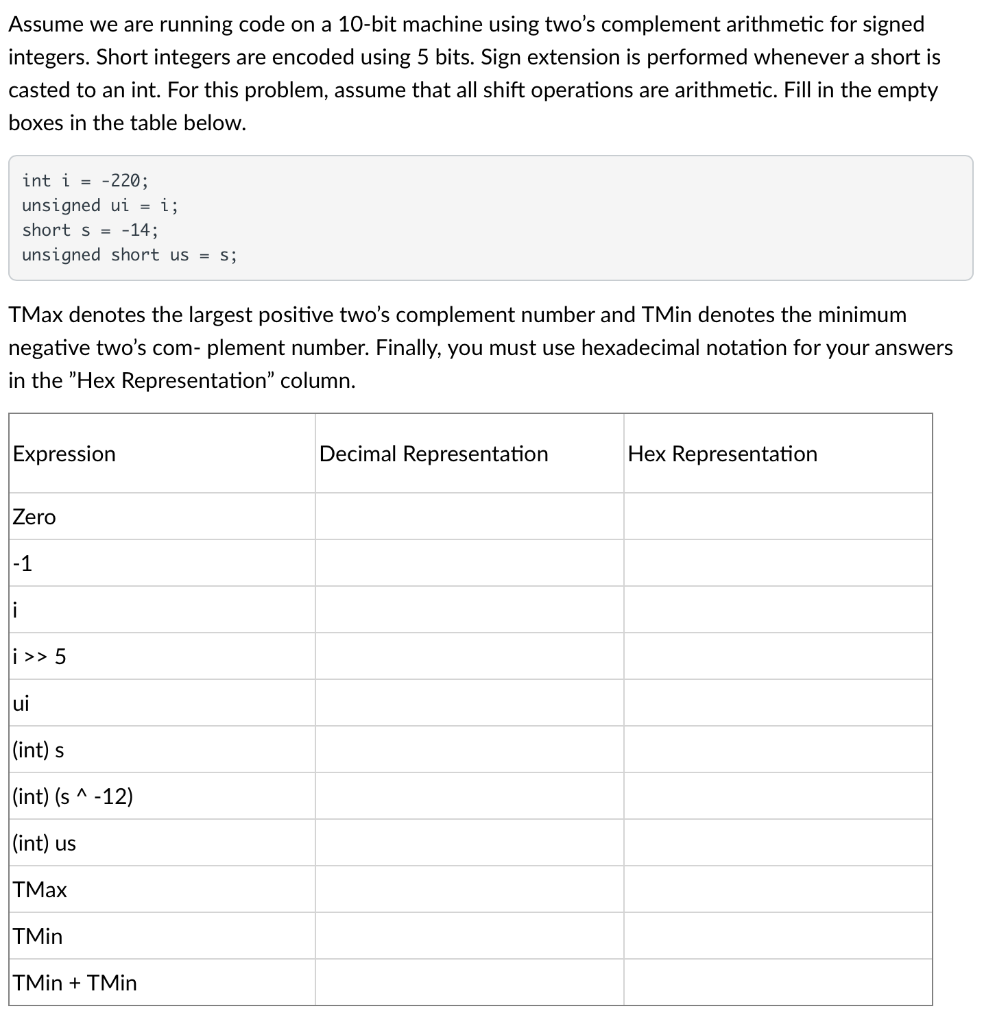
Assume we are running code on a 10-bit machine using two's complement arithmetic for signed integers. Short integers are encoded using 5 bits. Sign extension is performed whenever a short is casted to an int. For this problem, assume that all shift operations are arithmetic. Fill in the empty boxes in the table below. int i = -220; unsigned ui = i; short s = -14; unsigned short us = s; TMax denotes the largest positive two's complement number and TMin denotes the minimum negative two's com- plement number. Finally, you must use hexadecimal notation for your answers in the "Hex Representation" column. Expression Decimal Representation Hex Representation Zero -1 li i >> 5 ui (int)s (int) (s ^-12) (int) us TMax TMin TMin + TMin
Step by Step Solution
There are 3 Steps involved in it

Get step-by-step solutions from verified subject matter experts
 Study Help