







Question: Assume we have a 16-bit computer. For signs, represents negative. Floating-point representation uses 1 bit for the sign, 5 bits for the exponent, and
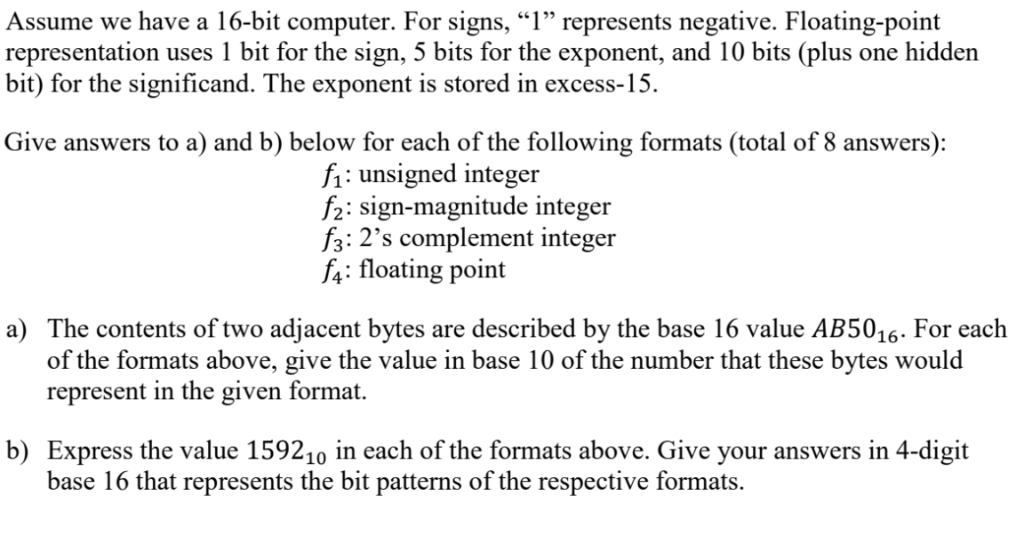
Assume we have a 16-bit computer. For signs, "" represents negative. Floating-point representation uses 1 bit for the sign, 5 bits for the exponent, and 10 bits (plus one hidden bit) for the significand. The exponent is stored in excess-15 Give answers to a) and b) below for each of the following formats (total of 8 answers): fi: unsigned integer : sign-magnitude integer f3: 2's complement integer f: floating point The contents of two adjacent bytes are described by the base 16 value AB5016. For each of the formats above, give the value in base 10 of the number that these bytes would represent in the given format. a) b) Express the value 159210 in each of the formats above. Give your answers in 4-digit base 16 that represents the bit patterns of the respective formats. Assume we have a 16-bit computer. For signs, "" represents negative. Floating-point representation uses 1 bit for the sign, 5 bits for the exponent, and 10 bits (plus one hidden bit) for the significand. The exponent is stored in excess-15 Give answers to a) and b) below for each of the following formats (total of 8 answers): fi: unsigned integer : sign-magnitude integer f3: 2's complement integer f: floating point The contents of two adjacent bytes are described by the base 16 value AB5016. For each of the formats above, give the value in base 10 of the number that these bytes would represent in the given format. a) b) Express the value 159210 in each of the formats above. Give your answers in 4-digit base 16 that represents the bit patterns of the respective formats
Step by Step Solution
There are 3 Steps involved in it

Get step-by-step solutions from verified subject matter experts
 Study Help