







Question: Assume we have the following program for some language with C-like syntax. Int x, y, z; void foo (a, b, c) {a = a *
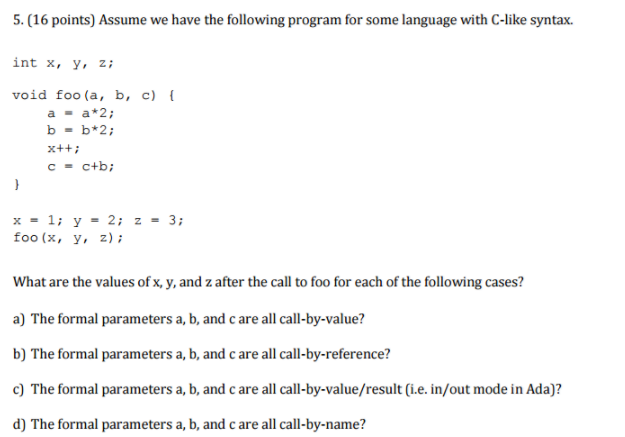
Assume we have the following program for some language with C-like syntax. Int x, y, z; void foo (a, b, c) {a = a * 2; b = b * 2; x++; c = c + b;} x = 1; y = 2; z = 3; foo(x, y, z); What are the values of x, y, and z after the call to foo for each of the following cases? a) The formal parameters a, b, and c are all call-by-value? b) The formal parameters a, b, and c are all call-by-reference? c) The formal parameters a, b, and c are all call-by-value/result (i.e. in/out mode in Ada)? d) The formal parameters a, b. and c are all call-by-name
Step by Step Solution
There are 3 Steps involved in it
1 Expert Approved Answer
Step: 1 Unlock

Question Has Been Solved by an Expert!
Get step-by-step solutions from verified subject matter experts
Step: 2 Unlock
Step: 3 Unlock
 Study Help