



Question: Assume you are conducting a demand modeling study for the morning commuting trips during the peak hour of a typical work day between the City
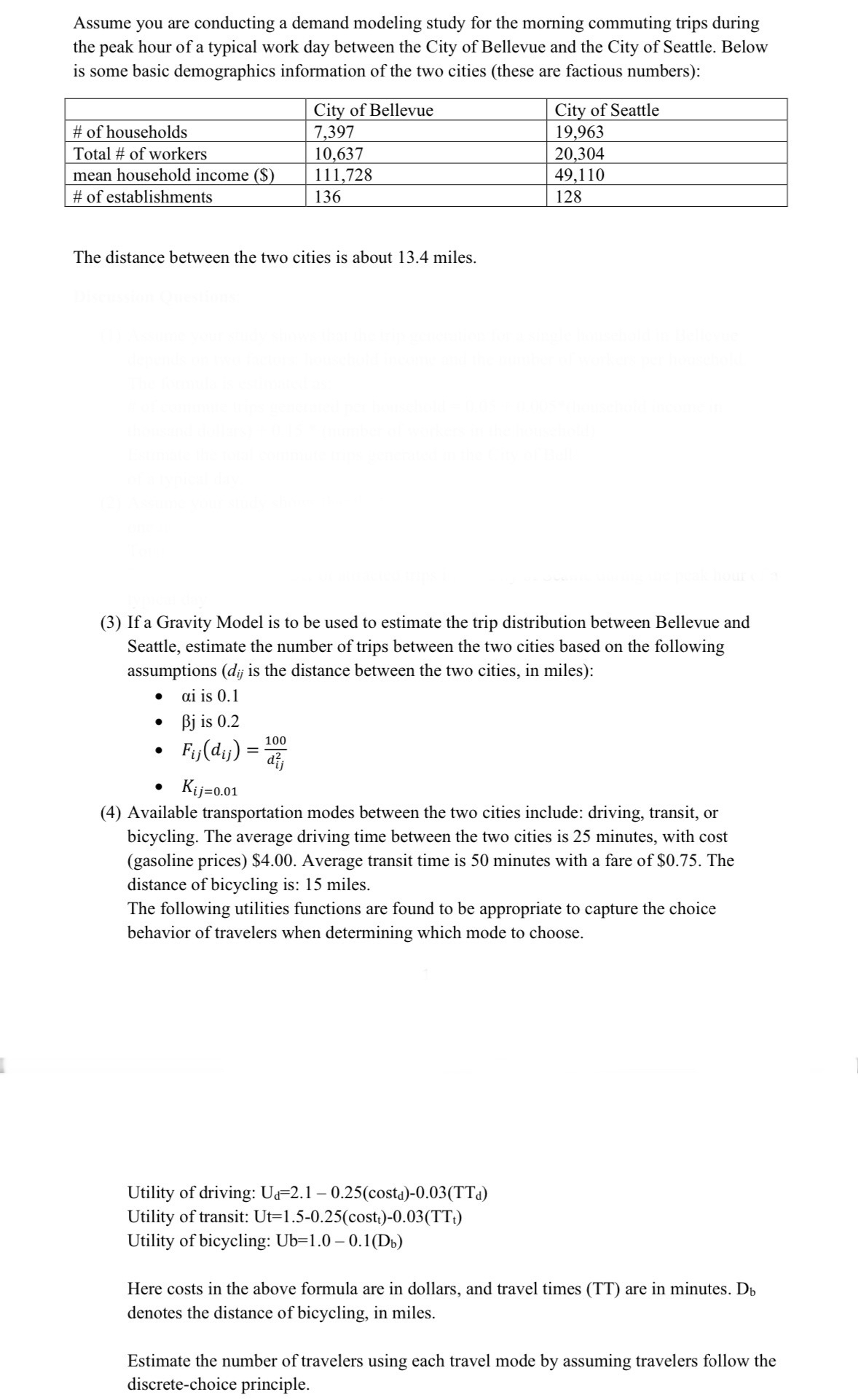
Assume you are conducting a demand modeling study for the morning commuting trips during the peak hour of a typical work day between the City of Bellevue and the City of Seattle. Below is some basic demographics information of the two cities these are factious numbers:
tableCity of Bellevue,City of Seattle# of households,Total # of workers,mean household income $# of establishments,
The distance between the two cities is about miles.
If a Gravity Model is to be used to estimate the trip distribution between Bellevue and Seattle, estimate the number of trips between the two cities based on the following assumptions is the distance between the two cities, in miles:
i is
is
Available transportation modes between the two cities include: driving, transit, or bicycling. The average driving time between the two cities is minutes, with cost gasoline prices $ Average transit time is minutes with a fare of $ The distance of bicycling is: miles.
The following utilities functions are found to be appropriate to capture the choice behavior of travelers when determining which mode to choose.
Utility of driving:
Utility of transit:
Utility of bicycling:
Here costs in the above formula are in dollars, and travel times TT are in minutes. denotes the distance of bicycling, in miles.
Estimate the number of travelers using each travel mode by assuming travelers follow the discretechoice principle.
Step by Step Solution
There are 3 Steps involved in it
1 Expert Approved Answer
Step: 1 Unlock

Question Has Been Solved by an Expert!
Get step-by-step solutions from verified subject matter experts
Step: 2 Unlock
Step: 3 Unlock