







Question: Assume you are using linear programming to develop a forest management plan. Your objective function is to maximize net revenue from timber harvest over a
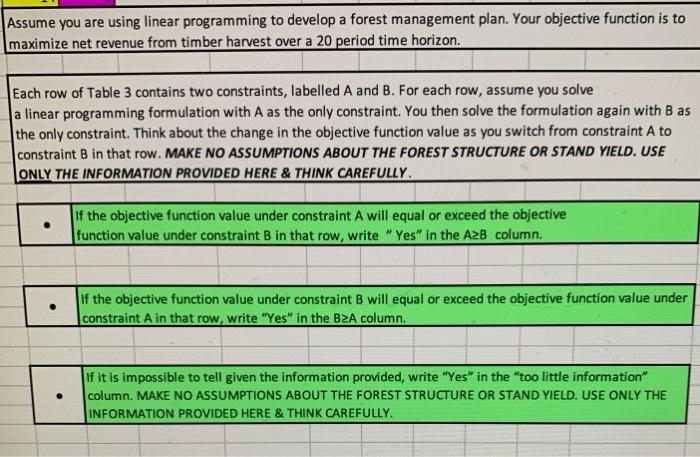
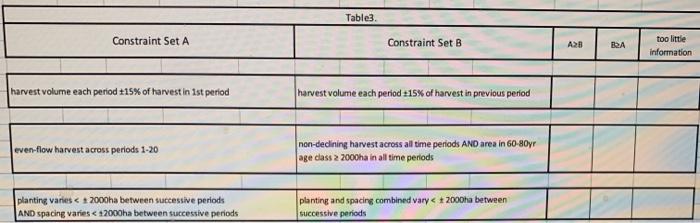
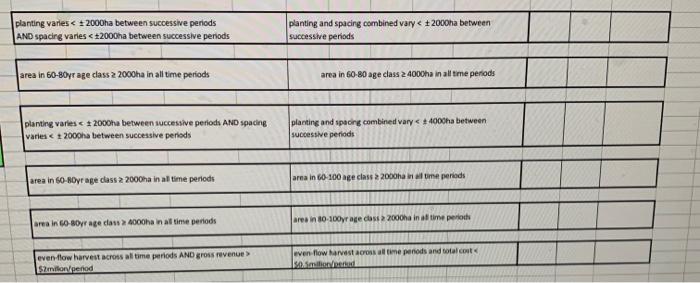
Assume you are using linear programming to develop a forest management plan. Your objective function is to maximize net revenue from timber harvest over a 20 period time horizon. Each row of Table 3 contains two constraints, labelled A and B. For each row, assume you solve a linear programming formulation with A as the only constraint. You then solve the formulation again with B as the only constraint. Think about the change in the objective function value as you switch from constraint A to constraint B in that row. MAKE NO ASSUMPTIONS ABOUT THE FOREST STRUCTURE OR STAND YIELD. USE ONLY THE INFORMATION PROVIDED HERE & THINK CAREFULLY. . If the objective function value under constraint A will equal or exceed the objective function value under constraint B in that row, write "Yes" in the A2B column. If the objective function value under constraint B will equal or exceed the objective function value under constraint A in that row, write "Yes" in the BPA column . If it is impossible to tell given the information provided, write "Yes" in the "too little information" column. MAKE NO ASSUMPTIONS ABOUT THE FOREST STRUCTURE OR STAND YIELD. USE ONLY THE INFORMATION PROVIDED HERE & THINK CAREFULLY. Table3 Constraint Set A Constraint Set B A> ERA too little information harvest volume each period 15% of harvest in 1st period harvest volume each period +15% of harvest in previous period even-flow harvest across periods 1-20 non-declining harvest across all time periods AND area in 60-80yr age class 2 2000ha in all time periods planting varies 4000ha inaltime periods rea in 80-100rage com > 2000ha in a time periode even flow harvest across all time periods and total cost even flow harvest across all time periods AND gross revenue Smlongend Assume you are using linear programming to develop a forest management plan. Your objective function is to maximize net revenue from timber harvest over a 20 period time horizon. Each row of Table 3 contains two constraints, labelled A and B. For each row, assume you solve a linear programming formulation with A as the only constraint. You then solve the formulation again with B as the only constraint. Think about the change in the objective function value as you switch from constraint A to constraint B in that row. MAKE NO ASSUMPTIONS ABOUT THE FOREST STRUCTURE OR STAND YIELD. USE ONLY THE INFORMATION PROVIDED HERE & THINK CAREFULLY. . If the objective function value under constraint A will equal or exceed the objective function value under constraint B in that row, write "Yes" in the A2B column. If the objective function value under constraint B will equal or exceed the objective function value under constraint A in that row, write "Yes" in the BPA column . If it is impossible to tell given the information provided, write "Yes" in the "too little information" column. MAKE NO ASSUMPTIONS ABOUT THE FOREST STRUCTURE OR STAND YIELD. USE ONLY THE INFORMATION PROVIDED HERE & THINK CAREFULLY. Table3 Constraint Set A Constraint Set B A> ERA too little information harvest volume each period 15% of harvest in 1st period harvest volume each period +15% of harvest in previous period even-flow harvest across periods 1-20 non-declining harvest across all time periods AND area in 60-80yr age class 2 2000ha in all time periods planting varies 4000ha inaltime periods rea in 80-100rage com > 2000ha in a time periode even flow harvest across all time periods and total cost even flow harvest across all time periods AND gross revenue Smlongend
Step by Step Solution
There are 3 Steps involved in it

Get step-by-step solutions from verified subject matter experts
 Study Help