







Question: Assume zero-based indexing 1. Consider memoizing this function: function f(x) if(x-a) return return 1; return f(x-1)f(x-2); else if (x 1) else T or F: Even
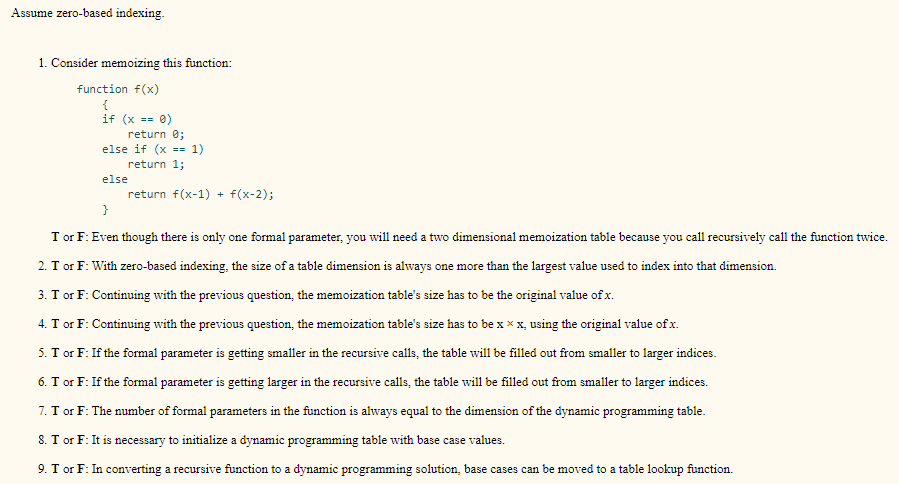
Assume zero-based indexing 1. Consider memoizing this function: function f(x) if(x-a) return return 1; return f(x-1)f(x-2); else if (x 1) else T or F: Even though there is only one formal parameter, you will need a two dimensional memoization table because you call recursively call the function twice. 2. T or F: With zero-based indexing, the size of a table dimension is always one more than the largest value used to index into that dimension 3. T or F: Continuing with the previous question, the memoization table's size has to be the original value of x. . T or F: Continuing with the previous question, the memoization table's size has to be xx x, using the original value of x. 5. T or F: If the formal parameter is getting smaller in the recursive calls, the table will be filled out from smaller to larger indices 6. T or F: If the formal parameter is getting larger in the recursive calls, the table will be filled out from smaller to larger indices 7. T or F: The number of formal parameters in the function is always equal to the dimension of the dynamic programming table. 8. T or F: It is necessary to initialize a dynamic programming table with base case values 9. T or F: In converting a recursive function to a dynamic programming solution, base cases can be moved to a table lookup function
Step by Step Solution
There are 3 Steps involved in it

Get step-by-step solutions from verified subject matter experts
 Study Help