







Question: Assuming #bits = 8 and 2's complement show the decimal equivalent to each of the binary values for both signed and unsigned values. 0100 0110
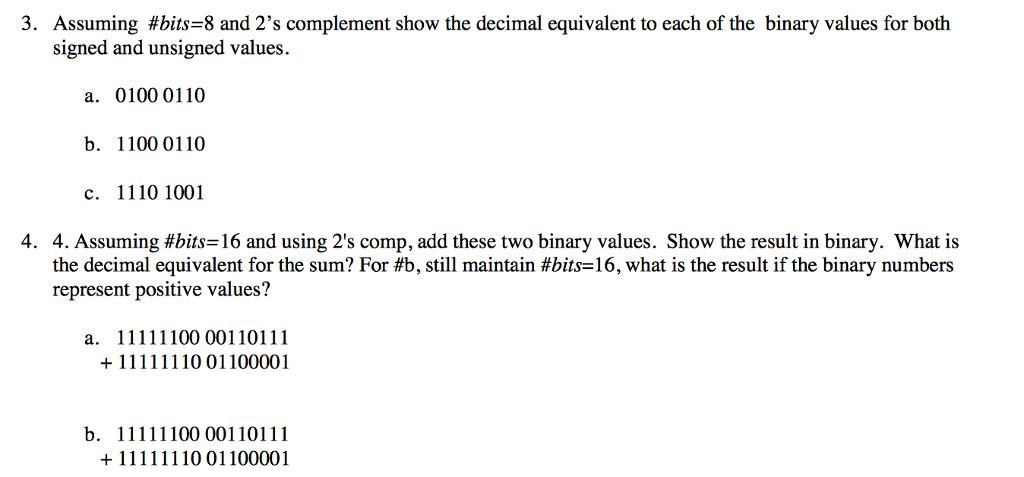
Assuming #bits = 8 and 2's complement show the decimal equivalent to each of the binary values for both signed and unsigned values. 0100 0110 1100 0110 1110 1001 4. Assuming #bits = 16 and using 2's comp, add these two binary values. Show the result in binary. What is the decimal equivalent for the sum? For #b, still maintain #bits=16, what is the result if the binary numbers represent positive values? 11111100 00110111 + 11111110 01100001 11111100 00110111 + 11111110 01100001 Assuming #bits = 8 and 2's complement show the decimal equivalent to each of the binary values for both signed and unsigned values. 0100 0110 1100 0110 1110 1001 4. Assuming #bits = 16 and using 2's comp, add these two binary values. Show the result in binary. What is the decimal equivalent for the sum? For #b, still maintain #bits=16, what is the result if the binary numbers represent positive values? 11111100 00110111 + 11111110 01100001 11111100 00110111 + 11111110 01100001
Step by Step Solution
There are 3 Steps involved in it

Get step-by-step solutions from verified subject matter experts
 Study Help