







Question: Assuming you can make the changes mentioned in question 4 : 1- What will be the qualifying criteria, order winning criteria? 2- What does this
Assuming you can make the changes mentioned in question 4 :
1- What will be the qualifying criteria, order winning criteria?
2- What does this suggest about supply chain management?
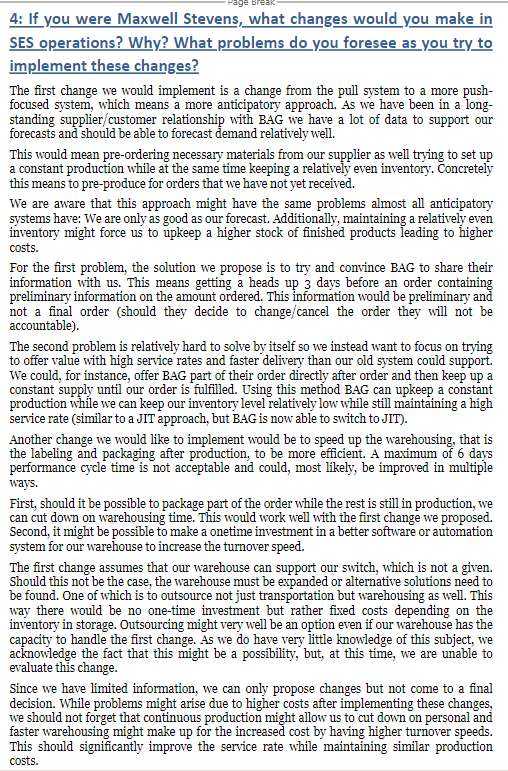
4: If you were Maxwell Stevens, what changes would you make in SES operations? Why? What problems do you foresee as you try to implement these changes? The first change we would implement is a change from the pull system to a more push- focused system, which means a more anticipatory approach. As we have been in a long- standing supplier/customer relationship with BAG we have a lot of data to support our forecasts and should be able to forecast demand relatively well. This would mean pre-ordering necessary materials from our supplier as well trying to set up a constant production while at the same time keeping a relatively even inventory. Concretely this means to pre-produce for orders that we have not yet received. We are aware that this approach might have the same problems almost all anticipatory systems have: We are only as good as our forecast. Additionally, maintaining a relatively even inventory might force us to upkeep a higher stock of finished products leading to higher costs. For the first problem, the solution we propose is to try and convince BAG to share their information with us. This means getting a heads up 3 days before an order containing preliminary information on the amount ordered. This information would be preliminary and not a final order (should they decide to change cancel the order they will not be accountable) The second problem is relatively hard to solve by itself so we instead want to focus on trying to offer value with high service rates and faster delivery than our old system could support. We could, for instance, offer BAG part of their order directly after order and then keep up a constant supply until our order is fulfilled. Using this method BAG can upkeep a constant production while we can keep our inventory level relatively low while still maintaining a high service rate (similar to a JIT approach, but BAG is now able to switch to JIT). Another change we would like to implement would be to speed up the warehousing, that is the labeling and packaging after production, to be more efficient. A maximum of 6 days performance cycle time is not acceptable and could, most likely, be improved in multiple ways. First, should it be possible to package part of the order while the rest is still in production, we can cut down on warehousing time. This would work well with the first change we proposed. Second, it might be possible to make a onetime investment in a better software or automation system for our warehouse to increase the turnover speed. The first change assumes that our warehouse can support our switch, which is not a given. Should this not be the case, the warehouse must be expanded or alternative solutions need to be found. One of which is to outsource not just transportation but warehousing as well. This way there would be no one-time investment but rather fixed costs depending on the inventory in storage. Outsourcing might very well be an option even if our warehouse has the capacity to handle the first change. As we do have very little knowledge of this subject, we acknowledge the fact that this might be a possibility, but, at this time, we are unable to evaluate this change. Since we have limited information, we can only propose changes but not come to a final decision. While problems might arise due to higher costs after implementing these changes, we should not forget that continuous production might allow us to cut down on personal and faster warehousing might make up for the increased cost by having higher turnover speeds. This should significantly improve the service rate while maintaining similar production costsStep by Step Solution
There are 3 Steps involved in it
1 Expert Approved Answer
Step: 1 Unlock

Question Has Been Solved by an Expert!
Get step-by-step solutions from verified subject matter experts
Step: 2 Unlock
Step: 3 Unlock
 Study Help