



Question: Asymptotic Notation Properties. Let f(n) and g(n) be asymptotically non-negative functions. Using the definitions of asymptotic notations: (a) (4 points) Prove that if f_(1)(n)=O(g_(1)(n)) and
Asymptotic Notation Properties. Let
f(n)and
g(n)be asymptotically non-negative functions. Using the definitions of asymptotic notations:\ (a) (4 points) Prove that if
f_(1)(n)=O(g_(1)(n))and
f_(2)(n)=O(g_(2)(n))then
f_(1)(n)+f_(2)(n)=O(g_(1)(n)+g_(2)(n))\ (b) (4 points) Prove that if
f(n)=O(n)+O(n^(2))+O(n^(3))then
f(n)=O(n^(3)).\ 3
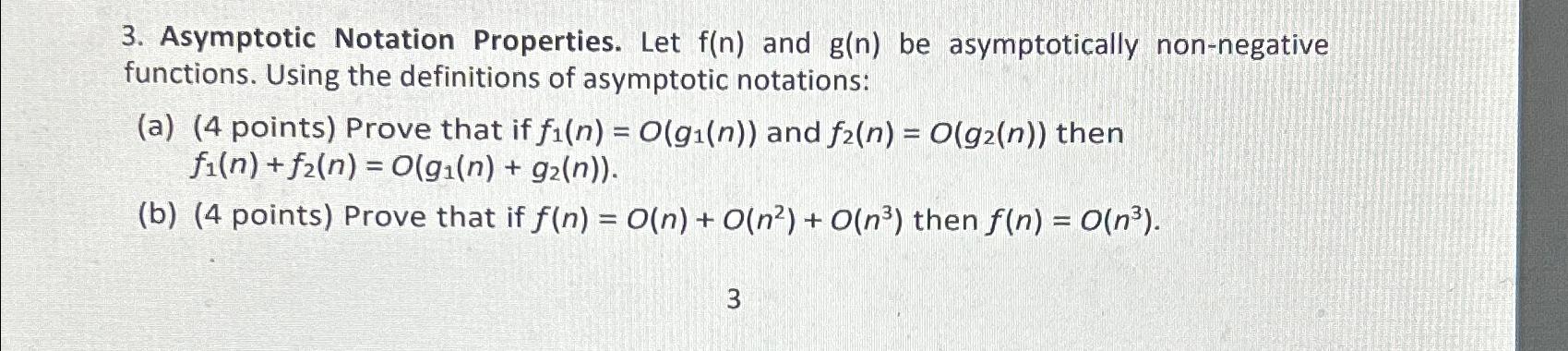
3. Asymptotic Notation Properties. Let f(n) and g(n) be asymptotically non-negative functions. Using the definitions of asymptotic notations: (a) (4 points) Prove that if f1(n)=O(g1(n)) and f2(n)=O(g2(n)) then f1(n)+f2(n)=O(g1(n)+g2(n)). (b) (4 points) Prove that if f(n)=O(n)+O(n2)+O(n3) then f(n)=O(n3)
Step by Step Solution
There are 3 Steps involved in it
1 Expert Approved Answer
Step: 1 Unlock

Question Has Been Solved by an Expert!
Get step-by-step solutions from verified subject matter experts
Step: 2 Unlock
Step: 3 Unlock