







Question: (Asymptotic Notations and Basic Efficiency Classes) 3. Indicate whether the first function of each of the following has a smaller, same, or larger order of
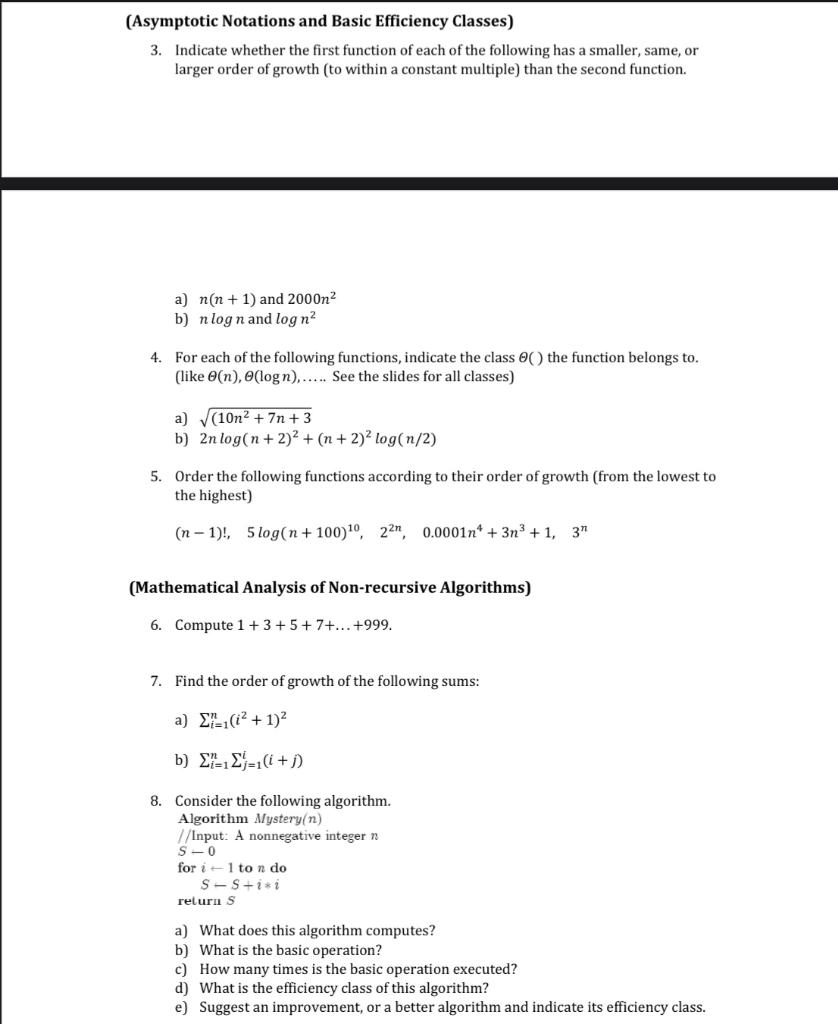
(Asymptotic Notations and Basic Efficiency Classes) 3. Indicate whether the first function of each of the following has a smaller, same, or larger order of growth (to within a constant multiple) than the second function. a) n(n+1) and 2000n2 b) nlogn and logn2 4. For each of the following functions, indicate the class () the function belongs to. (like (n),(logn),. . See the slides for all classes) a) (10n2+7n+3 b) 2nlog(n+2)2+(n+2)2log(n/2) 5. Order the following functions according to their order of growth (from the lowest to the highest) (n1)!,5log(n+100)10,22n,0.0001n4+3n3+1,3n (Mathematical Analysis of Non-recursive Algorithms) 6. Compute 1+3+5+7++999. 7. Find the order of growth of the following sums: a) i=1n(i2+1)2 b) i=1nj=1i(i+j) 8. Consider the following algorithm. Algorithm Mystery( n ) //lnput: A nonnegative integer n S0 for i1 to n do sS+ii relurn S a) What does this algorithm computes? b) What is the basic operation? c) How many times is the basic operation executed? d) What is the efficiency class of this algorithm? e) Suggest an improvement, or a better algorithm and indicate its efficiency class
Step by Step Solution
There are 3 Steps involved in it

Get step-by-step solutions from verified subject matter experts
 Study Help