







Question: At a high level, you can model the time to access a hard disk drive as the access time and the transfer time and a
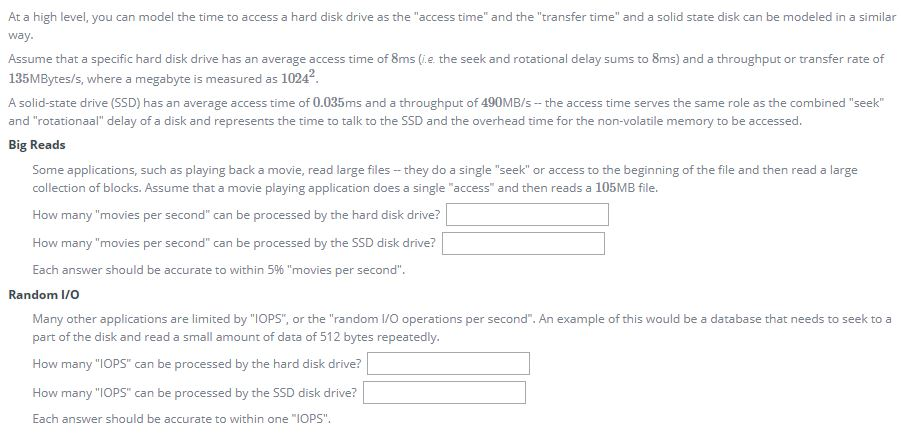
At a high level, you can model the time to access a hard disk drive as the "access time" and the "transfer time" and a solid state disk can be modeled in a similar way Assume that a specific hard disk drive has an average access time of 8ms (ie the seek and rotational delay sums to 8ms) and a throughput or transfer rate of 135MBytes/s, where a megabyte is measured as 10242 A solid-state drive (SSD) has an average access time of 0.035ms and a throughput of 490MB/s the access time serves the same role as the combined "seek" and "rotationaal" delay of a disk and represents the time to talk to the SSD and the overhead time for the non-volatile memory to be accessed. Big Reads Some applications, such as playing back a movie, read large files-they do a single "seek" or access to the beginning of the file and then read a large collection of blocks. Assume that a movie playing application does a single "access How many "movies per second" can be processed by the hard disk drive? How many "movies per second" can be processed by the SSD disk drive? Each answer should be accurate to within 5% "movies per second". and then reads a 105MB file. Random I/O Many other applications are limited by "IOPS", or the "random I/O operations per second". An example of this would be a database that needs to seek to a part of the disk and read a small amount of data of 512 bytes repeatedly. How many "IOPS" can be processed by the hard disk drive? How many "IOPS" can be processed by the SSD disk drive? Each answer should be accurate to within one "IOPS
Step by Step Solution
There are 3 Steps involved in it

Get step-by-step solutions from verified subject matter experts
 Study Help