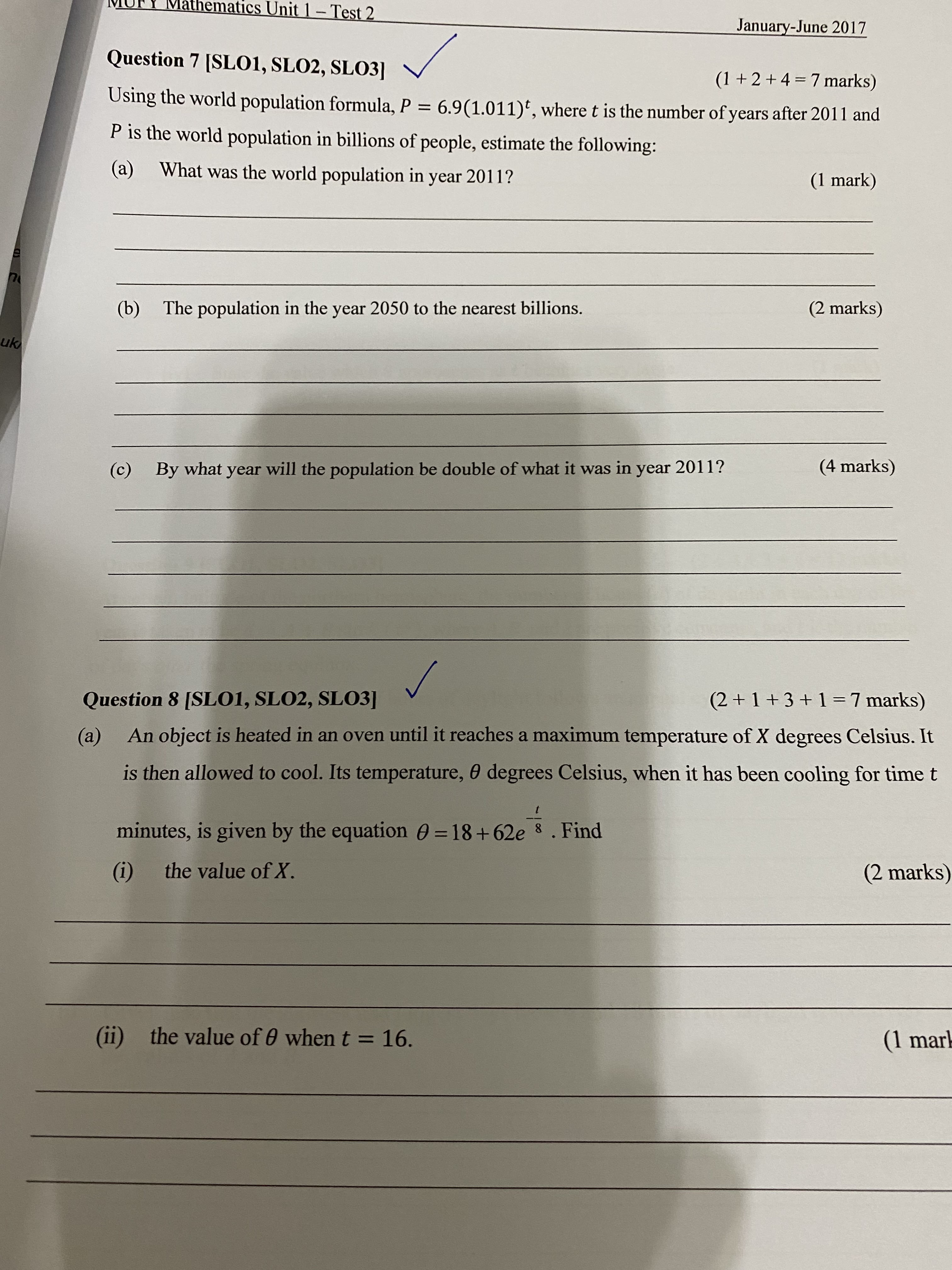
Question: athematics Unit 1 - Test 2 January-June 2017 Question 7 [SLO1, SLO2, SLO3] (1 +2 +4 = 7 marks) Using the world population formula, P
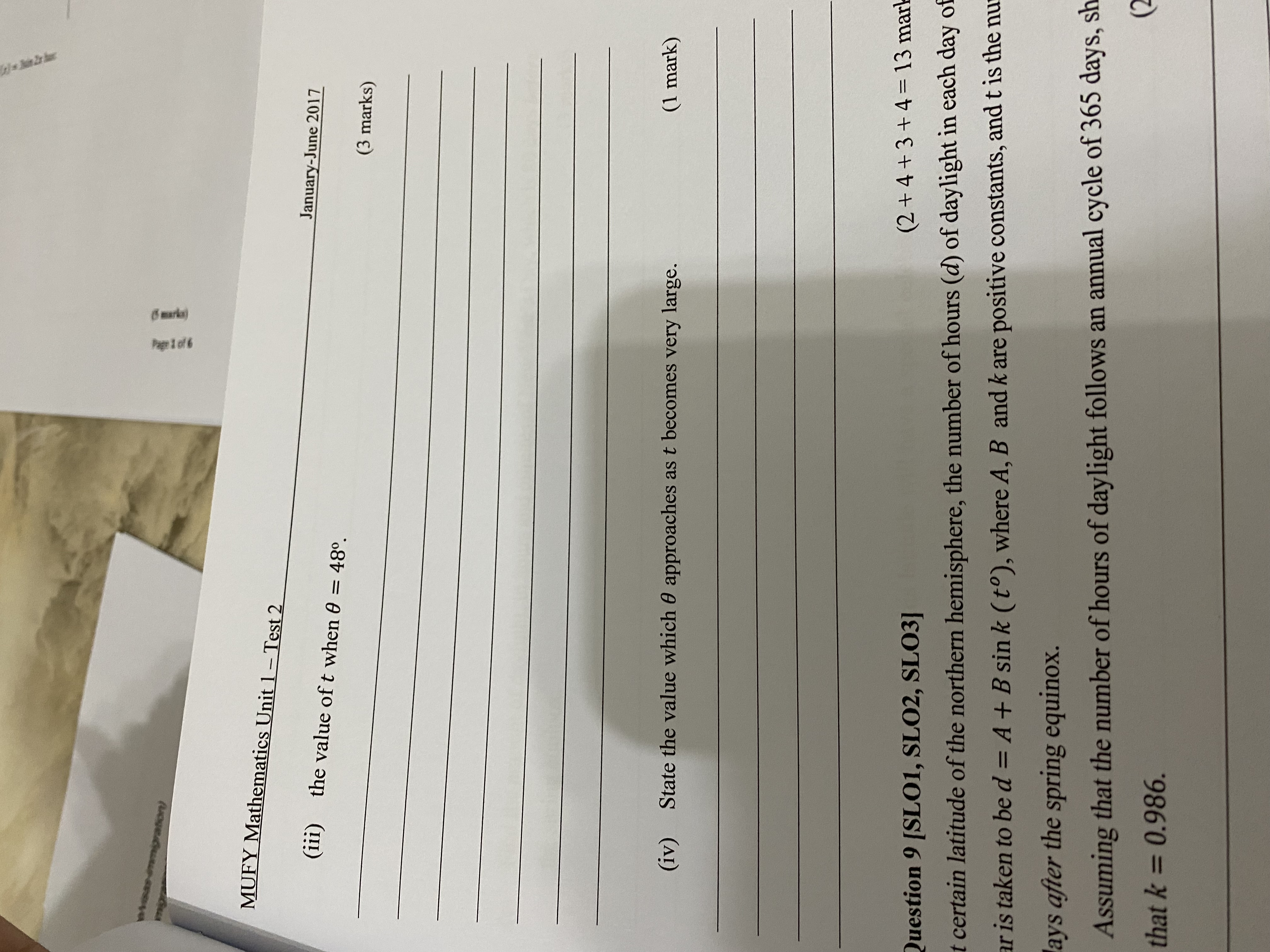
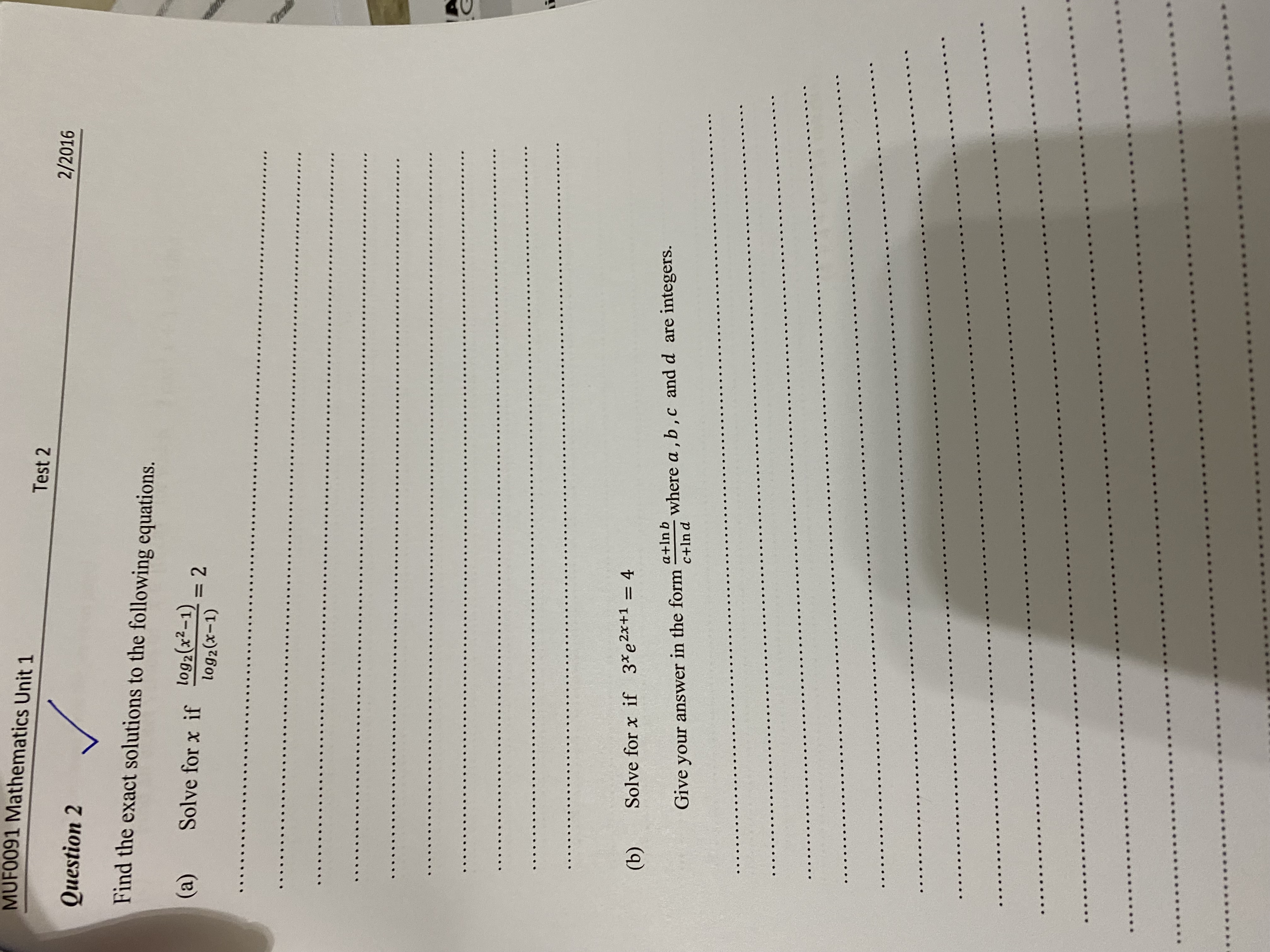
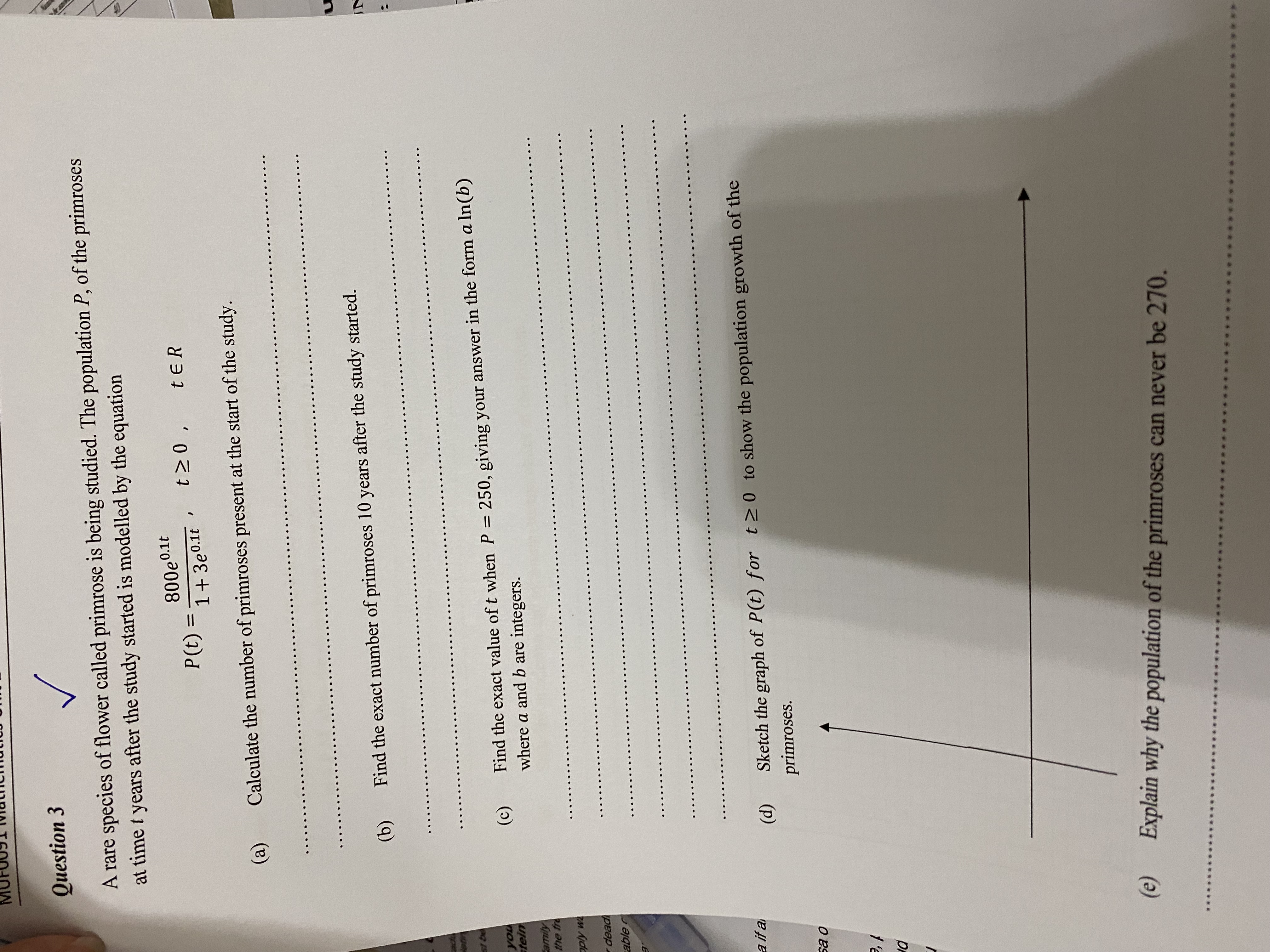
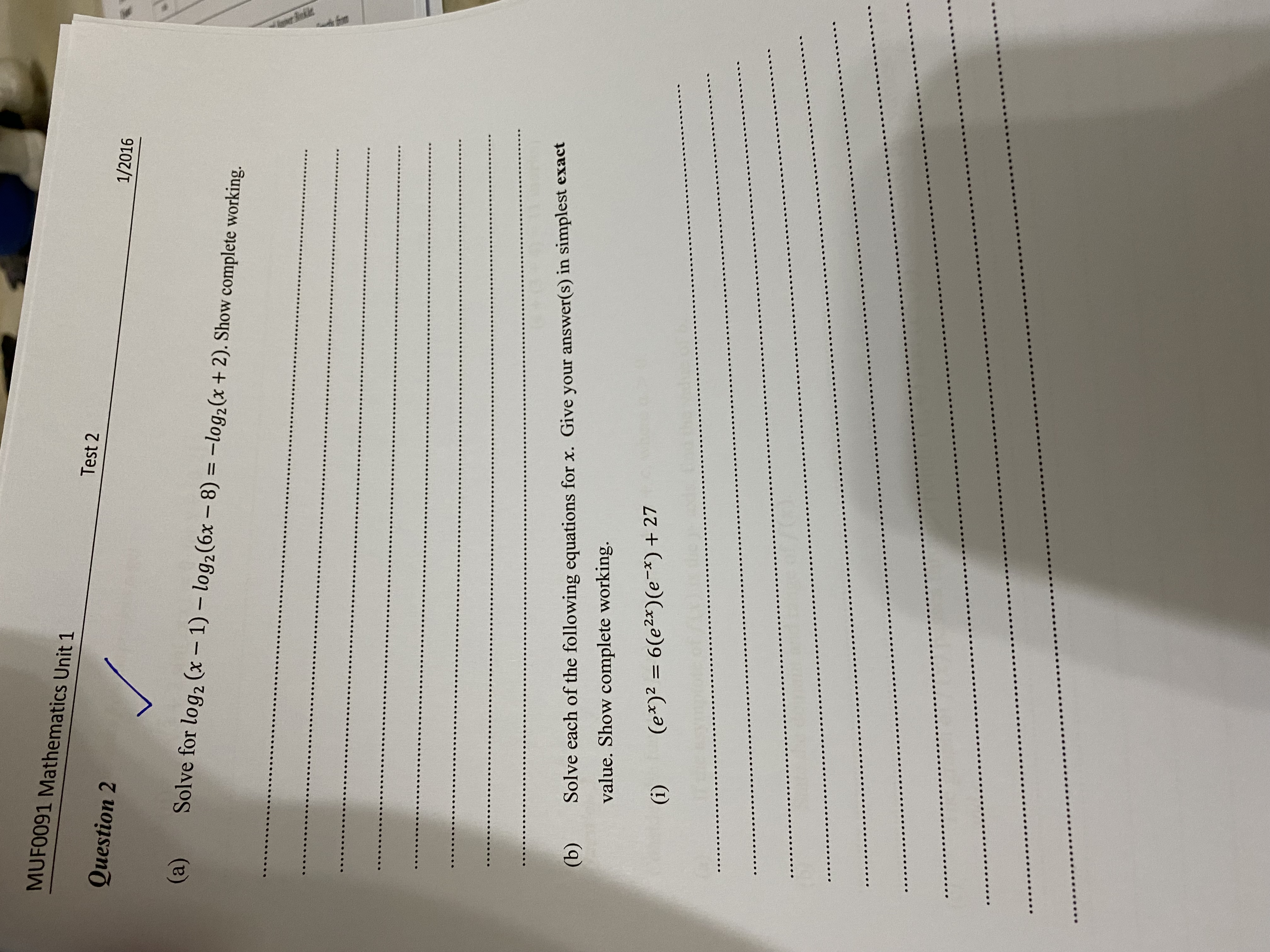
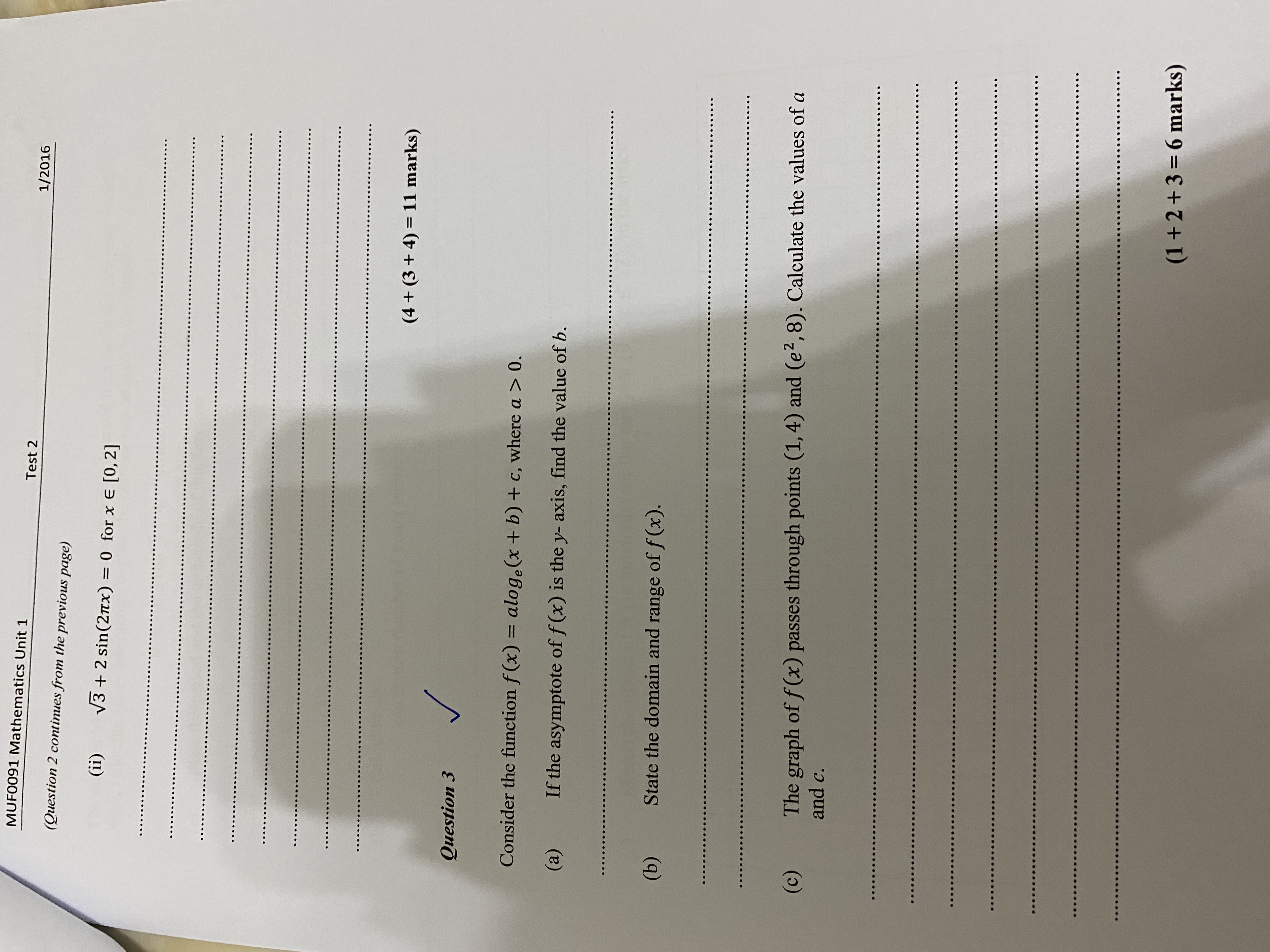
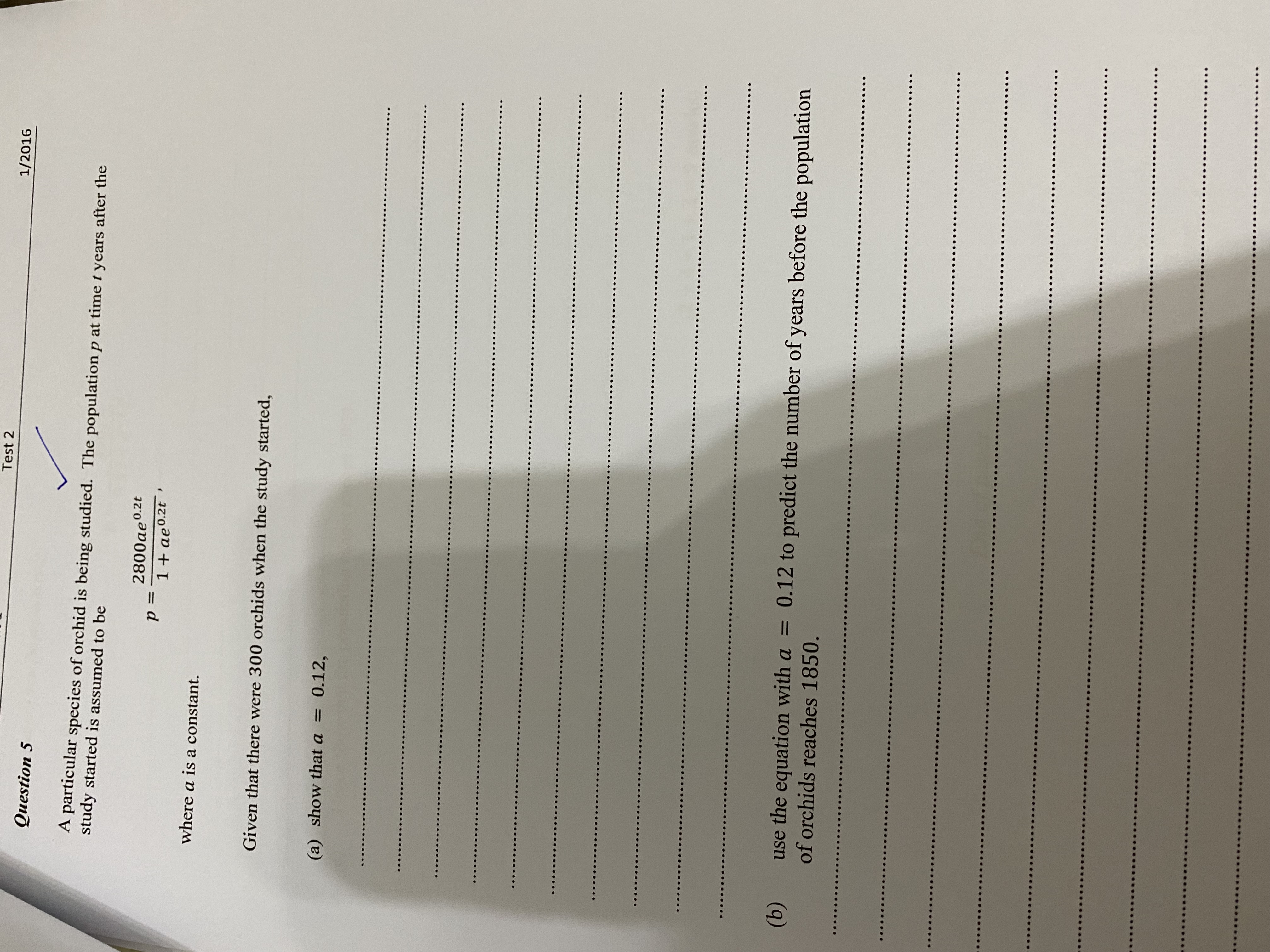
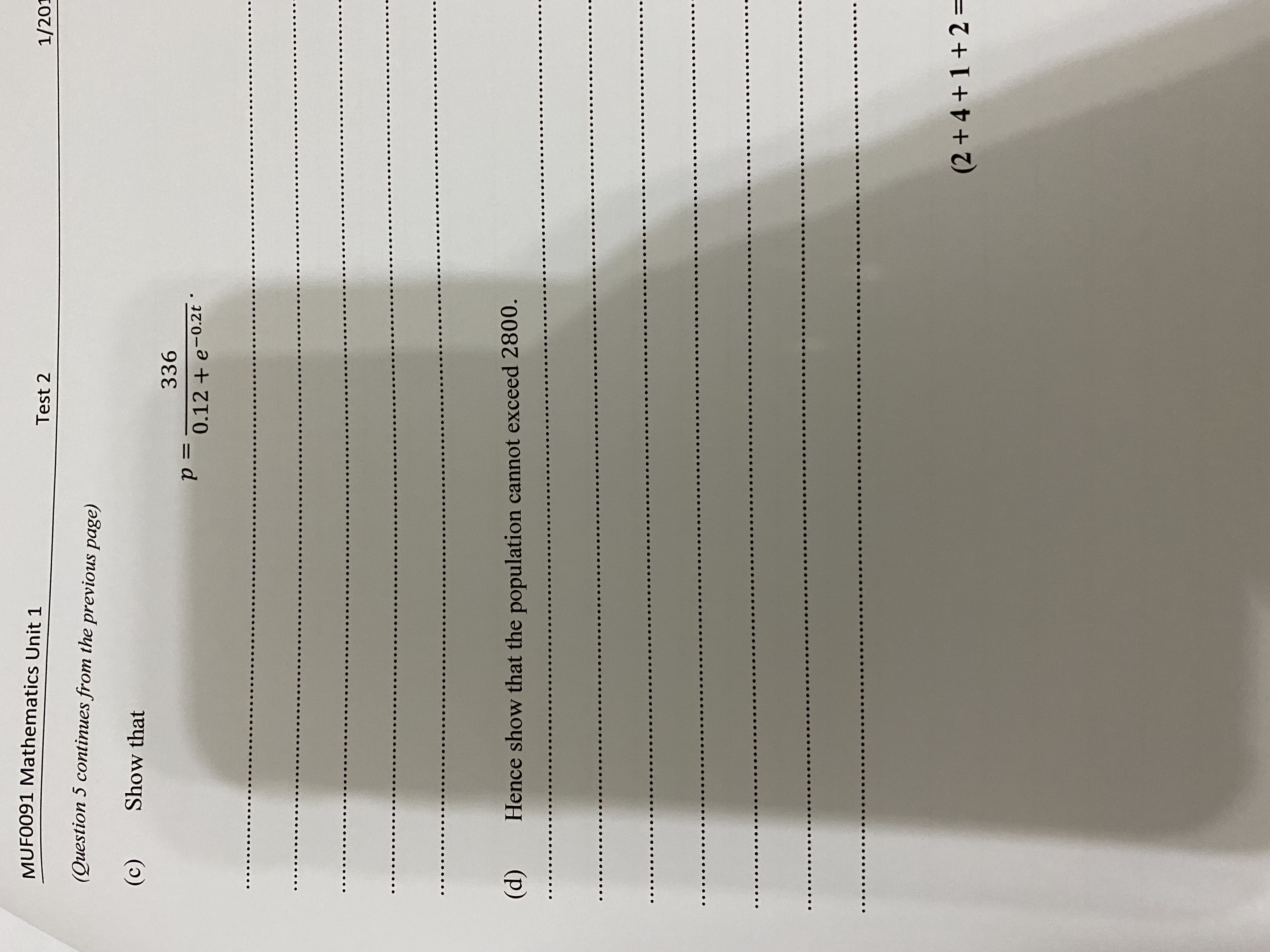
athematics Unit 1 - Test 2 January-June 2017 Question 7 [SLO1, SLO2, SLO3] (1 +2 +4 = 7 marks) Using the world population formula, P = 6.9(1.011), where t is the number of years after 201 1 and P is the world population in billions of people, estimate the following: What was the world population in year 2011? (1 mark) ( b ) The population in the year 2050 to the nearest billions. (2 marks) Uk c) By what year will the population be double of what it was in year 2011? (4 marks) Question 8 [SLO1, SLO2, SLO3] V (2+1+3+1=7 marks) (a) An object is heated in an oven until it reaches a maximum temperature of X degrees Celsius. It is then allowed to cool. Its temperature, 0 degrees Celsius, when it has been cooling for time t minutes, is given by the equation 0 =18 + 62e 8 . Find (i) the value of X. (2 marks) (ii) the value of 0 when t = 16. (1 marl910 1 324 MUFY Mathematics Unit 1 - Test 2 (iii) the value of t when 0 = 48. January-June 2017 (3 marks) (iv) State the value which 0 approaches as t becomes very large. (1 mark) Question 9 [SLO1, SLO2, SLO3] (2+4+3+4= 13 mark t certain latitude of the northern hemisphere, the number of hours (d) of daylight in each day of ar is taken to bed = A + B sink (to), where A, B and k are positive constants, and t is the nu ays after the spring equinox. Assuming that the number of hours of daylight follows an annual cycle of 365 days, sh that k = 0.986.MUF0091 Mathematics Unit 1 Test 2 Question 2 2/2016 Find the exact solutions to the following equations. (a) Solve for x if Logz(x2-1) log2 (x-1) -= 2 . . .. . . . .... (b) Solve for x if 3xe2x+1 = 4 Give your answer in the form atinby c+Ind where a , b , c and d are integers. . . . . . . . . . . . . . . . . . . .. . . . . . . . . . . . . . . . .MUFO091 Mathematics Unit 1 Test 2 2/2016 (Question 2 continues from the previous page) (c) Find all exact values of x E [0,2x] for which 2 cos2 x + 1 = 5 sin x. (4+4+6 =14 mQuestion 3 A rare species of flower called primrose is being studied. The population P, of the primroses at time t years after the study started is modelled by the equation 800e 0.1t P(t ) = 1 + 3e0.It ' t20, tER (a) Calculate the number of primroses present at the start of the study. . . . . . . . . . .. b) Find the exact number of primroses 10 years after the study started. . . . . . . . .. . . . . . . . . ... . . . . . ... (c) Find the exact value of t when P = 250, giving your answer in the form a In (b) where a and b are integers. the fr ply w . . . . . . . . . . .. dead . . . . . . . . . . . . . . . . . . . . . . . . . . . ... a if a (d) Sketch the graph of P(t) for t 2 0 to show the population growth of the primroses. sa (e) Explain why the population of the primroses can never be 270.MUFO091 Mathematics Unit 1 Question 2 Test 2 1/2016 (a) Solve for logz (x - 1) - log2(6x - 8) = -log2(x + 2). Show complete working. . .... . .... ..... . . . . . . . . .. Solve each of the following equations for x. Give your answer(s) in simplest exact value. Show complete working. (ex)2 = 6(e2x)(e-x) +27 . . . . . .. . . . . . . ...... . . . . . . . . . ... . . . . . . . . . . . . .MUFO091 Mathematics Unit 1 Test 2 1/2016 (Question 2 continues from the previous page) (ii) V3 + 2 sin(2nx) = 0 for x E [0, 2] ...... . . . . . . . . . .. . . . . . . . . . . . . . . . . . . . . . . . . . . . . . . . . . . . . .. . . . . . ........ .... . . . . . . ..... (4 + (3+4) = 11 marks) Question 3 Consider the function f (x) = aloge (x + b) + c, where a > 0. (a) If the asymptote of f (x) is the y- axis, find the value of b. . . . ...... ( b ) State the domain and range of f (x). . . . . . . . . . ....... (c) The graph of f (x) passes through points (1, 4) and (e2, 8). Calculate the values of a and c. (1 + 2 + 3 = 6 marks)Test 2 1/2016 Question 5 A particular species of orchid is being studied. The population p at time t years after the study started is assumed to be 2800ae 0.2t p = 1 + ae0.2t where a is a constant. Given that there were 300 orchids when the study started, (a) show that a = 0.12, . . . . . . ... ..... . . . ... . . . . . . . . . .. ... (b) use the equation with a = 0.12 to predict the number of years before the population of orchids reaches 1850. . . . . . . .. . . . . ...\f










 Study Help