Question: AT&T Inc. Dollars in millions except per share amounts Licensed Programming Inventory Cost Recognition and Impairment We enter into agreements to license programming exhibition rights
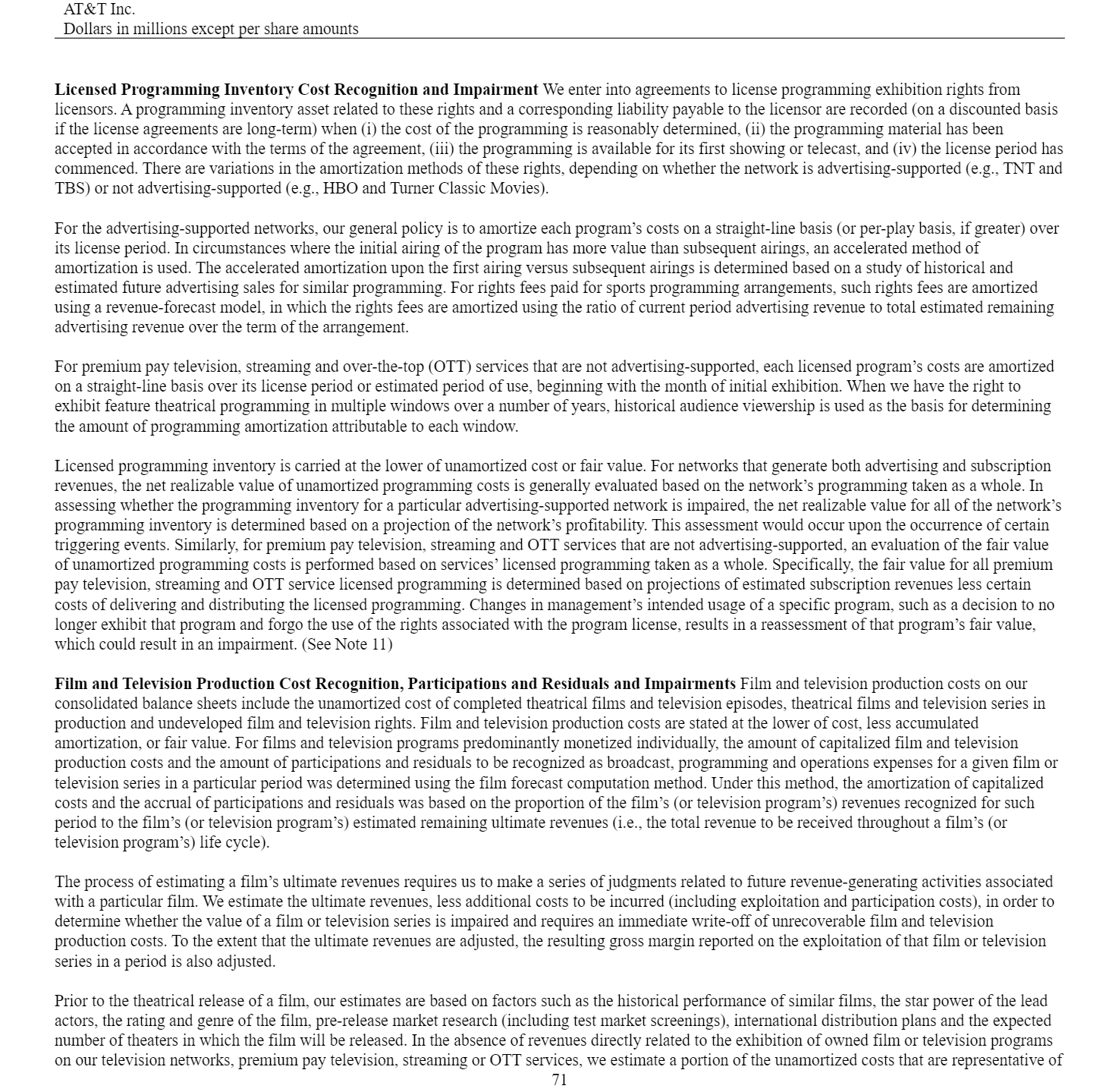
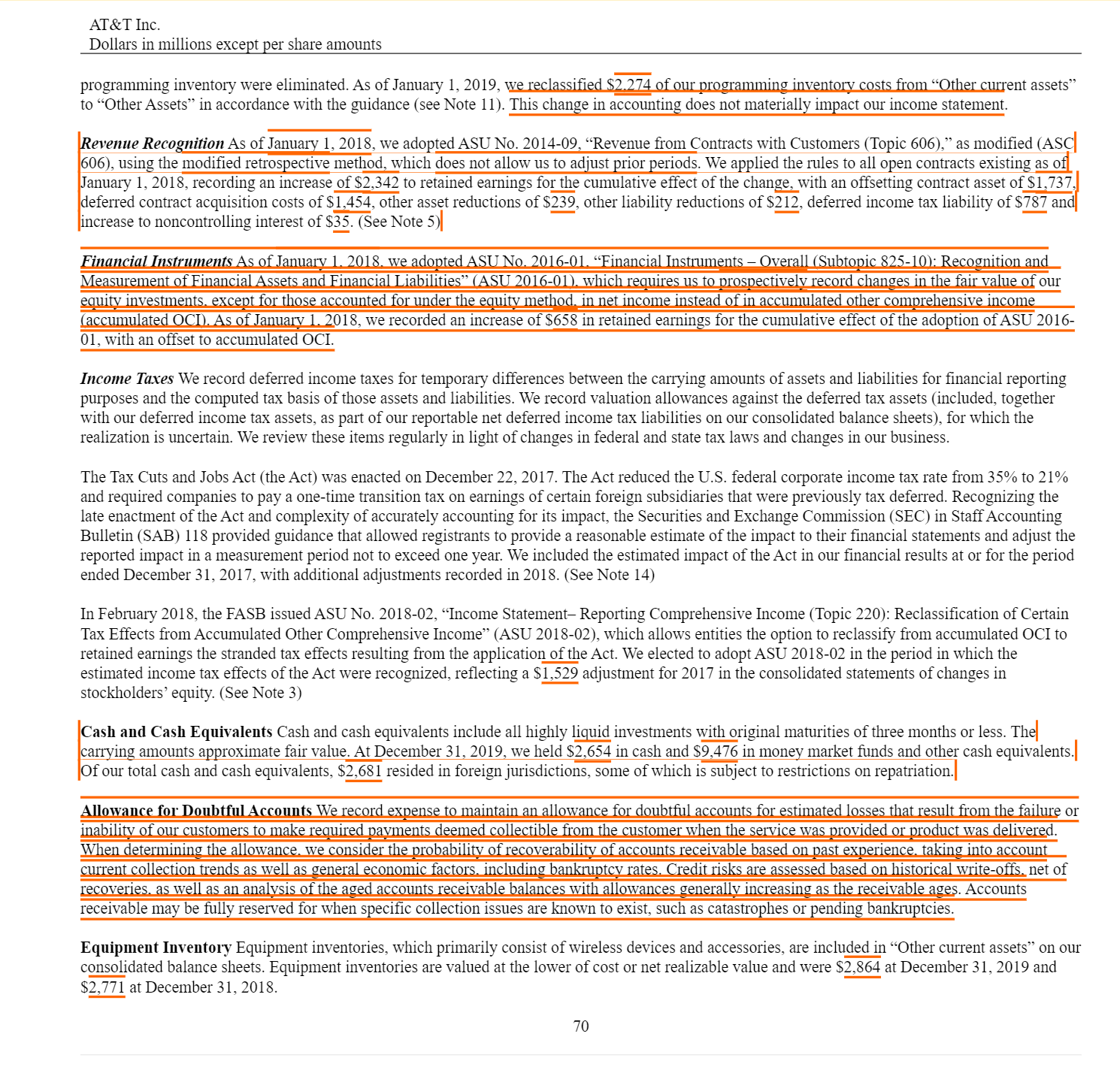
AT&T Inc. Dollars in millions except per share amounts Licensed Programming Inventory Cost Recognition and Impairment We enter into agreements to license programming exhibition rights from licensors. A programming inventory asset related to these rights and a corresponding liability payable to the licensor are recorded (on a discounted basis if the license agreements are long-term) when (i) the cost of the programming is reasonably determined, (ii) the programming material has been accepted in accordance with the terms of the agreement, (iii) the programming is available for its first showing or telecast, and (iv) the license period has commenced. There are variations in the amortization methods of these rights, depending on whether the network is advertising-supported (e.g., TNT and TBS) or not advertising-supported (e.g., HBO and Turner Classic Movies). For the advertising-supported networks, our general policy is to amortize each program's costs on a straight-line basis (or per-play basis, if greater) over its license period. In circumstances where the initial airing of the program has more value than subsequent airings, an accelerated method of amortization is used. The accelerated amortization upon the first airing versus subsequent airings is determined based on a study of historical and estimated future advertising sales for similar programming. For rights fees paid for sports programming arrangements, such rights fees are amortized using a revenue-forecast model, in which the rights fees are amortized using the ratio of current period advertising revenue to total estimated remaining advertising revenue over the term of the arrangement. For premium pay television, streaming and over-the-top (OTT) services that are not advertising-supported, each licensed program's costs are amortized on a straight-line basis over its license period or estimated period of use, beginning with the month of initial exhibition. When we have the right to exhibit feature theatrical programming in multiple windows over a number of years, historical audience viewership is used as the basis for determining the amount of programming amortization attributable to each window. Licensed programming inventory is carried at the lower of unamortized cost or fair value. For networks that generate both advertising and subscription revenues, the net realizable value of unamortized programming costs is generally evaluated based on the network's programming taken as a whole. In assessing whether the programming inventory for a particular advertising-supported network is impaired, the net realizable value for all of the network's programming inventory is determined based on a projection of the network's profitability. This assessment would occur upon the occurrence of certain triggering events. Similarly, for premium pay television, streaming and OTT services that are not advertising-supported, an evaluation of the fair value of unamortized programming costs is performed based on services' licensed programming taken as a whole. Specifically, the fair value for all premium pay television, streaming and OTT service licensed programming is determined based on projections of estimated subscription revenues less certain costs of delivering and distributing the licensed programming. Changes in management's intended usage of a specific program, such as a decision to no longer exhibit that program and forgo the use of the rights associated with the program license, results in a reassessment of that program's fair value which could result in an impairment. (See Note 11) Film and Television Production Cost Recognition, Participations and Residuals and Impairments Film and television production costs on our consolidated balance sheets include the unamortized cost of completed theatrical films and television episodes, theatrical films and television series in production and undeveloped film and television rights. Film and television production costs are stated at the lower of cost, less accumulated amortization, or fair value. For films and television programs predominantly monetized individually, the amount of capitalized film and television production costs and the amount of participations and residuals to be recognized as broadcast, programming and operations expenses for a given film or television series in a particular period was determined using the film forecast computation method. Under this method, the amortization of capitalized costs and the accrual of participations and residuals was based on the proportion of the film's (or television program's) revenues recognized for such period to the film's (or television program's) estimated remaining ultimate revenues (1.e., the total revenue to be received throughout a film's (or television program's) life cycle). The process of estimating a film's ultimate revenues requires us to make a series of judgments related to future revenue-generating activities associated with a particular film. We estimate the ultimate revenues, less additional costs to be incurred (including exploitation and participation costs), in order to determine whether the value of a film or television series is impaired and requires an immediate write-off of unrecoverable film and television production costs. To the extent that the ultimate revenues are adjusted, the resulting gross margin reported on the exploitation of that film or television series in a period is also adjusted. Prior to the theatrical release of a film, our estimates are based on factors such as the historical performance of similar films, the star power of the lead actors, the rating and genre of the film, pre-release market research (including test market screenings), international distribution plans and the expected number of theaters in which the film will be released. In the absence of revenues directly related to the exhibition of owned film or television programs on our television networks, premium pay television, streaming or OTT services, we estimate a portion of the unamortized costs that are representative of 71AT&T Inc. Dollars in millions except per share amounts programming inventory were eliminated. As of January 1, 2019, we reclassified $2.274 of our programming inventory costs from "Other current assets" to "Other Assets" in accordance with the guidance (see Note 11). This change in accounting does not materially impact our income statement. Revenue Recognition As of January 1, 2018, we adopted ASU No. 2014-09. "Revenue from Contracts with Customers (Topic 606)," as modified (ASC] 606), using the modified retrospective method, which does not allow us to adjust prior periods. We applied the rules to all open contracts existing as off January 1, 2018, recording an increase of $2,342 to retained earnings for the cumulative effect of the change, with an offsetting contract asset of $1.737. deferred contract acquisition costs of $1,454, other asset reductions of $239, other liability reductions of $212, deferred income tax liability of $787 and increase to noncontrolling interest of $35. (See Note 5)| Financial Instruments As of January 1. 2018 we adopted ASU No. 2016-01. "Financial Instruments - Overall (Subtopic 825-10): Recognition and Measurement of Financial Assets and Financial Liabilities" (ASU 2016-01). which requires us to prospectively record changes in the fair value of our equity investments. except for those accounted for under the equity method. in net income instead of in accumulated other comprehensive income (accumulated OCD). As of January 1. 2018, we recorded an increase of $658 in retained earnings for the cumulative effect of the adoption of ASU 2016- 01, with an offset to accumulated OCI. Income Taxes We record deferred income taxes for temporary differences between the carrying amounts of assets and liabilities for financial reporting purposes and the computed tax basis of those assets and liabilities. We record valuation allowances against the deferred tax assets (included, together with our deferred income tax assets, as part of our reportable net deferred income tax liabilities on our consolidated balance sheets), for which the realization is uncertain. We review these items regularly in light of changes in federal and state tax laws and changes in our business. The Tax Cuts and Jobs Act (the Act) was enacted on December 22, 2017. The Act reduced the U.S. federal corporate income tax rate from 35% to 21% and required companies to pay a one-time transition tax on earnings of certain foreign subsidiaries that were previously tax deferred. Recognizing the late enactment of the Act and complexity of accurately accounting for its impact, the Securities and Exchange Commission (SEC) in Staff Accounting Bulletin (SAB) 118 provided guidance that allowed registrants to provide a reasonable estimate of the impact to their financial statements and adjust the reported impact in a measurement period not to exceed one year. We included the estimated impact of the Act in our financial results at or for the period ended December 31, 2017, with additional adjustments recorded in 2018. (See Note 14) In February 2018, the FASB issued ASU No. 2018-02, "Income Statement- Reporting Comprehensive Income (Topic 220): Reclassification of Certain Tax Effects from Accumulated Other Comprehensive Income" (ASU 2018-02), which allows entities the option to reclassify from accumulated OCI to retained earnings the stranded tax effects resulting from the application of the Act. We elected to adopt ASU 2018-02 in the period in which the estimated income tax effects of the Act were recognized, reflecting a $1,529 adjustment for 2017 in the consolidated statements of changes in stockholders' equity. (See Note 3) Cash and Cash Equivalents Cash and cash equivalents include all highly liquid investments with original maturities of three months or less. The] carrying amounts approximate fair value. At December 31, 2019, we held $2,654 in cash and $9,476 in money market funds and other cash equivalents.| Of our total cash and cash equivalents, $2,681 resided in foreign jurisdictions, some of which is subject to restrictions on repatriation.| Allowance for Doubtful Accounts We record expense to maintain an allowance for doubtful accounts for estimated losses that result from the failure or inability of our customers to make required payments deemed collectible from the customer when the service was provided or product was delivered When determining the allowance. we consider the probability of recoverability of accounts receivable based on past experience. taking into account current collection trends as well as general economic factors. including bankruptcy rates. Credit risks are assessed based on historical write-offs. net of recoveries. as well as an analysis of the aged accounts receivable balances with allowances generally increasing as the receivable ages. Accounts receivable may be fully reserved for when specific collection issues are known to exist, such as catastrophes or pending bankruptcies. Equipment Inventory Equipment inventories, which primarily consist of wireless devices and accessories, are included in "Other current assets" on our consolidated balance sheets. Equipment inventories are valued at the lower of cost or net realizable value and were $2,864 at December 31, 2019 and $2,771 at December 31, 2018. 70









 Study Help