







Question: Attached is an assignment I submitted for my advanced calculus. The red text are the notes that the instructor gave me to correct. would someone
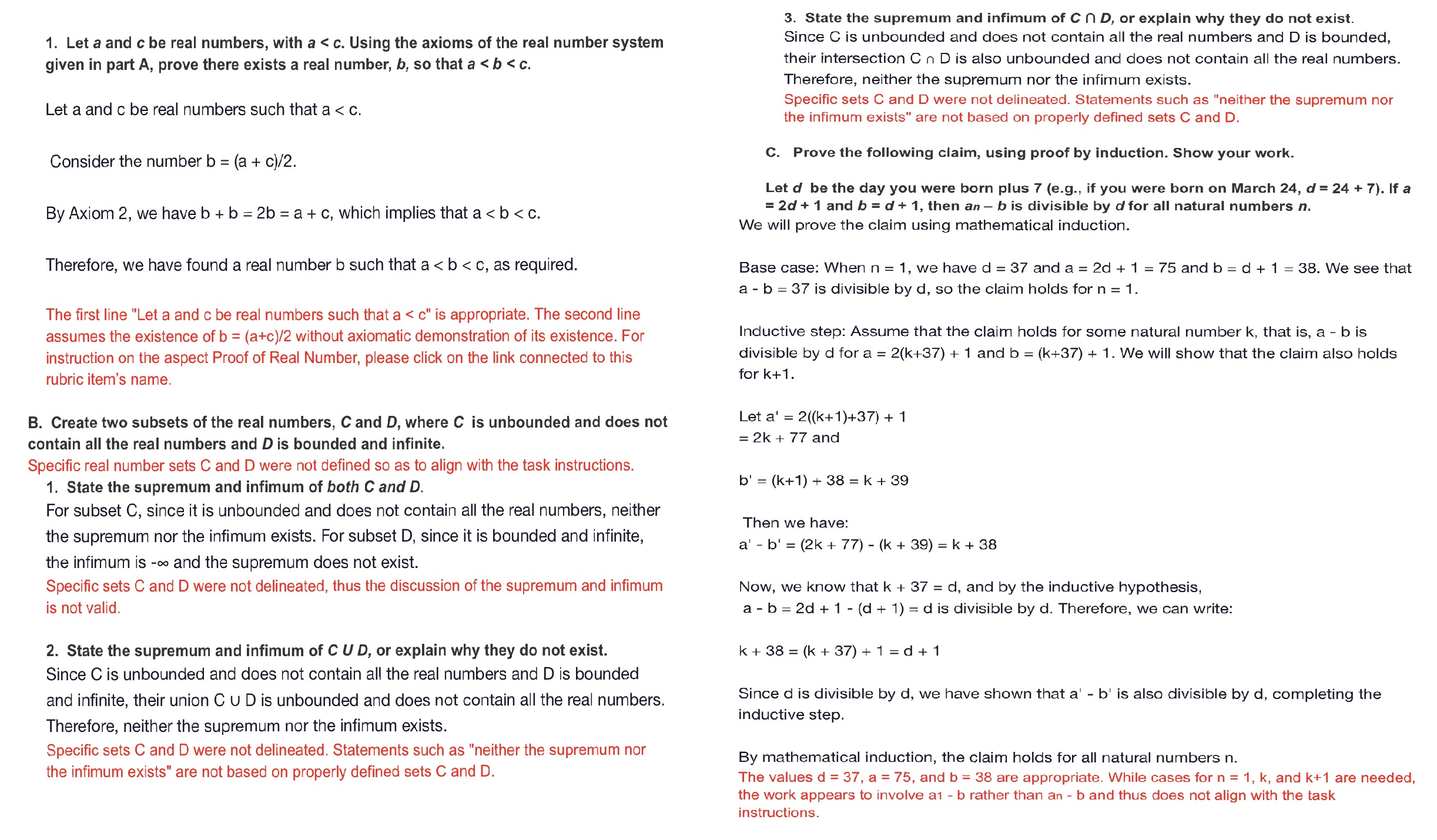
Attached is an assignment I submitted for my advanced calculus. The red text are the notes that the instructor gave me to correct. would someone be able to help me make corrections?
Here are the given Axioms:
Axiom 1: (x + y) + z = x + (y + z);(x * y) * z = x * (y * z)
Axiom 2: x + y = y + x; x * y = y * x
Axiom 3: x * (y + z)=(x * y)+(x * z)
Axiom 4: There is a unique element 0 ? R such that 0 + x = x for all x ? R.
Axiom 5: For each x ? R, there is a unique y ? R such that x + y = 0, and we write y = -x.
Axiom 6: There is a unique element 1 ? R such that x * 1 = x for all x ? R and 0 ? 1.
Axiom 7: For each x ? R, with x ? 0, there is a unique element y ? R such that x * y = 1, and we write y = 1/x.
Axiom 8: x y implies x + z y + z
Axiom 9: x y and y z implies x z
Axiom 10: For x, y ? R, exactly one of the following is true: x y, y x, or x = y.
Axiom 11: x y and z > 0 implies xz yz
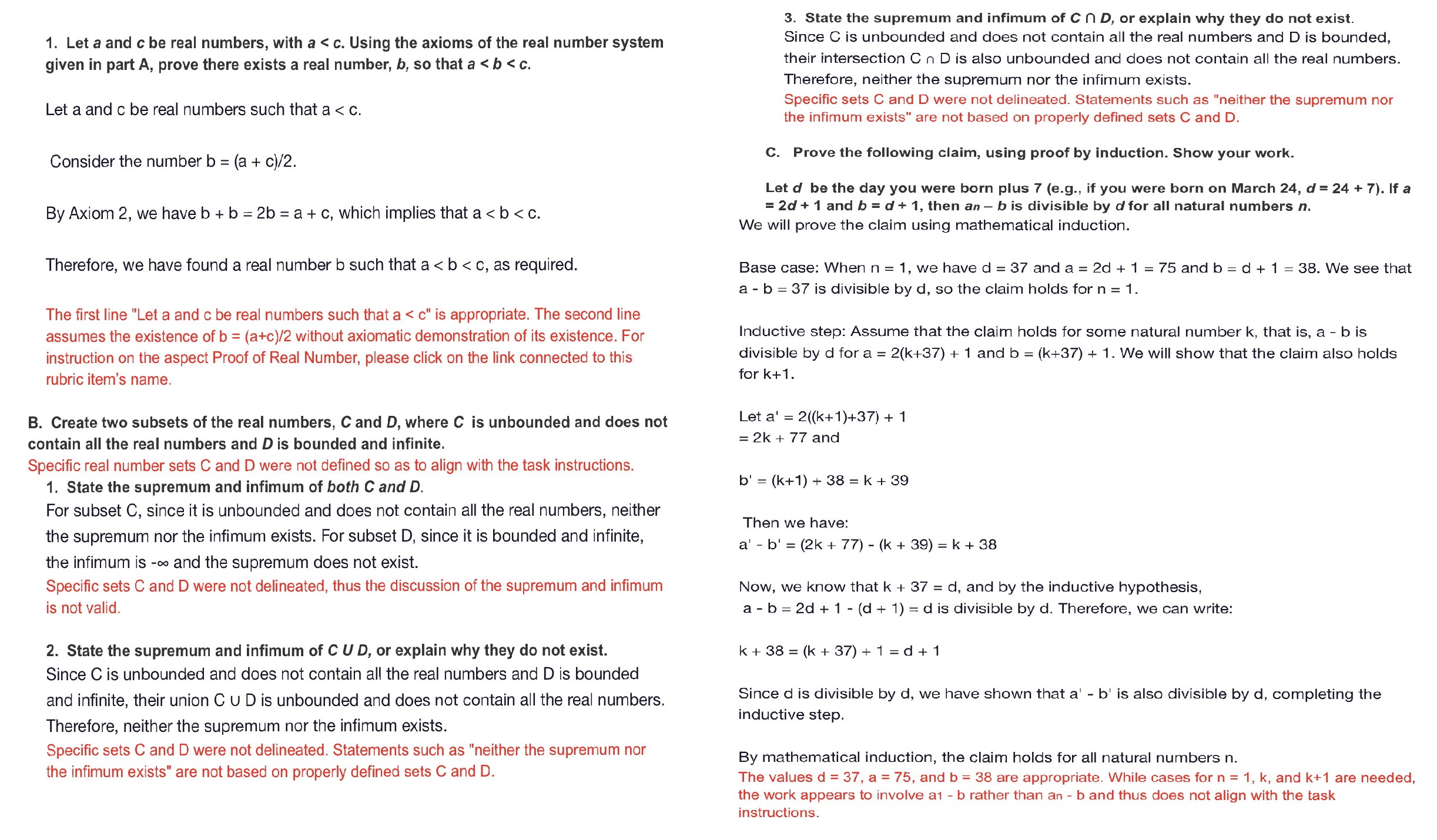
1. Leta and c be real numbers, with a b'=(2k+77)-(k+39)=k+38 Now, we know that k + 37 = d, and by the inductive hypothesis, a - b = 2d + 1 - (d +1): d is divisible by d. Therefore, we can write: k+38=(k+37)+1:d+1 Since d is divisible by d, we have shown that a' b' is also divisible by d, completing the inductive step. By mathematical induction, the claim holds for all natural numbers n. The values d = 37, a = 75, and b = 38 are appropriate. While cases for n =1, k, and k+1 are needed, the work appears to involve at - b rather than an - b and thus does not align with the task instructions
Step by Step Solution
There are 3 Steps involved in it

Get step-by-step solutions from verified subject matter experts
 Study Help