







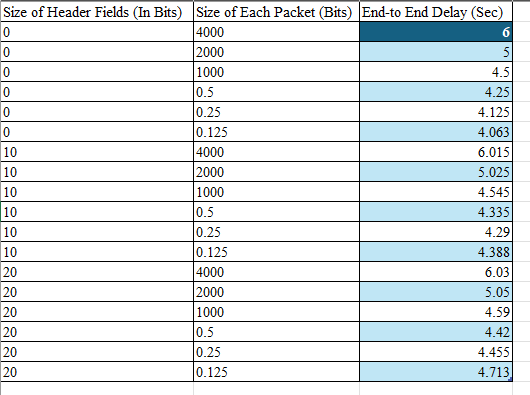
Question: Attached is the table for reference 1 . 3 Mathematical Analysls Through your work for Section 1 . 2 above where header fields were considered,
Attached is the table for reference
Mathematical Analysls
Through your work for Section above where header fields were considered, you saw that as the size of
each segment lets denote it as decreases, the EndtoEnd delay lets denote it as went down then
picked up So what is the value of that would minimize
To simplify our analysis, let's assume:
The network topology above ie two hosts connected by two routers and three links is used. The transmission rate of each link is bps Size of the original message that the "Source" node sends to the "Destination" node is bits. The "Source" node conducts message segmentation. The size of each segment is bits. The "Source" node adds bits of header fields to each packet it sends.
On the same paper that you used for Section
Derive a mathematical formula for as a function of and
Then, to calculate the value of which leads to the minimum find out the derivative of with respect
to and set it to Ensure to circle your final answer.
Verify your answer by comparing it with pertaining values in the table for Section above ie that last
six entries where size of headers is bits
Step by Step Solution
There are 3 Steps involved in it
1 Expert Approved Answer
Step: 1 Unlock

Question Has Been Solved by an Expert!
Get step-by-step solutions from verified subject matter experts
Step: 2 Unlock
Step: 3 Unlock
 Study Help