Question: Attached you will find a sample case brief. Notice that the sections are Facts, Issues, Analysis, and Court Ruling. This is a good format for
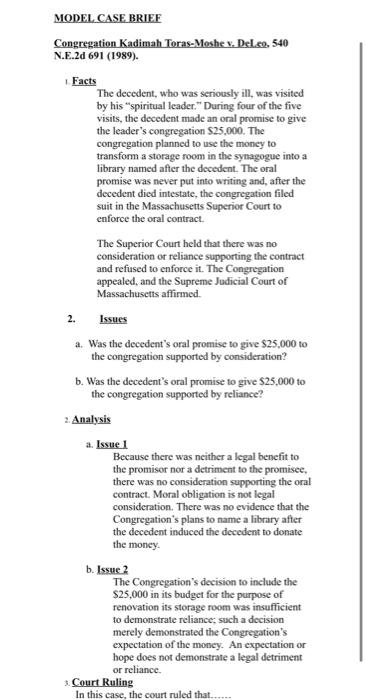
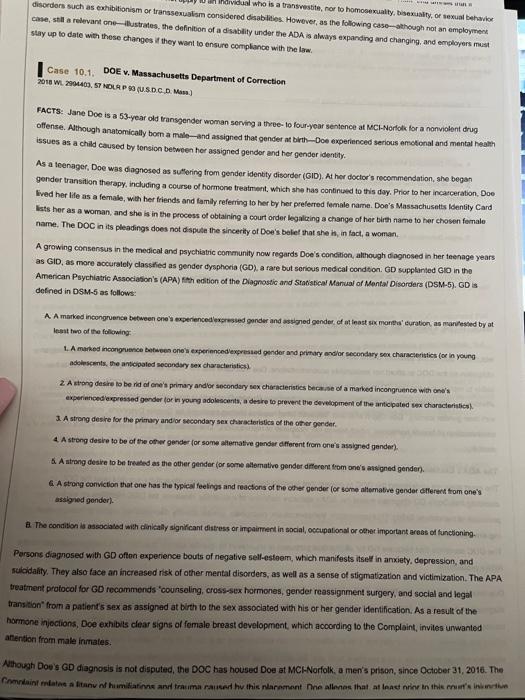
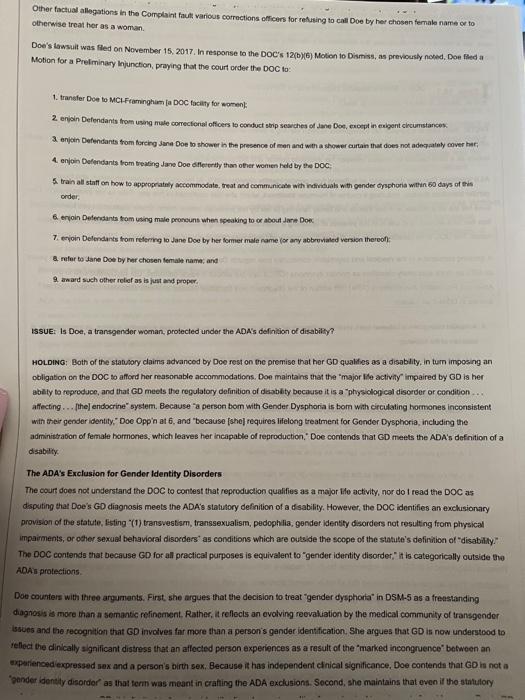
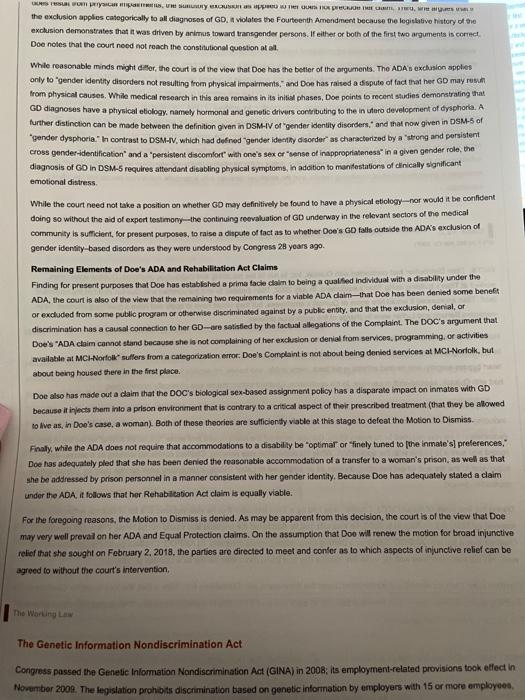
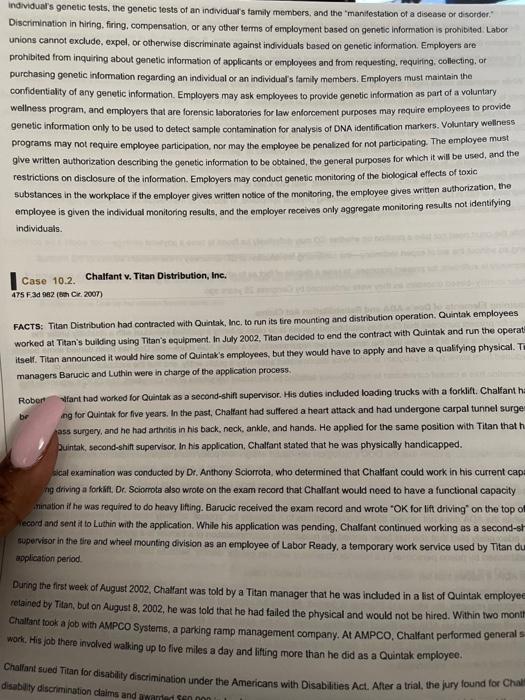
Attached you will find a sample case brief. Notice that the sections are Facts, Issues, Analysis, and Court Ruling. This is a good format for a case brief. Please use this format to brief Case 10.1 (Doe v. Massachusetts Department of Correction) found on page 277 of your textbook. MODEL CASE BRIEF Congregation Kadimah Toras-Moshe v. Dele2, 540 N.E.2d 691 (1989). Facts The decedent, who was seriously ill, was visited by his spiritual leader. During four of the five visits, the decedent made an oral promise to give the leader's congregation S25.000. The congregation planned to use the money to transform a storage room in the synagogue into a library named after the decedent. The oral promise was never put into writing and, after the decedent died intestate, the congregation filed suit in the Massachusetts Superior Court to enforce the oral contract The Superior Court held that there was no consideration or reliance supporting the contract and refused to enforce it. The Congregation appealed, and the Supreme Judicial Court of Massachusetts affirmed. 2. Issues a. Was the decedent's oral promise to give $25,000 to the congregation supported by consideration? b. Was the decedent's oral promise to give $25,000 to the congregation supported by reliance? 2. Analysis a. Issue 1 Because there was neither a legal benefit to the promisor nor a detriment to the promisee, there was no consideration supporting the oral contract. Moral obligation is not legal consideration. There was no evidence that the Congregation's plans to name a library after the decedent induced the decedent to donate the money b. Issue 2 The Congregation's decision to include the $25,000 in its budget for the purpose of renovation its storage room was insufficient to demonstrate reliance, such a decision merely demonstrated the Congregation's expectation of the money. An expectation or hope does not demonstrate a legal detriment or reliance Court Ruling In this case, the court ruled that...... . dividual who is a transvestite, nor to homosexuality, anty, or sexual behavior disorders such as exhibitionism or transsexual considered disabiles. However, as the following case-although not an employment case, still a relevant one-ustrates the definition of a disability under the ADA is always expanding and changing, and employers must stay up to date with these changes they want to ensure complance with the law. | Case 10.1. DOE v. Massachusetts Department of Correction 2018 W., STOLAPU.S.D.C.D. Mas FACTS: Jane Doe is a 53-year old transgender woman serving a three-to four-year sentence at MCI-Norfolk fora nonviolent drug offense. Although anatomically bom a male and assigned that gender at birt-Doe experienced serious emotional and mental health issues as a child caused by tension between her assigned gender and her gender identity. As a teenager, Doe was diagnosed as suffering from gender identity disorder (GID), A her doctor's recommendation, she began gender transition therapy, including a course of hormone treatment, which she has continued to this day. Price to her incarceration. Doe lived her life as a female, with her friends and family referring to her by her preferred female name. Doe's Massachusetts Identity Card Bists her as a woman, and she is in the process of obtaining a court order legalizing a change of her birth name to her chosen female name. The DOC in its pleadings does not dispute the sincerity of Doe's belief that she h, in fact, a woman A growing consensus in the medical and psychiatric community now regards Doe's condition, although diagnosed in her teenage years as GID, as more accurately classified as gender dysphoria (GO), a rare but serious medical condition. GD supplanted GIO in the American Psychiatric Association's (APA) fith edition of the Diagnostic and Statistical Manual of Mental Disorders (DSM-5). GD defined in DSM-5 as follows: A A marked incongruence between one experiencedoresund gender and signed gender of at least six months oration as manifested by at least two of the following: LA marked incongruence between one's experienced expressed gender and privacy and/or secondary sex characteristics (or in young adolescents, the anticipated secondary sex characteristics) 2. A strong desire to be rid of one's primary and secondary sex characteristics because of a marked incongrutnce with one's experienced expressed gender for in young adolescents, a desire to prevent the development of the anticipated sex characteristics A strong desire for the primary and/or secondary sex characteristics of the merger der 4. A strong desire to be of the other gender for some teative gender different from one's assigned gender). Astrong desire to be treated as the other gender for some stomativo gender different from one's assigned gender). & Astrong conviction that one has the typical feelings and reactions of the other gender for some otomatve gender different from one's assigned gender). The condition sociated with clinically significant distress or impairment in social, occupational or other important areas of functioning. Persons diagnosed with GD often experience bouts of negative self-esteem, which manifests itself in anxiety, depression, and suloidalty. They also face an increased risk of other mental disorders, as well as a sense of stigmatization and Victimization. The APA treatment protocol for GO recommends counseling, cross-sex hormones, gender reassignment surgery, and social and legal transition from a patient's sex as assigned at birth to the sex associated with his or her gender identification. As a result of the hormone injections, Doe exhibits clear signs of female breast development, which according to the Complaint, invites urwanted attention from male inmates Although Doo's GD diagnosis is not disputed, the DOC has housed Dou at MCH-Norfolk, a men's prison, since October 31, 2016. The romaint mate tant humiliations and trimarned hu thienlarament Mne allones that at least in the musim Other factual allegations in the Complaint tout various corrections offices for refusing to cal Doe by her chosen female or to otherwise treat her as a woman Don's lawsuit was filed on November 15, 2017. In response to the DOC's 1276) Motion to Dismiss, as previously noted. Don filed a Motion for a Preliminary injunction, praying that the court order the DOC : 1. transfer Doe te MC Framingham ja doc tcy for woment 2 enjin Defendants from using male correctional officers to conduct serp seaches of Jane Dos, compt in exigent circumstances enjoin Defendants from forcing Jane Doe to shower in the presence of men and with a shower curtain that does not adeploy over her 4 noin Defendants from treating Jane Doe differently than other women red by the DOG 5. train all staff on how to appropriately accommodate. treat and communicate with individush with gender dysphoria within 60 days of this order 6 erin Defendants from using male pronouns when speaking to about Jane Doe 7. enjoin Defendants from refering to Jane Doe by her former male rame for any brwiated version thereon: & refer to Jane Doe by her chosen female name and A ward such other relief as is just and proper ISSUE: Is Doe, a transgender woman protected under the ADA's definition of disability HOLDING: Both of the statutory claims advanced by Doe rest on the premise that her GD qualifies as a disability, in tur imposing an obligation on the DOC to afford her reasonable accommodations. Doe maintains that the major life activity impaired by GD is her ability to reproduce, and that GD meets the regulatory definition of disability because it is a "physiological disorder or condition ... affecting the endocrine system. Because a person bom with Gender Dysphoria is bom with circulating hormones inconsistent with their gender identity." Doe Opp'n at 6, and because she requires lifelong treatment for Gender Dysphoria, including the administration of female hormones, which leaves her incapable of reproduction. Doe contends that meets the ADA's definition of a disability The ADA's Exclusion for Gender identity Disorders The court does not understand the DOC to contest that reproduction qualifies as a major to activity, nor do I read the DOC as disputing that Doe's GD diagnosis meets the ADA's statutory definition of a disability. However, the DOC identifies an exclusionary provision of the statute listing (1) transvestism, transsexualism, pedophilia, gender identity disorders not resulting from physical impairments, or other sexual behavioral disorders as conditions which are outside the scope of the statute's definition of disability The DOC contends that because GD for all practical purposes is equivalent to gender identity disorder," it is categorically outside the ADA's protections Doe counters with three arguments. First she argues that the decision to treat gender dysphoria in DSM-5 as a freestanding diagnosis is more than a semantic refinement. Rather, it reflects an evolving reevaluation by the medical community of transgender Issues and the recognition that GD involves far more than a person's gender identification. She argues that GD is now understood to fellect the dinically significant distress that an affected person experiences as a result of the marked incongruenco" between an experienced expressed sex and a person's birth sex. Because it has independent clinical significance. Doe contends that Goin nota gender identity disorder as that term was meant in crafting the ADA exclusions. Second, she maintains that even if the statutory NOTICIAS HIS WORST TO PGT the exclusion applies categorically to all diagnoses of GD. violates the Fourteenth Amendment because the legislative history of the exclusion demonstrates that it was driven by animus toward transgender persons. If either or both of the first two arguments incorrect Doc notes that the court nood not reach the constitutional question at all While reasonable minds might differ the court is of the view that Doe has the better of the arguments. The ADA's exclusion applies only to gender identity disorders not resulting from physical impairments. and Doe has raised a dispute of fact that her GD may rusum from physical causes. While medical research in this area romains in its initial phases, Dom points to recent studios demonstrating that GD diagnoses have a physical etiology, namely hormonal and genetic drivers contributing to the inuturo development of oysphorta. A further distinction can be made between the definition given in DSM-IV of gender identity disorders, and that now given in DSM-5 of gender dysphoria." In contrast to DSM-IV, which had defned gender identity disorders characterized by a strong and persistent cross gender-Identification and a "persistent discomfort with one's sex or sense of inappropriateness in a given gender role, the diagnosis of GD In DSM-5 requires attendant disabing physical symptoms, in addition to manifestations of clinically significant emotional distress While the court need not take a position on whether GO may definitively be found to have a physical etiology-nor would it be confident doing so without the aid of export testimony the continuing reevaluation of GD underway in the relevant sectors of the medical community is sufficient, for present purposes, to raise a dispute of fact as to whether Doe's GO falls outside the ADA's exclusion of gender identity-based disorders as they were understood by Congress 28 years ago. Remaining Elements of Doe's ADA and Rehabilitation Act Claims Finding for present purposes that Doe has established a prima facie claim to being a qualified individual with a disability under the ADA, the court is also of the view that the remaining two requirements for a viable ADA claim that Doe has been denied some benefit or excluded from some public program or otherwise discriminated against by public entity, and that the exclusion, denial, or discrimination has a causal connection to her GD-re satisfied by the factual allegations of the Complaint. The DOC's argument that Doe's "ADA claim cannot stand because she is not complaining of her exclusion or denial from services, programming, or activities available at MCH-Norfolk suffers from a categorization error: Doe's Complaint is not about being denied services at MCI-Norfolk, but about being housed there in the first place, Doe also has made out a daim that the DOC's biological sex-based assignment policy has a disparate impact on inmates with GD because it injects them into a prison environment that is contrary to a critical aspect of their prescribed treatment that they be allowed to live as In Doe's case, a woman). Both of these theories are sufficiently viable at this stage to defeat the Motion to Dismiss Finally, while the ADA does not require that accommodations to a disability be optimal or finely tuned to the inmate's preferences, Doe has adequately pled that she has been denied the reasonable accommodation of a transfer to a woman's prison, as well as that she be addressed by prison personnel in a manner consistent with her gender identity. Because Doe has adequately stated a claim under the ADA, it follows that her Rehabilitation Act claim is equally viable. For the foregoing reasons, the Motion to Dismiss is denied. As may be apparent from this decision, the court is of the view that Doe may very well prevail on her ADA and Equal Protection claims. On the assumption that Doo will renew the motion for broad injunctive relief that she sought on February 2, 2018, the parties are directed to meet and confer as to which aspects of injunctive relief can be agreed to without the court's intervention, The Working Law The Genetic Information Nondiscrimination Act Congress passed the Genetic Information Nondiscrimination Act (GINA) in 2008, its employment-related provisions took etfect in November 2009. The legislation prohibits discrimination based on genetic information by employers with 15 or more employees Individual's genetic tests, the genetic tests of an individual's family members, and the manifestation of a disease or disorder." Discrimination in hiring, firing, compensation, or any other terms of employment based on genetic Information is prohibited. Labor unions cannot exclude, expel, or otherwise discriminate against individuals based on genetic Information. Employers are prohibited from inquiring about genetic information of applicants or employees and from requesting, requiring collecting, or purchasing genetic information regarding an individual or an individual's family members, Employers must maintain the confidentiality of any genetic information. Employers may ask employees to provide genetic Information as part of a voluntary wellness program and employers that are forensic laboratories for law enforcement purposes may require employees to provide genetic Information only to be used to detect sample contamination for analysis of DNA identification markers. Voluntary wellness programs may not require employee participation, nor may the employee be penalized for not participating. The employee must give written authorization describing the genetic information to be obtained, the general purposes for which it will be used, and the restrictions on disclosure of the information. Employers may conduct genetic monitoring of the biological effects of toxic substances in the workplace if the employer gives written notice of the monitoring the employee gives written authorization, the employee is given the individual monitoring results, and the employer receives only aggregate monitoring results not identifying individuals. Case 10.2. Chalfant v. Titan Distribution, Inc. 475 F.3d 962 (Cit. 2007) FACTS: Titan Distribution had contracted with Quintak, Inc. to run its tire mounting and distribution operation. Quintak employees worked at Titan's building using Titan's equipment. In July 2002. Titan decided to end the contract with Quintak and run the operat itself. Titan announced it would hire some of Quintak's employees, but they would have to apply and have a qualifying physical T managers Barucic and Luthin were in charge of the application process Robert ant had worked for Quintak as a second-shift supervisor. His duties included loading trucks with a forklift. Chalfantha be ng for Quintak for five years. In the past, Chalant had suffered a heart attack and had undergone carpal tunnel surge ass surgery, and he had arthritis in his back, neck, ankle, and hands. He applied for the same position with Titan thath buintak, second-shift supervisor. In his application, Chalfont stated that he was physically handicapped. sical examination was conducted by Dr. Anthony Scorrota, who determined that Chalfant could work in his current cap ng driving a forkait, Dr. Sciorrota also wrote on the exam record that Chattant would need to have a functional capacity mination if he was required to do heavy lifting. Barucic received the exam record and wrote OK for lift driving on the top om Wecord and sent it to Luthin with the application. While his application was pending, Chalfont continued working as a second-s supervisor in the tire and wheel mounting division as an employee of Labor Ready, a temporary work service used by Titan du application period During the first week of August 2002. Chalfant was told by a Titan manager that he was included in a list of Quintak employee retained by Titan, but on August 8, 2002, he was told that he had failed the physical and would not be hired. Within two month Chaltant took a job with AMPCO Systems, a parking ramp management company. At AMPCO, Chalfant performed generals work. His job there involved walking up to five miles a day and iftung more than he did as a Quintak employee. Challant sued Titan for disability discrimination under the Americans with Disabilities Act. After a trial, the jury found for Chal disability discrimination daims and wanted









 Study Help