







Question: Attempt ONLY d AND e Feedback: . In part (d), each moment should have included all the particles (both the 50-100 m range and the
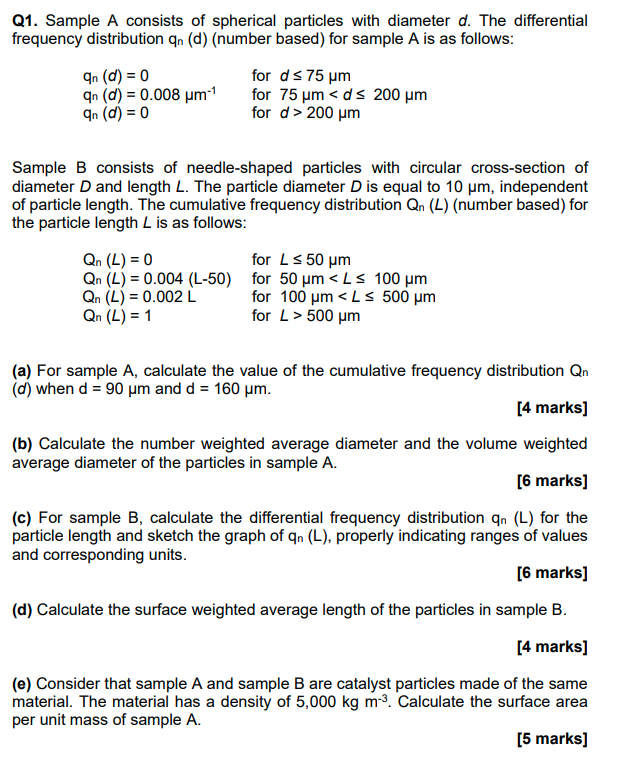
Attempt ONLY d AND e
Feedback: . In part (d), each moment should have included all the particles (both the 50-100 m range and the 100-500 m range). In part (e), the most common mistake was to assume all particles had the same size which is not appropriate for this question as you have the differential frequency distribution. With knowledge of the differential frequency distribution, the integral expression for total surface area should be used for a given mass.
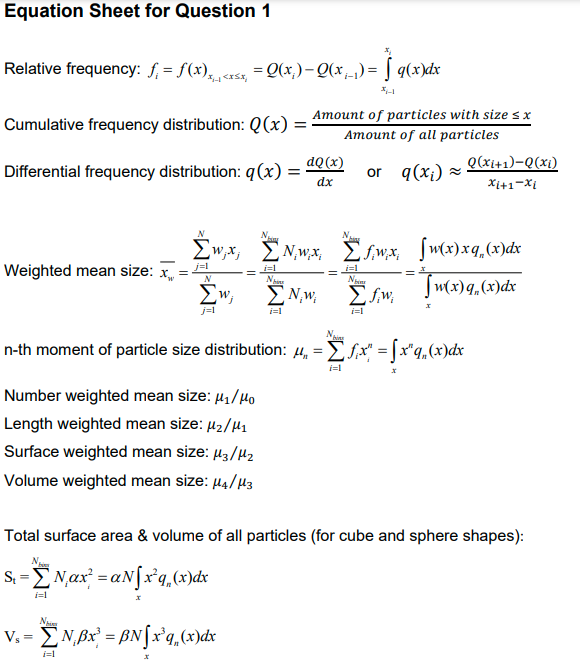
Equation Sheet for Question 1 Relative frequency: f;= f(x) y s, = Q(x,)- Q(x,-1) = 5 g(x)dx Cumulative frequency distribution: Q(x) Amount of particles with size s x Amount of all particles dQ(x) Differential frequency distribution: 7(x) = or 9(xi) Q(xi+1)-Q(xi) dx Xi+1-Xi N w.x, Nwx, Weighted mean size: x j=! = N i=1 N Ef.w.x w(x)xqy(x)dx fw, u(x)q,()dx Now , , Nos = i=1 n-th moment of particle size distribution: 4. = {1*= [x"q(v)dx Number weighted mean size: M1/Mo Length weighted mean size: Mz/u1 Surface weighted mean size: uz/uz Volume weighted mean size: M4/M3 Total surface area & volume of all particles (for cube and sphere shapes): S = 3 Nax = aNx*q,(x)dx N i=1 N. Vs = EN,Bx? = BNxq_(x)dx = i=1 Q1. Sample A consists of spherical particles with diameter d. The differential frequency distribution qn (d) (number based) for sample A is as follows: 9n (d) = 0 for ds 75 um qn (d) = 0.008 um? for 75 um
Step by Step Solution
There are 3 Steps involved in it

Get step-by-step solutions from verified subject matter experts
 Study Help