Question: Attempts: Average: /6 2. Absolute and comparative advantage Consider two neighboring island countries, Botoga and Euclidia. Each has 24,000 labor hours available per week that
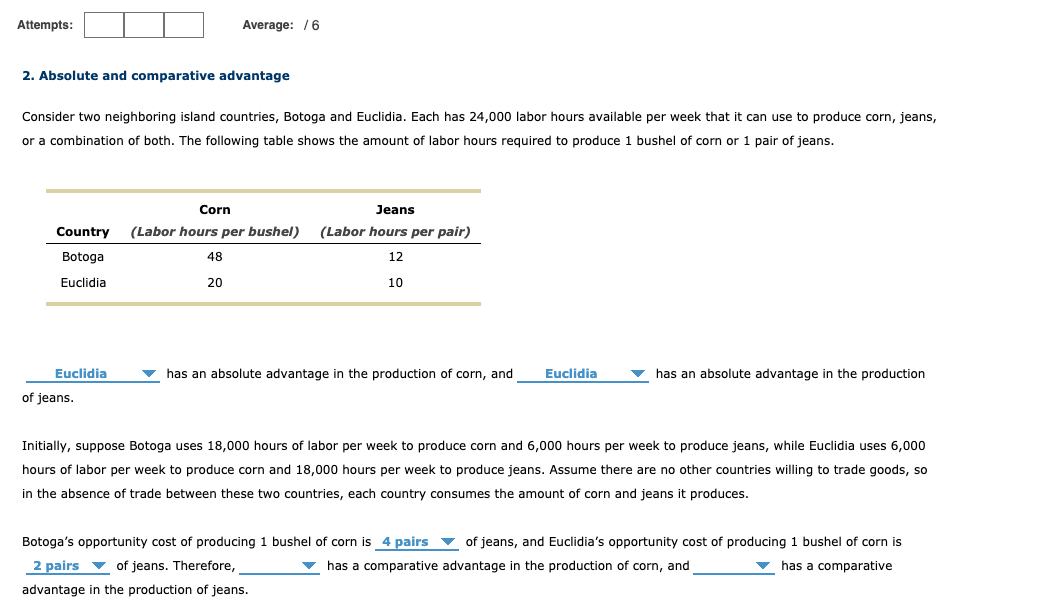
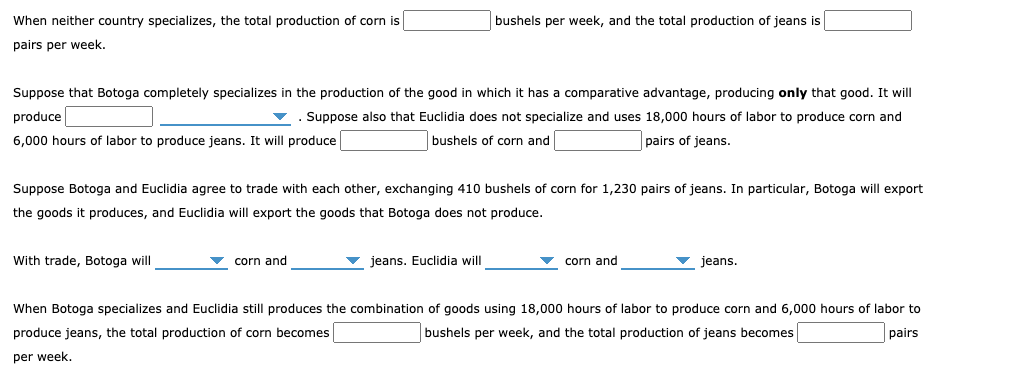
Attempts: Average: /6 2. Absolute and comparative advantage Consider two neighboring island countries, Botoga and Euclidia. Each has 24,000 labor hours available per week that it can use to produce corn, jeans, or a combination of both. The following table shows the amount of labor hours required to produce bushel of corn or 1 pair of jeans. Corn Country (Labor hours per bushel) Jeans (Labor hours per pair) 12 Botoga 48 Euclidia 20 10 Euclidia has an absolute advantage in the production of corn, and Euclidia has an absolute advantage in the production of jeans. Initially, suppose Botoga uses 18,000 hours of labor per week to produce corn and 6,000 hours per week to produce jeans, while Euclidia uses 6,000 hours of labor per week to produce corn and 18,000 hours per week to produce jeans. Assume there are no other countries willing to trade goods, so in the absence of trade between these two countries, each country consumes the amount of corn and jeans it produces. Botoga's opportunity cost of producing 1 bushel of corn is 4 pairs of jeans, and Euclidia's opportunity cost of producing 1 bushel of corn is 2 pairs of jeans. Therefore, has a comparative advantage in the production of corn, and has a comparative advantage in the production of jeans. bushels per week, and the total production of jeans is When neither country specializes, the total production of corn is pairs per week. Suppose that Botoga completely specializes in the production of the good in which it has a comparative advantage, producing only that good. It will produce Suppose also that Euclidia does not specialize and uses 18,000 hours of labor to produce corn and 6,000 hours of labor to produce jeans. It will produce bushels of corn and pairs of jeans. Suppose Botoga and Euclidia agree to trade with each other, exchanging 410 bushels of corn for 1,230 pairs of jeans. In particular, Botoga will export the goods it produces, and Euclidia will export the goods that Botoga does not produce. With trade, Botoga will corn and jeans. Euclidia will corn and jeans. When Botoga specializes and Euclidia still produces the combination of goods using 18,000 hours of labor to produce corn and 6,000 hours of labor to produce jeans, the total production of corn becomes bushels per week, and the total production of jeans becomes pairs per week









 Study Help