



Question: Attempts: Average: 77 11. Strategy 3 - Dollar-cost averaging Dollar-cost averaging is a systematic program of investing equal sums of money at regular intervals, regardless
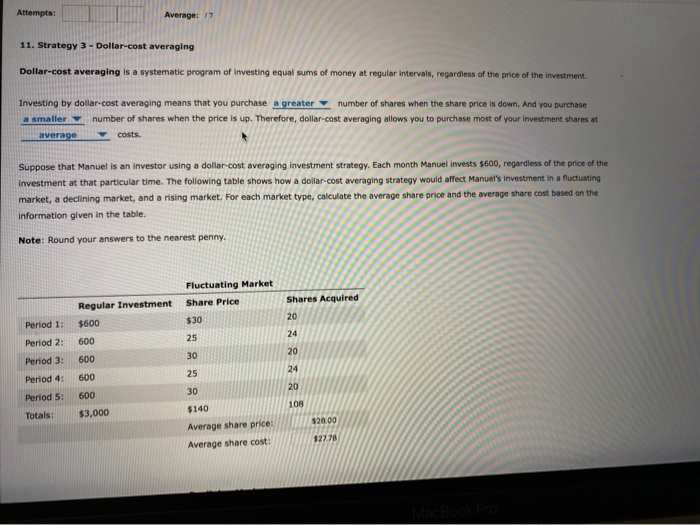
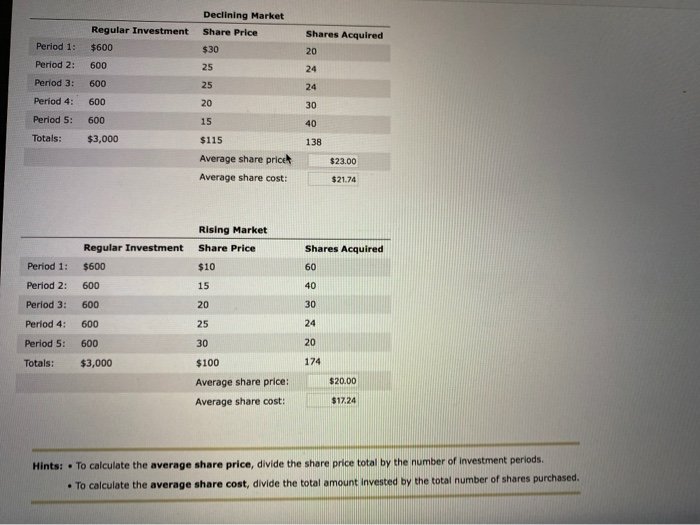
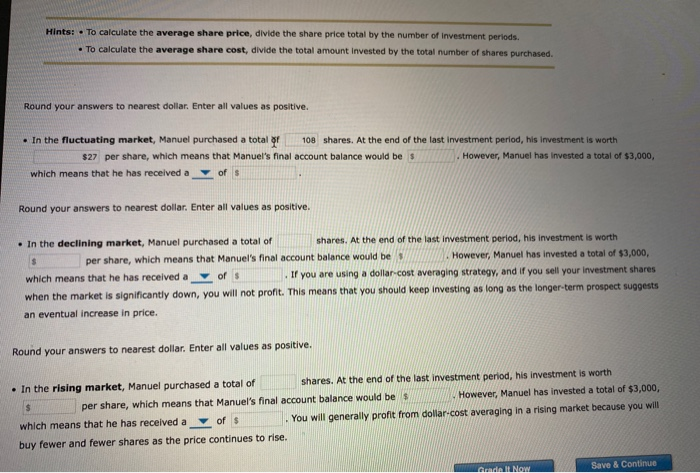
Attempts: Average: 77 11. Strategy 3 - Dollar-cost averaging Dollar-cost averaging is a systematic program of investing equal sums of money at regular intervals, regardless of the price of the investment Investing by dollar.cost averaging means that you purchase a greater number of shares when the share price is down. And you purchase a smaller number of shares when the price is up. Therefore, dollar-cost averaging allows you to purchase most of your investment shares at average costs. Suppose that Manuel is an investor using a dollar cost averaging investment strategy. Each month Manuel invests $600, regardless of the price of the Investment at that particular time. The following table shows how a dollar-cost averaging strategy would affect Manuel's Investment in a fluctuating market, a declining market, and a rising market. For each market type, calculate the average share price and the average share cost based on the information given in the table. Note: Round your answers to the nearest penny. Fluctuating Market Share Price Shares Acquired Period 1: Period 2: Period 3 Period 4: Period 5: Totals: Regular Investment $600 600 600 600 600 $3,000 $28.00 $140 Average share price: Average share cost: $2778 Declining Market Share Price Shares Acquired $30 Period 1: Period 2: Period 3: Period 4: Period 5: Totals: Regular Investment $600 600 600 600 600 $3,000 15 $115 Average share price Average share cost: $23.00 $21.74 Rising Market Share Price Shares Acquired Regular Investment $600 600 Period 1: Period 2: $10 15 Period 3: 600 Period 4: Period 5: 600 600 Totals: $3,000 $100 Average share price: Average share cost: $20.00 $17.24 Hints. To calculate the average share price, divide the share price total by the number of investment periods To calculate the average share cost, divide the total amount invested by the total number of shares purchased. Hints: - To calculate the average share price, divide the share price total by the number of investment periods. To calculate the average share cost, divide the total amount invested by the total number of shares purchased Round your answers to nearest dollar. Enter all values as positive. In the fluctuating market, Manuel purchased a total of 108 shares. At the end of the last investment period, his investment is worth $27 per share, which means that Manuel's final account balance would be $ However, Manuel has invested a total of $3,000, which means that he has received a of S Round your answers to nearest dollar. Enter all values as positive. . In the declining market, Manuel purchased a total of shares. At the end of the last investment period, his investment is worth per share, which means that Manuel's final account balance would be However, Manuel has invested a total of $3,000, which means that he has received a of . If you are using a dollar-cost averaging strategy, and if you sell your investment shares when the market is significantly down, you will not profit. This means that you should keep Investing as long as the longer-term prospect suggests an eventual increase in price. Round your answers to nearest dollar. Enter all values as positive. In the rising market, Manuel purchased a total of shares. At the end of the last investment period, his investm per share, which means that Manuel's final account balance would be However, Manuel has invested a total of $3,000, which means that he has received a of You will generally profit from dollar cost averaging in a rising market because you will buy fewer and fewer shares as the price continues to rise. und Now Save & Continue
Step by Step Solution
There are 3 Steps involved in it

Get step-by-step solutions from verified subject matter experts